Large-scale vegetable registration shows poor results; Agriculture and Food Agency hits bottleneck in promotion
At the beginning of this month, the Council of Agriculture launched, for the third year, the "Bulk Vegetable Planting Registration and Seedling Supply Warning Mechanism," urging farmers to register in advance the winter vegetables they plan to grow. If future output is too large and fields need to be plowed under, those who registered will receive a subsidy of 70,000 yuan per hectare, in the hope of stabilizing farmers' incomes and prices. However, this covers only about 30 percent of the planted volume, and industry players are calling for smooth marketing channels as the fundamental solution.
This plan, now in its third year of implementation this month, has not stopped the frequent "vegetable dirt, vegetable gold" phenomenon in the market. Chuang Lao-ta, head of the Crop Production Section of the Agriculture and Food Agency, admitted that this mechanism covers only about 30 percent of Taiwan's vegetable volume and that more outreach is needed.
Farmers register in advance, plow-under subsidy 30,000 more per hectare
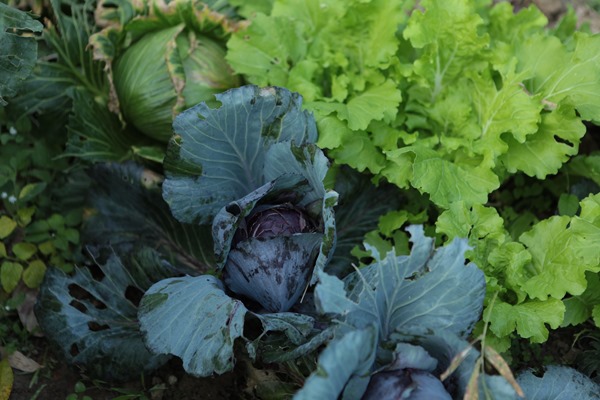
Taiwan's winter climate suits vegetables, and vegetables have a short growing period, taking about 60 days to harvest, so farmers always plant vegetables after the second rice crop. Once the harvest period arrives, prices collapse because of the large volume. This year it was said that "one cabbage can't buy one braised egg," and some farmers, unable to cover costs, let cabbages rot in the fields.
To stabilize prices, the Agriculture and Food Agency began promoting the "Bulk Vegetable Planting Registration and Seedling Supply Warning Mechanism" three years ago. Farmers growing cabbage (head cabbage) and napa cabbage report their plantings to the local farmers' association or cooperative during the announced period, or register with the seedling nursery when buying seedlings. If output is excessive, the government initiates plow-under, with a subsidy of 70,000 yuan per hectare; those who did not register receive only 40,000 yuan. This year's reporting period runs from August 1 to February 28 of next year.
Chuang Lao-ta said the Agriculture and Food Agency estimates the amount that should be planted across Taiwan based on past consumption by the people and yield per hectare, then uses data sent back from counties, cities and seedling nurseries to judge whether the planted area is saturated. For example, the agency estimates an upper planting limit of 180 hectares per ten-day period for cabbage and 80 hectares for napa cabbage; when 160 hectares and 60 hectares are reached respectively, it issues messages via text message, radio and TV ticker, asking farmers to switch crops or plant in the next ten-day period.
Chuang Lao-ta noted that since the policy was implemented, plow-under has been activated only once, in the spring of ROC year 100, when the climate was mild and cabbage yield per hectare rose from 60 metric tons to 80 metric tons, with the total for all of Taiwan exceeding estimates by more than 3,000 metric tons. "After implementation, vegetable prices have been much more stable."

Smooth production and marketing channels are the fundamental solution
In response, Liao Ting-chuan said agriculture depends on the weather, so it is inherently impossible to be as precise as industrial production. The registration system is well intentioned, but the most important thing is to establish smooth production and marketing channels, help farmers find outlets or promote contract farming. Once there are outlets, planning the production area can better avoid price collapses.
Li Kuo-chang, a member of the Erlun Vegetable Production and Marketing Group in Yunlin County, also believes that smooth transport and marketing is the fundamental solution. He said that including basic expenses such as seedlings, fertilizer, packaging and transport, leafy vegetables cost about 5 to 7 yuan per kilogram. For stability, more than half of the production and marketing group currently contracts with large supermarkets, and the supermarkets quote prices every three days based on the fruit and vegetable market. Although there are profits and losses depending on output in various places, "what farmers want is simply to be able to sell."
Li Kuo-chang said enviously that Japan's corporate association system is very well developed: farmers only need to handle production, and the association plans a fixed area and guarantees purchase, taking no excess if too much is grown. He believes that in addition to advance registration, the government should estimate the daily demand for leafy vegetables; leafy vegetables within the quota should start bidding in the auction market at a floor price above cost, and otherwise start below the floor price, so farmers will assess for themselves how much to plant. Only in this way can prices be stabilized, and farmers will not lose everything.
Fruit and vegetable distributor Tien Cheng-chung said that from childhood he followed his vegetable-selling parents to the fruit and vegetable market, and that in recent years, with advance registration, vegetable prices have been much more stable than twenty-some years ago. But he also said the government's job is to make information transparent, such as estimated area, how many people are currently growing, and how much quota remains; farmers must also take responsibility, judging from existing information whether to plant, rather than relying solely on the government.