High-heel Church spawns business opportunities, Tourism Bureau promises review
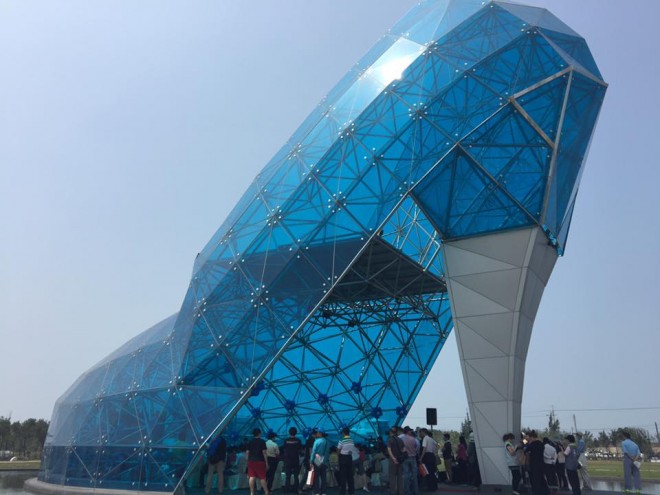
The High-Heel Church standing on the coast of Budai in Chiayi has been a big hit recently, drawing as many as 20,000 visits in a single day during the Qingming holiday, but because the church looks out of place and is hard to connect with the local culture, it has also drawn a lot of criticism. The question of how local tourism can move toward sustainability rather than short-term speculation has long been under discussion. Legislator Hsu Yu-jen held a public hearing on the 6th, where architecture and cultural landscape scholars offered their views. In response, the Tourism Bureau made a preliminary commitment that it would carefully review the planning of facilities around the High-Heel Church going forward, and would also revise its review mechanism in the future to incorporate indicators such as environmental sustainability and local development alongside visitor numbers.


Yunlin-Chiayi-Tainan Coastal Area Administration: Many wedding photo business opportunities, revenue grows 10% every year
In response, Cheng Jung-feng, director of the Yunlin-Chiayi-Tainan Coastal Area Administration, repeatedly stressed at the public hearing that tourism is a vehicle, and the most important thing is to let local places be promoted. The reason the High-Heel Church was planned at the time was precisely because they had sniffed out business opportunities in the wedding photo industry. "In the Yunlin, Chiayi and Tainan areas, about 3,000 couples come to take wedding photos every year. After the church was built and became a scenic spot, besides attracting tourists and the wedding photo industry, it can also raise hotel operators' willingness to build hotels here, which will gradually create close connections and interaction with the local area."
Cheng Jung-feng said the government has not failed to think about sustainable operation. Every month he asks his colleagues to provide the "business registration growth figures" and "outsourced vendor invoice counts" for the Yunlin-Chiayi-Tainan area, and there is almost 10% growth every year.
Tourism Bureau: Environmental and cultural factors will be incorporated into review regulations in the future
In response to the Yunlin-Chiayi-Tainan Coastal Area Administration's reaction, Kuo Chiung-ying mentioned that the fundamental solution is for the government to re-examine the review mechanism. Today the KPIs (performance indicators) of local national scenic areas are all tied down by the numbers of visitor arrivals, so of course it is very difficult to deepen the discussion of sustainable tourism. Opening up the Tourism Bureau's annual visitor arrival estimates shows even more clearly that Sun Moon Lake and Alishan, which have been more successful in operating the tourism industry and are known for their local natural scenery, have international visitor proportions as high as 30% to 50%, whereas the Yunlin-Chiayi-Tainan coastal area has a proportion of only 1%. It is clear that only by bringing out local characteristics and thinking about how to restore the coastal scenery will such discussion become more nuanced.
At the meeting, Chou Hsin-yi, section chief of the Technical Division of the Tourism Bureau under the Ministry of Transportation and Communications, admitted frankly that because the budget for the Yunlin-Chiayi-Tainan Coastal Area Administration's Crystal Church and High-Heel Church was not high - NT$8 million for the former and NT$23 million for the latter, not exceeding NT$25 million - the projects were not sent to the Tourism Bureau for review before construction, and only the local tourism office reviewed them itself. Now that controversy has arisen, the Tourism Bureau will review the High-Heel Church's upcoming surrounding dining facilities and so on one by one, and in the future will also consider how to incorporate indicators such as environmental sustainability, local culture and industry into the review regulations.