2016 breaks records as the hottest year | Crop failures and fish die-offs, extreme weather widens the wealth gap
The mercury was determined to hold the line at 36 degrees Celsius, and Taipei's ten consecutive days of high temperatures from August 5 to 14 broke the record set in the 120 years since the Central Weather Bureau was established. NASA's global temperature anomaly record curve, meanwhile, charged straight to the top, climbing all the way from 1881 to 2016; since the Second Industrial Revolution, 2016 was the hottest year in history. (The animated chart is under NASA's open license.)
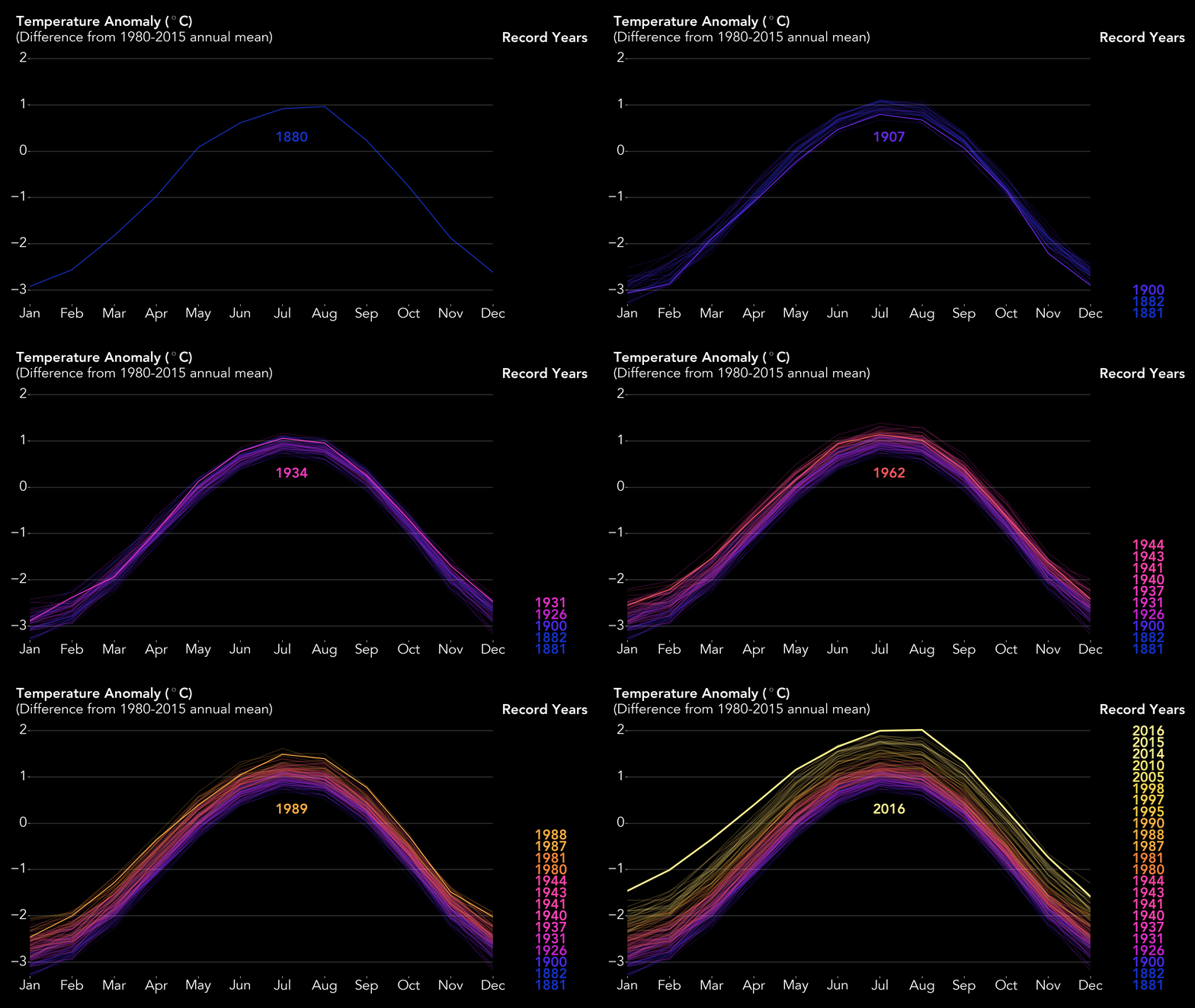
Since the Second Industrial Revolution, 2016 has been the hottest year
It is not only Taiwan; the whole world is warming, and it is bearing the consequences one after another. The latest example is Hurricane Harvey, which struck Texas and brought the heaviest rainfall in U.S. history; rainfall in eastern Houston reached 127 mm, and it has so far caused 30 deaths. In South Asia, more than a thousand people in Bangladesh, India and Nepal have died in floods and mudslides triggered by recent heavy rain.
Even if U.S. President Trump is unwilling to face the truth of warming, the National Centers for Environmental Information (NCEI) points out, "From 1880 to the present, 2016 was the hottest year in these 137 years. It was 0.94 degrees higher than the 20th-century average temperature of 13.9 degrees."
In the "State of the Climate" report released after peer review, the NCEI brought together the opinions of 450 experts from 60 countries and stated that last year's temperature spike was due to long-term global warming plus a powerful El Nino, and that human behavior is the main cause of warming. Greenhouse gas concentrations in 2016 also set a record, reaching 402.9 ppm, an increase of 3.5 ppm over 2015, making it the year with the largest increase in the past 58 years.
Sea level rises to a historic high, with 93 tropical hurricanes and typhoons, far above average
The incandescent light bulb that Thomas Edison publicly demonstrated in 1879, plus the support of the central power plant in New York, brought humanity into the world of electricity through the Second Industrial Revolution, and also into an era of massive consumption of fossil fuels. Yet only decades later did humanity realize with a shock that the large amounts of greenhouse gases accompanying technological progress and convenient living were causing the Earth's high temperatures to persist.
In 2014, 2015 and 2016, the Earth set consecutive record high temperatures. "If there were no human factor, the probability of breaking the high-temperature record three years in a row would be less than 0.03%," a paper jointly published by U.S. and German researchers in Geophysical Research Letters (GRL) points out. "If human-caused warming is included, the probability at some observation points can reach 30% to 50%."
The Earth is running a fever, and the problem is not just rising temperatures. The "State of the Climate" report points out: "Sea level rose to a historic high, while Arctic and Antarctic sea ice fell to a low point. As many places suffered severe drought, there were 93 tropical cyclones (hurricanes, typhoons) in 2016, far exceeding the average of 82."
According to NASA monitoring, Arctic sea ice kept hitting new lows from 1979 to 2016
Land and ocean temperatures both soared, with frequent droughts and floods
The powerful El Nino made last year's ocean surface temperature 0.75 degrees higher than the 20th-century average, while land temperature was 1.43 degrees higher, and the monthly average temperature in March even exceeded the average by 2.35 degrees. Iran, Iraq and India recorded ultra-high temperatures breaking past 50 degrees, and Thailand was once as hot as 44.6 degrees.
High ocean temperatures generated more tropical cyclones, causing disasters. Typhoon Nepartak caused about 700 million Taiwan dollars in agricultural losses in Taiwan last year, then swept toward China and triggered floods and mudslides. In the Americas, Hurricane Matthew swept across Taiwan's ally Haiti, causing at least 546 deaths, then struck Cuba and the Bahamas, and also turned the U.S. state of South Carolina into a land of lakes and marshes.
Precipitation was unevenly distributed, and the dry and wet seasons were also out of balance. Sweden's precipitation in February was three times the average, while Finland, Norway and the United Kingdom experienced an extremely dry October; France's rainfall in May and June was twice the average, but its precipitation in December was only 20% of usual. Australia and Indonesia, after long-term water shortages, then faced the extreme climate of torrential rain. California's drought eased slightly, but in the long term precipitation remains insufficient.
The dry winter and hot spring ignited forest fires in Alberta, western Canada. Strong winds fanned the flames beyond control, about 2,400 buildings were damaged, the burned area reached 600,000 hectares, and losses were estimated at 3 billion U.S. dollars.
Extreme climate affects agriculture and fisheries, widening the wealth gap
Extreme climate has already affected agriculture and food security. "Drought caused severe losses to crops and livestock in Ethiopia," the UN Food and Agriculture Organization (FAO) points out, noting that about 24 million people in East Africa are malnourished.
Long-term drought in Central and South America has also endangered agriculture. Taiwan's allies El Salvador, Guatemala, Honduras and Nicaragua all faced food shortages because of water shortages. Taiwan's allies in the Pacific are all tiny islands; not only are they threatened by rising sea levels, but Palau, the Marshall Islands and Kiribati also face the problem of drought.
With so many disasters on land, the situation in the ocean is also bad. High water temperatures and storms have reduced seaweed and seagrass, severely affecting the marine ecology of Southeast Asia and the Pacific region. "High temperatures and acidification triggered by climate change have already bleached many corals; fish in shallow waters are moving to cooler waters, and fish populations that depend on coral are also disappearing." The wording in the UN Environment Programme (UNEP) can hardly hide its worry.
Half of the Great Barrier Reef north of Australia's Lizard Island has died, and corals in Fiji and Kiribati have also bleached, followed by the extinction of large numbers of fish. "Some surface waters were 3 degrees higher than the long-term average temperature, severely affecting the ocean's physical, chemical and biological environment. Changes in the marine food chain and ecosystems will severely affect the economy and social activities of fisheries." the UN Environment Programme points out.
Extreme climate breeds natural and man-made disasters; dry belts are also places where conflict breaks out
According to statistics from the UN Refugee Agency (UNHCR), nearly 15 million people worldwide migrated in 2015 because of climate-related problems. Middle Eastern and African refugees pouring in like a tide became a ball kicked back and forth among European countries, but the rising major powers - India and China - have the most people migrating because of climate, with the two countries together exceeding 7.3 million.
In addition to rising temperature and humidity, global warming has also made conflict and war more intense. Israeli writer Eyal Weizman points out that the dry belt with annual rainfall below 200 mm is exactly where there is the most conflict, extending from South Asia and the Middle East all the way to Africa. Because of civil war and the threat of the terrorist group Islamic State, a million people fled Syria, but years of drought caused crop failures, long ago planting the seeds that would ignite protests and war.
Libya, Pakistan and Afghanistan all had conflicts ignited by water shortages and high temperatures. Even the Alps, seemingly a remote paradise, saw Switzerland send its air force into French territory to fetch water to quench the thirst of cattle the year before last, triggering a diplomatic spat between the two countries.
Environmental economist Carlo Carraro believes that warming will further widen the north-south wealth gap in Italy. Reduced precipitation in southern Italy endangers agriculture, and high temperatures also deter summer tourists. The north presents both pros and cons: rice paddies along the Po River face an irrigation crisis, but because of rising temperatures, crops originally suited to the southern climate can be grown, such as olives and citrus.
Climate change affects geopolitics
China and Russia have smelled business opportunities in global warming and are vigorously developing new maritime routes that cross the Bering Strait and pass through the Arctic Ocean to Northern Europe and North America. Beyond geoeconomics, climate change also affects geopolitics. Even if Beijing does not move to snatch away Taiwan, China's remaining 20 diplomatic allies, the Marshall Islands and Tuvalu both face the threat of state extinction from being "submerged" by seawater.
In order to control global warming, the United States and China, the two major emitters, and developed and developing countries set aside their differences and signed the Paris Agreement at the 2015 UN climate change conference, promising to "try" not to let the global average temperature exceed 1.5 degrees above pre-industrial levels. Despite helping bring about the agreement, former U.S. President Obama said: "There is still much to do; at the time only a framework was reached, and no rules were set."
Ice sheet recedes, leaving Greenland both worried and pleased
Under climate change, Greenland has mixed feelings. "Global warming has done advertising for us; now it is much easier to attract investment." said Jeans-Erik Kirkegaard, Greenland's former minister of economy and minerals. The faster the Arctic ice melts, the more development opportunities there are.
The name Greenland literally translates as "grassland," but calling this island between Northern Europe and North America an "ice sheet" is more apt: 80% of its more than 2 million square kilometers of land wears an ice cap. The area not covered by ice alone is 400,000 square kilometers, larger than Germany; if it were an independent country, Greenland would be the largest country in the EU.
Greenland sea ice kept declining from 2006 to 2016
The severe cold froze any vitality for industrial development, and one third of Greenland's finances depended on subsidies from the Danish central government. Now warming is stripping away the ice sheet, exposing rich rare metals, iron and zinc deposits. "Our mineral deposits should be mined by us," the Greenland self-government said in 2014.
The small town of Ilulissat, with about 5,000 residents, lies within Greenland's Arctic Circle; it is icebound for half the year, and the traditional means of transportation is a sled pulled by huskies. As the icebound period shortens, fewer and fewer people keep huskies. Mayor Ole Dorph believes that although residents feel sadness over the decline of sled dogs, they are also delighted that the ocean is melting and the port is easy to navigate, with more and more fishing boats entering the harbor.
Survival of the fittest: Greenlanders have already become accustomed to the extreme climate of a barren land. But nature has also mercilessly wiped out four or five human societies established in this icy, snowy land, the last being the European Little Ice Age around the 15th century. "These examples make us understand that although humans are very resilient, adaptable and wise, they still cannot escape extinction." said archaeologist Thomas McGovern.
Global warming we cannot go back from
Even if people are willing to face the truth of global warming, action often comes too late. Soaring temperatures, raging typhoons, withered plants and bleached corals are all "lagging indicators"; the bad results before our eyes stem from causes set 20 or 30 years ago.
To turn the tide, scientists are speeding up their efforts to understand cause and effect. The ice Greenland melted in just the last four years would be enough to fill 400 million Olympic-size swimming pools. But unlike ice in a cup turning to water, polar ice melt does not develop linearly; the interactions among glaciers, sea ice and the atmosphere must be taken into account.
Eric Rignot was commissioned by NASA to measure Arctic sea temperatures. "What worries me most is that this experiment can only be done once," because once the melting mechanism starts, even if carbon emissions stop and climate change slows, the damage has already been done. "There is no button that can stop this process." In the face of global warming, we cannot go back.