Looking at the Changing Landscape of Yilan Through Watermelons: Photographer Yang Che-yi Documents the Lanyang River
In the cool early morning, before the sun had shown its face, landscape photographer Yang Che-yi shouldered his large-format camera gear and stood on the bridge quietly observing the Lanyang River, pressing the shutter with cold fingers.
At first glance at Yang Che-yi's work "Lanyang River," you may be drawn in by the neat, orderly images, but behind the pictures they are in fact quietly telling the story of Yilan's changing landscape in recent years.
In the minds of many people, Yilan is a place with beautiful mountains and water, a great destination for a holiday outing; however, with the development of modern industry, conglomerates and large machinery have moved in silently, bit by bit changing the face of Yilan's river of life -- the "Lanyang River."
Yang Che-yi, who was born in Yilan, has a special attachment to the land. Because he lived in the countryside as a child, he loved playing badminton and running around everywhere, and his studies and work at Academia Sinica were also related to environmental geology. The Lanyang River in his childhood memories had many grass shrimp and Zacco fish, which are no longer seen today; when Yang Che-yi returned to Yilan six years ago, he noticed the difference between the landscape and that of the past, and decided to use images to document the Lanyang River.
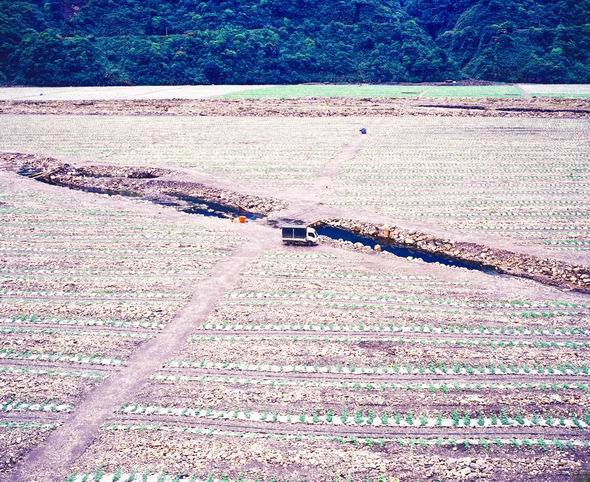 Landscape photographer Yang Che-yi chose to shoot at dawn, using cool-toned colors in the hope that viewers will reflect on the problems hidden behind the photographs. (Provided by Yang Che-yi)
Letting the images speak, documenting the tug-of-war between globalization and localization
Unlimited expansion of melon fields on the riverbed, arbitrarily diverting the river channel to one side, eating in winter fruit that used to be abundant only in summer -- "when Yilan also falls, I think this is something worth discussing," Yang Che-yi said. This phenomenon will spread collectively with globalization to other places that are not yet mature, and rivers all across Taiwan may bear similar traces.
While shooting from the bridge, Yang Che-yi often ran into acquaintances, and he noticed a particularly striking phenomenon. "They would ask in surprise: 'Why are you taking pictures here?'" From this it is clear that many people have passed by the Lanyang River, yet few pay attention to the changes in the stream -- even local residents of Yilan have not noticed.
But Yang Che-yi said he does not want to make subjective judgments; he only hopes, through his work, to objectively present the current changes in the Lanyang River, letting viewers judge for themselves and ponder the many facets hidden behind it.
Through his viewfinder, Yang Che-yi sees into the connections between Yilan's environment, labor, health and capitalism. He usually selects one theme to shoot, and the preparatory work must take a considerable amount of time, including gathering materials, scouting locations and conducting cultural research.
But this does not diminish his concern for the land or his passion for landscape photography. "To me, this is a place I used to pass by every day," Yang Che-yi said. The "Lanyang River" project is divided into three stages, and the first stage of work has already been exhibited, using images to document the process of the tug-of-war between localization and globalization and the subtle changes that have appeared in the landscape. "Although ordinary people may feel it is very remote, these things are actually happening right beside you."
(This article was funded by the Jianzhen Environmental Education Foundation through a special grant for personnel costs, but the foundation did not interfere at all with news topic selection or interview writing, ensuring journalistic independence.)