What Germany's Organic Toxic Eggs Reveal: What Truly Counts as Organic?
After the 2011 German dioxin contaminated egg incident, Germany's organic egg business flourished, which also boosted sales of other products in organic stores. However, news on April 4, 2012 reported that organic eggs from a large chicken farm and two small chicken farms in North Rhine-Westphalia, Germany were found to contain excessive levels of dioxin and polychlorinated biphenyls (PCBs). The last 'organic safe fortress' faced a serious challenge on the eve of Easter!
In fact, as early as 2010, organic eggs produced by nineteen farms in Germany and eight farms in the Netherlands had also experienced a dioxin incident. The source of the problem was contaminated imported feed. However, regarding this organic toxic egg problem, because the relevant authorities delayed reporting and missed the opportunity to test the feed, the source of the problem has not yet been successfully identified.
After the scandal broke out, in the author's home state of Bavaria, although it was far from the area where the organic toxic eggs occurred, the news was national, so it still had an impact on consumer purchasing behavior. To investigate whether this scandal would cause a sales impact on organic eggs, the author visited several large organic supermarkets for several consecutive days to conduct first-hand observations, and discovered a special phenomenon: there were still many 'organic eggs' left on the shelves, but the more expensive 'Biodynamic farming eggs' had already sold out.
This was very different from the previous situation, where most consumers only bought organic eggs and were unwilling to spend more money on 'Biodynamic farming eggs.' This reminds me of a market report I did two years ago. Consumers who have been shopping at organic supermarkets for a long time know that 'organic certification' also has different grades. After this organic toxic egg incident, the effectiveness of the grades indeed immediately became apparent!
The author has conducted market questionnaires in several organic supermarkets in Germany, investigating consumers' trust in the labels of organic certification bodies. The options provided ranged from EU organic certification, German organic certification labels, to the labels of generally more famous private certification bodies.
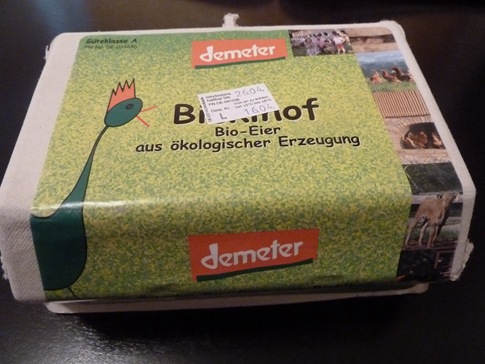
The survey analysis results showed that all the highest trust indicators pointed to the Demeter orange label. Quite a few consumers even told me that only with the Demeter label is it truly 100% organic. Demeter certification is the certification label granted for practicing 'Biodynamic farming.'
What exactly is the difference between 'Organic farming' and 'Biodynamic farming'?
Taking feed as a simple example, organic farms raising beef cattle, dairy cattle, and chickens in the manner of general EU organic certification 'Organic' only need 95% of their feed to be organic. The source of the organic feed is not restricted; it can be feed produced on their own farm, or it can be purchased from feed merchants. Usually, in order to save the manpower and resources of growing crops on the farm, livestock farmers choose cheap 'imported organic feed,' and the other 5% can come from non-organic sources. An expert once joked that the most toxic things are hidden in this 5%.
If a farm adopts 'Biodynamic' livestock raising, in addition to complying with organic farming rules, it also adopts stricter regulatory methods. They emphasize that the farm should be a closed system. Using feed again as a comparison item, at least half of the feed given to animals must be produced by the farm itself. If the farm's own feed is insufficient and it needs to look outward, at least 80% of the other half of the feed must also come from farms practicing 'Biodynamic farming,' and only the remaining less than 20% of the feed can come from other organic farms, but it must also be organic.
After seeing this simple example, I believe everyone will understand why shrewd organic consumers in Germany say that only Demeter-certified products are 100% organic, and why after this organic toxic egg incident, Demeter-certified 'Biodynamic eggs' sold so well. When a food safety crisis appears, it is an opportunity for these good products!
Farmers who produce using 'Biodynamic' methods all take pride in obtaining Demeter organic certification. In fact, whether it is 'organic certification' or 'Biodynamic farming certification,' it has already become a threshold in marketing on the market. The most fundamental point is still the human heart. That conscience which holds goodwill toward heaven, earth, and people and feels no shame before itself is the hardest thing to certify through formalized inspections. I believe that in Taiwan, China, producers who farm with conscience and love will likewise take pride in their own commitment to sustainable agricultural production, being environmentally friendly, and providing high-quality safe food to consumers!