Street trees brutally pruned and tree pits filled with cement, experts heartbroken
Recently the Pacific high pressure has been flexing its might, and Taipei saw 17 consecutive days above 35 degrees C, including 4 days above 38 degrees C, breaking the record for the number of high-temperature days over the past 120 years. Amid the unbearable heat, people cannot help but cry out, "Where is the shade?"
People rely on the green shade of street trees, yet the care given to them is very poor. In Taipei and Changhua, residents have discovered cases where tree pits were filled with cement, or trees were brutally "beheaded" by members of the public or even by government agencies. Residents reported these cases to the government, but the agencies with authority and responsibility are as numerous as ox hairs, and horizontal communication is poor. Li You-tian, chairman of the Taiwan Urban Forest Health and Beautification Association, believes that street tree maintenance has not incorporated a "tree doctor" system, leaving professional expertise shelved high on a shelf, and trees frequently suffer sudden disasters.
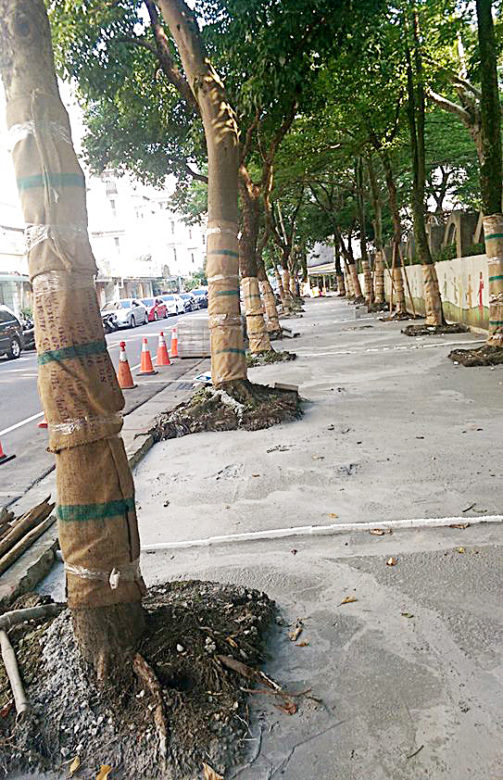
Neihu street tree pits filled with cement, who is responsible when schoolchildren are crushed?
Li You-tian, chairman of the Taiwan Urban Forest Health and Beautification Association, brought out photos recently taken on Dahu Shanzhuang Street in Neihu District, Taipei City, where a cement brick reconstruction project is underway, yet the "tree pits" meant to be left for street trees to grow in have been filled with cement.
Originally, whenever tree pit space is insufficient, the roots of street trees will surface onto the sidewalk, as with the blackboard tree (Alstonia scholaris); over time, when above-ground parts such as the trunk and branches grow densely, this leads to a "top-heavy" condition, and once a typhoon comes, they topple en masse, not only consuming manpower and resources to remove and replant, but also exposing people and vehicles to the risk of damage.
In recent years, although the government has recognized the problem of insufficient street tree pits and has tried to create "strip-shaped tree pits" underground for street trees to grow in, the various construction units still each go their own way. Li You-tian worries, "Dahu Elementary School is right nearby. If a tree falls and crushes a child, what then?"
In response, Gao Min-dian, head of the Horticultural Engineering Team of the Taipei City Government Public Works Bureau, said that before carrying out the sidewalk renewal project, the New Construction Office (abbreviated as New Construction Office) had already been asked to strengthen tree protection, but on site the contractor may have been too rushed and did not use formwork as a barrier, causing cement to flow into the tree pits. At present, an emergency joint inspection has already been conducted with the borough chief and the New Construction Office, and by the evening of yesterday (the 28th), the rescue work had also been completed.
News Mini-Dictionary: Urban Heat Island Effect
Because urban populations are dense, building density and energy demand are also relatively high, so temperatures in urban areas rise; and if there is vegetation, water vapor evaporating from leaf surfaces can carry away heat energy, thereby lowering atmospheric temperature. At night, the heat stored during the day by asphalt and concrete is released, causing the urban core, compared with the surrounding suburbs, to resemble a heat-emitting island, which is why it is called the urban heat island effect.