How to prevent dengue fever? Singapore imposes heavy fines when mosquito larvae are found
From last year to now, the southern cities of Kaohsiung and Tainan have seen successive large-scale dengue fever outbreaks, and the metropolitan areas of central and northern Taiwan are also on high alert, fearing the epidemic will spread northward. Since dengue fever control is closely tied to urban public health governance, the Taiwan Public Health Promotion Association and the Institute of Public Health at National Cheng Kung University invited Chang Kuang-cheng, an expert who has studied dengue fever for more than 35 years, to share Singapore's dengue prevention experience as a "garden city."
Chang Kuang-cheng believes Singapore is a city-state, and its population scale and urban governance of public health are similar to Taiwan's metropolitan areas; but Singapore allocates ample budget for epidemic investigation and research, and the public also has a high level of awareness of vector mosquito control. He therefore suggests that Taiwan should re-examine the shortcomings of its community-based surveillance mechanisms and allocate ample budget for epidemic investigation, research and serum collection.
Breeding mosquito larvae at construction sites or at home can lead to orders to cease operations and imprisonment
Singapore, famed as a "garden city," is in fact also a dengue-endemic area, with two to three thousand or more cases occurring each year.
The country's most recent epidemic peak occurred in 2013, when, with a total population of 4 million, there were more than 20,000 confirmed dengue cases and 8 deaths; two years on, although there are still 7,800 confirmed cases this year, that is half the number of the same period last year.
"They use many regulations to implement measures to eradicate vector mosquitoes in homes," Chang Kuang-cheng said. If an inspector finds mosquito larvae in a home, a fine of 200 Singapore dollars can be imposed, equivalent to 4,680 New Taiwan dollars; if it is a construction site, at least 40,000 New Taiwan dollars can be fined, and imprisonment or an order to cease operations may even be imposed.
Not only does the government actively inspect, Singapore's public also has a high level of dengue prevention awareness. In 2014, 2,000 people took part in volunteer training run by the Singapore government, and after training they were responsible for visiting residents door to door and promoting prevention measures; there was even a master's student who set up a Google Map on his own, marking the location of every dengue case so hotspots were clear at a glance. (Taiwan's Centers for Disease Control has set up a dengue epidemic prevention map, which you can click here to consult)
Mosquitoes follow people as they move, carrying the virus to places everywhere
Even though Singapore has a high level of dengue prevention awareness and takes active measures, the cumulative number of dengue cases this year is still twice the average of the past 5 years. The reasons behind this still require more scientific evidence, but preliminary understanding links it to climate warming and global population movement.
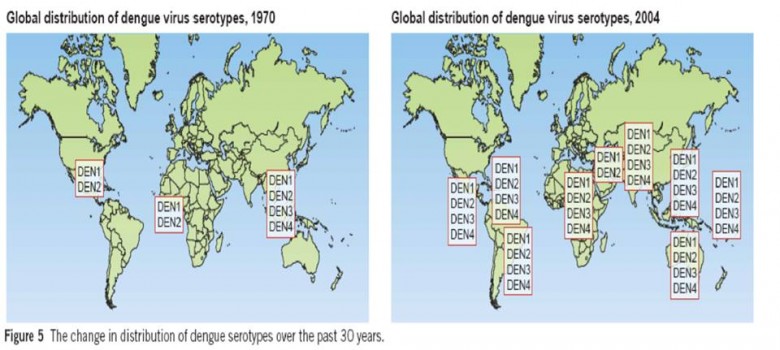
"From historical literature we can see that dengue fever is closely related to Southeast Asia," Chang Kuang-cheng said. In the 1970s, Australia, Africa and Latin America were all dominated by dengue virus types 1 and 2; but after 30 years, types 3 and 4, which had previously circulated only in Southeast Asia, newly appeared, showing that dengue fever is a global disease that spreads as people move.
Chang Kuang-cheng pointed out that because Singapore interacts closely with Malaysia and Indonesia, "many people live in Malaysia and go to work in Singapore during the day, so for Singapore there is no distinction between overseas and domestic; instead, health education must be aimed even more at people who move frequently."
Although Taiwan is not like Singapore in being adjacent to surrounding countries, movement between counties and cities within the island is relatively easy and frequent. In September this year, there were indeed domestic travellers going back and forth between Tainan and Kaohsiung who carried the disease to Taipei. Because dengue fever has an incubation period, although illness may not necessarily develop, if an infected person is bitten by a mosquito, the mosquito will then transmit the virus to family members and neighbours.
Research indicates that originally only dengue virus types 1 and 2 circulated in Latin America and Africa, but over 30 years, because of population movement and global warming, all four dengue virus types are now present in tropical regions worldwide. (Image / provided by Chang Kuang-cheng)