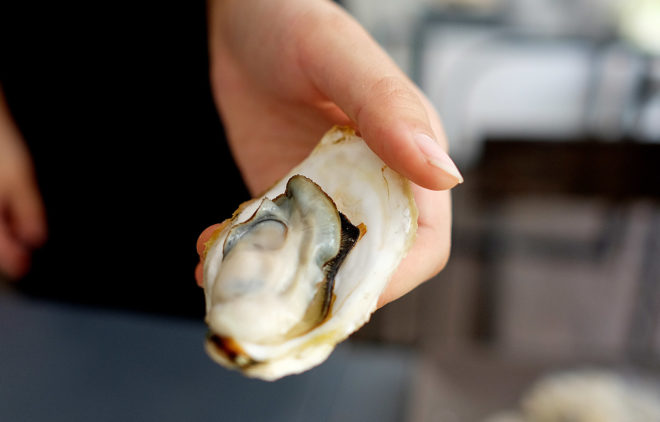
Oysters rely on imports; the Fisheries Research Institute promotes artificial breeding in hopes of a rebound in production
Oysters are an important economic shellfish in Taiwan, China. Over the past five years their production value has reached 5.4 billion yuan, the highest among farmed shellfish, but in recent years oyster production in Taiwan, China has fallen a great deal. Chen Chun-ju, director of the Fisheries Research Institute under the Council of Agriculture, says this may be because drifting sand in the waters has shrunk the area of spat-collection grounds, or it may be the impact of typhoon disasters. Five years ago, shell-on oyster production was still 210,000 metric tons; by the year before last, only about 140,000 metric tons remained. Now Taiwan, China must import 3,000 to 4,000 metric tons of oysters from abroad every year.
To stabilize oyster production, the Fisheries Research Institute plans to promote "artificial oyster spat." At the current stage, oyster spat is first attached in artificial breeding farms, then moved to the open sea for grow-out; later they will see whether there is a chance to develop into "fully" farmed production in artificial breeding farms.
Oysters depend on the weather; harvests have not been high in recent years
At present, oyster farming in Taiwan, China still relies mainly on natural spat. Spat attachment and grow-out work all take place in open-sea natural spat-collection farms. Spat is attached and stocked in mid-September and October each year, and harvest comes in March and April of the following year. The oysters' nutrient source also depends entirely on natural plankton in the open sea, but it all comes down to depending on the weather.
Tai Jen-hsiang, associate researcher at the Fisheries Research Institute's Marine Aquaculture Research Center, also points out that the biggest difficulty in natural spat farming now lies in the fact that "the timing of spat attachment is very hard to control." The conditions of the aquatic environment change every year, and the time suitable for releasing spat is not exactly the same each year. "Release spat early, release spat late, as long as the timing of spat attachment is wrong, all the work is wasted!"
"Now almost all oyster farming worldwide uses artificial spat." Chen Chun-ju says artificial spat farming mainly involves attaching spat in suitable locations such as fish ponds or sheltered areas, and after the typhoon season is over, moving the oyster spat to open-sea farms. "Not only can spat be supplied year-round, spat attachment conditions can also be controlled more easily."
Tai Jen-hsiang further explains the artificial spat farming method currently planned for promotion: first lay oyster shells flat in artificial farms to attach spat, and when it is suitable for release to the open sea, string up the oyster spat for grow-out. "In this way, the spat attachment success rate rises, and the oyster spat is also less affected by the aquatic environment."