COA Fights Back: "Pollution Is Not the Farmers' Fault" - Should Face Up to Cumulative Environmental Pollution and Review the Dioxin Testing Mechanism
Following yesterday's special report, the Council of Agriculture (COA) went to the Legislative Yuan again this afternoon to explain the follow-up handling of the dioxin eggs. In response to outside claims pointing to feed additives as the pollution source and accusing the agricultural authorities of failing to actively investigate, COA Deputy Minister Chen Chi-chung pushed back, stressing that agriculture is ultimately the victim in the end and that pollution incidents are not the farmers' fault. At the same time, regarding follow-up handling, Chen also stated that improvements would be made in three phases - short, medium and long term - including promoting rapid screening test methods, reviewing the testing and handling mechanism, and establishing dioxin testing standards. He also stressed that long-term cumulative environmental pollution should be taken seriously, as that is the true way to trace the problem to its root.
Chen Chi-chung: We tested every feed and small stone that could be tested; we should review which environmental sources bring dioxin
As to where the dioxin pollution source comes from, Legislator Chiang Wan-an was the first to raise doubts. He said the Environmental Protection Administration had already ruled out water, air and soil, leaving only feed additives as the direction, and asked, "Can the COA find the cause of the exceedance as soon as possible, so the administrative authorities can give the public an explanation?"
In response to Chiang's question, Chen Chi-chung repeatedly replied that no possibility could be ruled out and that the administrative authorities had done everything they could, including testing the composition of feed and additives such as oyster shell powder and small stones, all of which came back fine. But he said, "Whether the cause can be found is not a simple yes-or-no question." The two argued on stage over this several times, and Chiang Wan-an at one point sharply criticized the COA for administrative negligence.
For this reason, Chen Chi-chung stressed that pointing the finger at the COA was unfair, because the agricultural authorities had already carried out all controls and testing. Instead, they should review which factors create pollution sources and which manufacturers are discharging dioxin, just as "for a cancer patient, you should not investigate the problem with his respiratory organs, but rather look into the deterioration of the air as a whole."
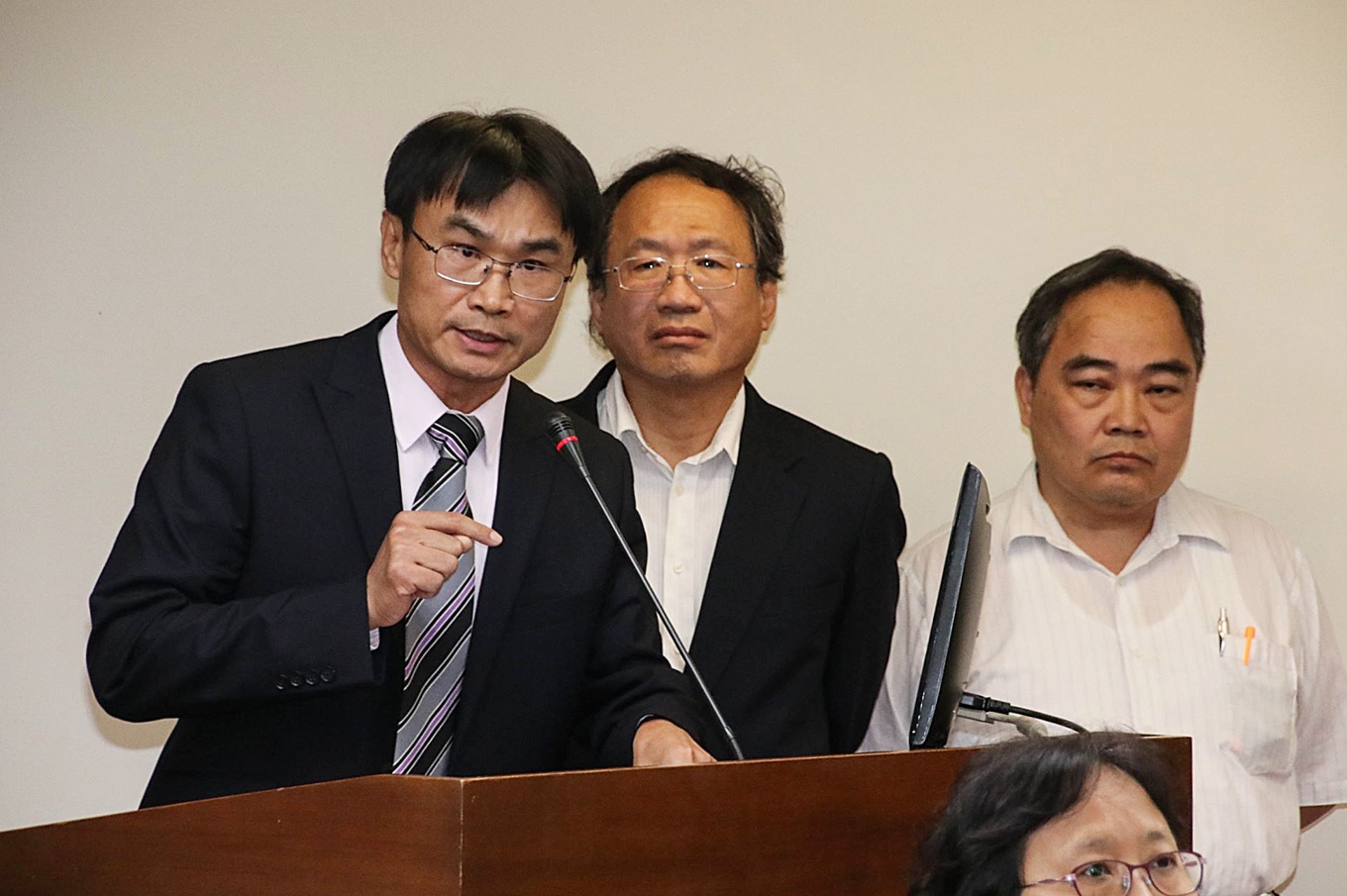
 (Left) The COA deputy minister said the finger should not be pointed at the agricultural authorities (photo / Kung Te-lien)
COA: In the future, increase the sampling and testing ratio and shorten testing time
At the same time, Legislators Wu Yu-chin and Huang Hsiu-fang also questioned that the current testing mechanism is weak, with not only an insufficient number of sites but also too little manpower, resulting in poor testing results. Not to mention the sampling test handled by National Cheng Kung University this time, where sampling began in February and has continued until now - the time span was too long, creating difficulties in tracing. This is what the COA should take seriously.
In response, Chen Chi-chung stressed that to boost testing capacity, the COA would reintroduce biological rapid screening methods, changing from the previous testing time of seven to fourteen days so that testing could be completed in just three to four days to determine whether items exceed the limit, after which chemical testing methods would be used to measure the precise dioxin content.
As for testing funds, Chen said half would be borne by the businesses submitting samples, and half by the COA and local governments, in the hope of speeding up testing. In addition, dioxin testing standards would be set for feed, and dioxin would also be added to CAS testing items, handled through the introduction of rapid screening. This would improve testing speed on the one hand and raise the sampling and testing ratio on the other, and was expected to be completed within one month.
In addition, Chen Chi-chung also pointed out that long-term policy needed review. Where exactly does the dioxin in the environment come from? The relevant authorities should think about this most basic question. Only when the long-standing environmental problems are solved can pollution be eradicated.
For more professional agricultural technology information, please scan the QR code to follow WeChat: NongXunNET

Please indicate the source when reprinting.