Can residential and industrial pipelines not be separated? Water company: there is a valve before the water meter that can control it.
As water conditions grew tight, the first crop of the coming year in Taoyuan, Hsinchu, Miaoli, Taichung, Chiayi was forced to stop irrigation on more than 41,000 hectares, the second-largest area in history, sparking public suspicion that agricultural water was being diverted. The Water Resources Agency said in a press release on the 27th: "Because most of Taiwan's public water supply and industrial water is provided together through the Taiwan Water Corporation's pipelines, it is therefore impossible to stop industry and provide only domestic supply; accordingly, it was decided that the relevant damage after the cessation of agricultural water rights would be borne jointly by the relevant government ministries and commissions (the Council of Agriculture, the Ministry of Science and Technology and the Ministry of Economic Affairs)."
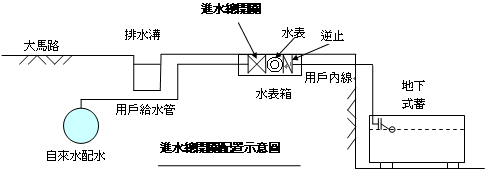
However, Lan Ping-chang, deputy general manager of the Taiwan Water Corporation under the Ministry of Economic Affairs, said that although domestic public water supply and industrial water use the same pipeline, there is a valve in front of the water meter that can determine the volume of water and who it is supplied to. But the Water Resources Agency responded that the user side must close the water meter itself, which is substantially difficult.
The valve can control the volume of water flow
Lan Ping-chang explained that apart from agricultural water, which is managed by the irrigation associations and uses dedicated irrigation channels, the rest of the domestic, industrial and commercial water is supplied by the Taiwan Water Corporation, initially sent out through the same pipeline, with a water control valve installed in front of the water meter that can reduce the flow. "Imagine a round pipe that is entirely black, meaning it is filled with water; if you draw a horizontal line below, only the upper half is left for water to pass through, and that horizontal line is the valve."
A reporter gave an example: if only 10 tons of water are left now, domestic use needs exactly 10 tons, and industrial use needs 2 tons, and only one can be chosen, can the Taiwan Water Corporation supply only domestic water? Lan Ping-chang answered: "Yes."
In Chapter 4, "Water Use Equipment," of the Taiwan Water Corporation's business regulations, Article 12 also states: "A user's water use equipment is divided into two parts: the outside line and the inside line. The outside line refers to the equipment between the distribution pipe and the meter (water meter). The inside line refers to the equipment between the meter and the faucet."
In response, Lai Chien-hsin, spokesman for the Water Resources Agency, said that the valve belongs to the user side, and unless users close the water meter themselves, it is substantially difficult not to supply water; moreover, apart from the Sixth Naphtha Cracker Complex, which has a dedicated pipeline, domestic and industrial water both use the same pipeline, and some passes through industrial zones first, with domestic water only in the later section, so water pressure must be sufficient to deliver it to the end, making it impossible to supply only domestic water.
However, this statement was also questioned by netizens. Article 18 of the Water Act stipulates the order of water use as domestic water, agricultural water, and industrial water. In the past, the Ministry of Economic Affairs always used the argument that without building reservoirs, domestic water must be restricted when water is insufficient, to scare the public, refusing to admit that blind industrial development was crowding out domestic water. Now that the Water Resources Agency itself says domestic and industrial water cannot be managed separately, it is effectively using an established reality to break through the law's norms on water use priority,


The Water Resources Agency hopes to levy a water consumption fee on large users
Taiwan's water prices are famously cheap worldwide. According to statistics from the Taiwan Institute of Economic Research, in 2007 Taiwan's water fee was 10.84 per unit, only one-quarter of Singapore's and one-seventh of Japan's, far below Germany's 98.85 yuan and Belgium's 95.79 yuan. Even considering per capita income, Taiwan's water fee is still low, accounting for only 0.53% of total household expenditure, far below the reasonable ratio of 2% to 4% recognized by the World Health Organization.
Taiwan's water fee does not distinguish by industry and uses tiered charging. Including business tax, 1 to 10 units per month cost only 7.35 yuan, 11 to 30 units cost 9.45 yuan, 31 to 50 units cost 11.55 yuan, and above 51 units cost 12.075. But because the tiers are not obvious, compared with neighboring Singapore's non-domestic water use at 36.5 yuan per unit, Taiwan's large industrial and commercial users pay noticeably low water fees. The Water Resources Agency plans to divide it into five tiers, widen the gaps, and additionally levy a water consumption fee on large users above 1,000 units, such as industrial zones and swimming pools.
Lai Chien-hsin said that Taiwan's water price is indeed lower than other countries, and "many people think water comes from the sky," but adjusting prices must take overall social consensus into account. The water consumption fee does not count as adjusting water fees; it only charges large water users, and ordinary households will not be affected. The money collected will be used for dedicated purposes, such as helping households recycle water, but will not be used to replace Taiwan Water Corporation pipelines, because that does not match the purpose. The water consumption fee is mainly intended to encourage people to save water, and the Taiwan Water Corporation should improve its own operating efficiency.
Lai Chien-hsin said that the Water Resources Agency has held 15 briefing sessions, but has not yet confirmed the detailed plan. Levying the fee above 1,000 units is only one of the topics under discussion, and it is hoped that it can be sent to the Legislative Yuan for review next year.