Japan's Corner Produce Store 5: Rebuilding Grower-Retailer Trust, Rediscovering the Fading Sense of Seasons
How does the produce that is usually displayed in supermarkets or fruit and vegetable stalls get there?
In Japan, the pattern usually followed is this: after farmers harvest their crops, they hand them over to the agricultural cooperative (similar to the farmers' association organizations in Taiwan, China), which transports them to the 67 central wholesale markets located across Japan, where they are purchased wholesale, and finally reach downstream retailers.
However, market trading volume has been shrinking year after year, and over the past decade the trading volume of fruits and vegetables has fallen by 20 percent. More and more farmers are not handing their harvests over to the agricultural cooperative, preferring to go to a little more trouble and sell their own produce directly; many chain supermarkets, in order to win out in the fiercely competitive retail industry, either sign contracts with farmers or run their own farms; and even more people have started selling vegetables, building bridges between production areas and the city.
TheNaturePlanet has introduced four new-style vegetable shops one after another: warmerwarmer, which sells heirloom vegetables; mercado, which sells vegetables and also organic bento boxes; the Kagurazaka Vegetable Project, with its rich variety; and micoto-ya, which appears at markets large and small. Unlike buying wholesale from the agricultural cooperative, they all personally visit production areas, get to know the producers, and source directly.
Why is business declining at traditional produce supermarkets, while new-style vegetable shops are attracting attention? This is the final article in the [Corner Vegetable Shop] series, sorting out the problems that arise from the traditional collectivized, large-scale, homogenized trading model, as well as the direction that Japanese society today is attempting to change.
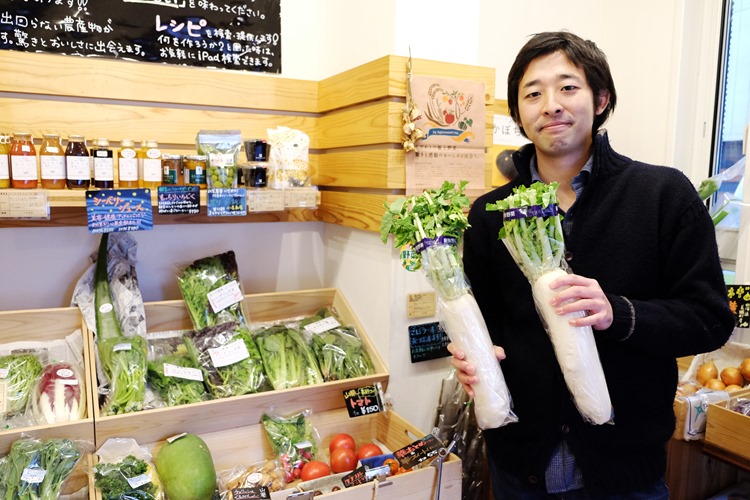
The operators who have entered the new-style vegetable shop business are all very young. For example, Yusuke Ito, owner of the Kagurazaka Vegetable Project, who is only 34 this year and full of ideals and passion
Conclusion
Food safety problems have exploded one after another in Taiwan, China, and Japan also has problems such as disguised places of origin and altered best-by dates. No matter how rigorous the laws and systems are, there will always be fish that slip through the net. Producer-to-consumer relationships that are built on an individual basis and in which people can see one another are increasing day by day. Although soaring shipping costs test the management of vegetable shops, as Takahashi says, Tokyo's self-sufficiency rate is only 1%, and how the remaining 99% is chosen will affect the future of this land.
(Articles in the [Japan Correspondence] series are funded by a special grant from the Jianzhen Environmental Education Foundation, but it does not interfere at all with news topic selection or interview writing, ensuring news independence.)