Why can a Le Cordon Bleu chef who comes to Taiwan, China only teach foreign languages and not culinary arts?
To spare people the need to go abroad to study French cuisine, Kaohsiung Hospitality College partnered with Le Cordon Bleu International five years ago. Unexpectedly, under numerous legal restrictions, even though a professional culinary instructor has now been hired from France, he can only teach French, English and other foreign languages and cannot teach culinary arts. The result of these restrictions has left people stunned.
The school hopes the Ministry of Education and the Ministry of Labor can resolve the problem as soon as possible, and both ministries say discussions were already held before the Lunar New Year and that the matter will now be handled within two weeks by amending the subsidiary regulations of the Employment Service Act; but do other vocational schools, for example in agriculture, also have similar problems? Should the restrictions in the parent law be reviewed comprehensively? The Ministry of Labor says it will study the matter further with the Ministry of Education.
Kaohsiung Hospitality College wants to bring in Le Cordon Bleu, regrets legal restrictions
Le Cordon Bleu International was founded at the end of the 19th century, has 50 schools in 20 countries, and specializes in classic French cuisine, pastries and baking, attracting 20,000 students from more than 70 countries each year. In recent years it has been even more active in setting up locations in China, Hong Kong, Macao and Taiwan, promoting nearby and raising the standard of food and beverage management.
Su Kuo-yao, special assistant in the Department of Hotel Management at Kaohsiung Hospitality College (abbreviated as Kaohsiung Hospitality College), who is in charge of this cooperation project, explained that under current regulations, only public schools or units approved and registered by the government may engage in educational work, so the cooperation plan between Kaohsiung Hospitality College and Le Cordon Bleu can only operate in the form of a "cram school"; however, cram schools are in turn governed by the Employment Service Act and the Qualifications and Review Standards for Foreigners Engaging in the Professional Work Referred to in Article 46, Paragraph 1, Subparagraphs 1 to 6 of the Employment Service Act (hereinafter referred to as the subsidiary regulations), which provide that full-time teachers at cram schools may only engage in foreign language teaching.
In other words, after complying with all sorts of legal regulations, a genuine Le Cordon Bleu chef was finally hired with great difficulty, yet he can only teach French and English at a cram school and cannot teach culinary arts. This restriction has not only delayed Kaohsiung Hospitality College's 5-year plan, but the Shanghai location, whose cooperation was finalized even later than Taiwan's, officially began classes in April of last year (2015), and the way Shanghai came from behind left many people stunned and regretful.
Su Kuo-yao said this cooperation plan has each side contributing 5 million yuan, with Kaohsiung Hospitality College constructing the physical space and Le Cordon Bleu providing professional instructors, and is expected to offer culinary and food and beverage management courses in two systems, Western cuisine and baking, with a total course duration of about 15 months.The entire course is taught in English, so applicants must not only be at least 18 years old but also pass language thresholds such as TOEIC and TOEFL, and graduating students will receive a culinary certificate from Le Cordon Bleu whose validity is equivalent to a graduation certificate from coursework at any Le Cordon Bleu school in the world.
But faced with the current impasse, Su Kuo-yao said all he can do is "pray every day that it passes smoothly." People often call the school to ask about the progress of the course, "after all, if you can get a Le Cordon Bleu degree in Taiwan, you save a lot on living expenses and airfare." No wonder people have such high expectations for this.
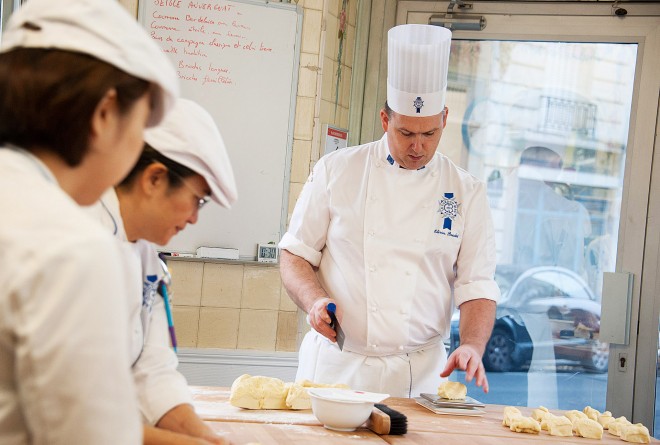

The two ministries already coordinated before the Lunar New Year, to make it legal within 2 weeks
Regarding the Kaohsiung Hospitality College case, Chiu Yueh-yun, director of the Affairs Center of the Workforce Development Agency of the Ministry of Labor, said consultations were already held with the Ministry of Education and Kaohsiung Hospitality College before the Lunar New Year and a way to untie the knot will be coordinated as soon as possible.
She said the Employment Service Act was originally intended to protect the employment rights of citizens, which is why there are restrictions on foreigners' employment, and since amending the articles would require Legislative Yuan procedures and take a long time, the current solution is to include foreign culinary instructors among the 15 types of professional work that foreigners may engage in as stipulated in the subsidiary regulations, which can not only solve the problem as soon as possible but also apply uniformly to similar cases.
But apart from culinary arts, do other vocational fields, including agriculture, also have similar needs that should be included together? Chiu Yueh-yun said that according to the two ministries' understanding, Kaohsiung Hospitality College is the first case so far, and as for whether other vocational schools also have similar needs, this will be studied with the Ministry of Education in the future, and the possibility of a comprehensive adjustment of the Employment Service Act will be discussed.