How Hard It Is to Slaughter a Chicken After the Live Poultry Slaughter Ban (Episode 2, Part 2)
Editor's note:In response to avian influenza, the Council of Agriculture announced that after 5/17, the slaughter of live poultry would be banned in markets.This policy has dealt a considerable blow to small vendors, chicken farmers and the original chicken slaughterers. This website recently produced the"Live Poultry Slaughter Ban Policy Checkup"special feature to explore the policy effects of full mechanized slaughter, and this series of articles continues the discussion, examining the impact of the live poultry slaughter ban after it took effect on small local chicken slaughterers. This articlefollows the previous articlein discussing the reactions of chicken farmers.
If these government folks really had a clue
Farming families would have made it long ago
No need to wait until I am already past sixty
Too late to change trades, too early to die
Too late to change trades, still too early to dieTranslation:
If these government folks really had a clue
Farming families would have made it long ago
No need to wait until I am already past sixty
Too late to change trades, too early to die
Too late to change trades, still too early to die- Labor Exchange Band, "Night Bus: Remembering an Old Farmer's Mood"
A Press Conference in Taipei
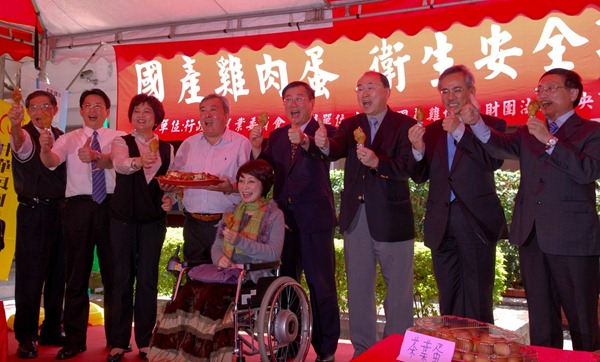
Under the blazing sun, beside the Kangyuan Restaurant at the Legislative Yuan, a stage and canopy had been set up, with plates of chicken cutlets, poached chicken and all kinds of chicken dishes laid out. Cadres from chicken farmers' associations across Taiwan gathered together, waiting for the arrival of officials such as the chairman of the Council of Agriculture.
Whenever the avian influenza outbreak subsides, it is time for the Council of Agriculture, the Central Livestock Production Association and the chicken farmers' associations to hold chicken tasting events. The outbreak has caused chicken prices to plummet, so officials can only gnaw on drumsticks in front of the cameras to stimulate buying.
Several chicken farmers acquainted with the young Changhua chicken farmer Yao Liang-yi also came north from Changhua. A group of uncles in their sixties, when they meet, besides complaining that "it's like this every year, it's really unbearable," and cursing the government for poor governance and the live poultry slaughter ban for being highly problematic, discuss what possibilities there are for changing trades if the worst comes to worst and they keep losing money and really have to leave farming.
Some said they were thinking of converting water-curtain chicken houses into mushroom sheds, since both are enclosed spaces and the principles should be similar; others said they had recently begun cooperating with solar energy companies, using chicken house roofs to install solar panels, and the income from generating electricity was not bad.
But different trades are as far apart as mountains, and at this age, too late to change trades and too early to die, the calculations in the chicken farmers' hearts turn day and night, yet none of them feels sure.