How high must chocolate purity be to be called chocolate?
Store shelves are packed with all kinds of chocolate products - milk chocolate, dark chocolate, chocolate wafers, and even the ball-shaped Ferrero Rocher that sells so well every Valentine's Day. Under the current situation, where the definition of chocolate has not yet been settled, all of them can be called chocolate.
The Food and Drug Administration plans to hold an expert meeting in the middle of the month to "rectify the name" of chocolate, defining how much total cocoa solids a product must contain to be called "chocolate." At present, the European Union, the Codex Alimentarius Commission (CAC), the UK, the US and other places stipulate that total cocoa solids must account for between 30% and 35% or more by weight to be called chocolate, but our country currently has no regulation.
Different proportions of cocoa ingredients mean big differences in price and quality
Truly pure chocolate is made from cocoa beans that undergo processes such as fermentation, sun-drying and pressing to produce cocoa mass (or cocoa blocks, which become cocoa powder when dried) and cocoa butter (or cocoa oil); these are blended in proportion and then flavored with a little sugar. The so-called 60%, 70%, 80% and 90% dark chocolates on the market belong to this category.
Taking 60% as an example, it refers to the combined proportion of cocoa mass (or cocoa blocks) and cocoa butter; the remaining 40% is usually sugar. "Some European manufacturers add soy lecithin to make the texture smoother," said Li Xinghua.
Li Xinghua, who has extensive experience running food processing plants and once opened a chocolate specialty store, pointed out that the cheaper chocolate on the market usually uses butter, palm oil or even margarine to replace cocoa butter, then mixes in cocoa mass or cocoa powder and blends in sugar and other ingredients to make the product. Therefore, the key to judging whether a chocolate is good or bad lies in its cocoa butter content.
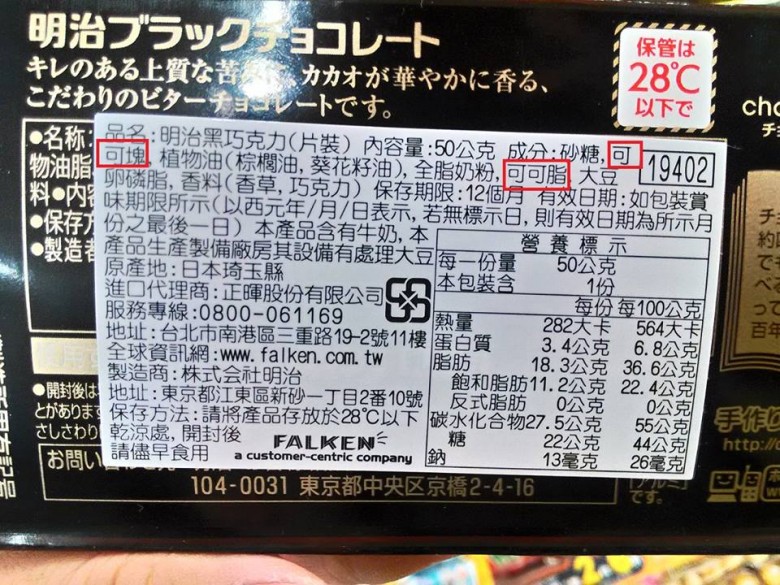
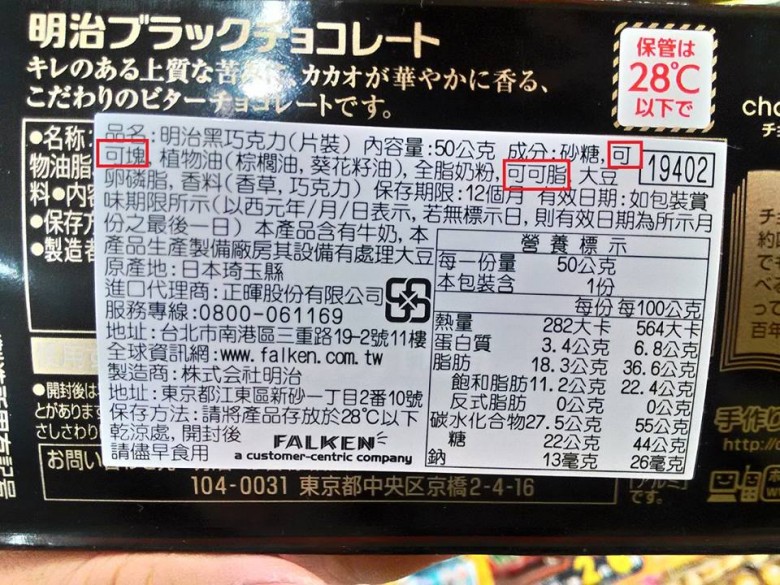
Compound chocolate: replacing cocoa butter with "hydrogenated palm oil"
In addition, the place of origin of cocoa beans is also key to influencing chocolate flavor and quality. Gu Zhengmu, general manager of Hongjie Foods, said that cocoa beans with stable yield and quality mostly come from the Ghana and Cote d'Ivoire region. If a product wants to highlight its uniqueness, it will select cocoa beans of native varieties from Central and South America, Peru and the Mexico region, but because yields are scarce and the supply chain is unstable, prices are relatively much higher.
Gu Zhengmu pointed out that chocolate made with hydrogenated palm oil instead of cocoa butter is called "non-tempering chocolate" or "compound chocolate" in the industry.
Gu Zhengmu explained that because cocoa butter has a melting point of only 28 degrees (it melts above 28 degrees), for subtropical countries it is much more difficult to store and distribute, so switching to hydrogenated palm oil is a response to the needs of industrialization, and of course the cost is also much cheaper.
FDA: will set the content proportion of "total cocoa solids"
The "total cocoa solids" that the FDA will discuss at a meeting in the middle of the month refers to the combined total of cocoa mass, cocoa butter and cocoa powder. According to current international regulations, including those of the European Union, the Codex Alimentarius Commission (CAC), the UK, Japan, South Korea, the US and the mainland, total cocoa solids account for between 30% and 35% or more by weight.
As for whether it will follow international regulations? Xu Chaokai, a specialist in the FDA's Food Division, said that a consensus must still be formed after discussion at the expert meeting before it can be determined. Once a proportion is decided in the future, operators will be given a one-year buffer period to revise outer packaging labeling.