Chronicles of Land Grabbing in Africa and Europe: La Via Campesina's Taiwan, China Feature (2)
Editor's note:
Over the past two years, friends concerned about agriculture and social movements in Taiwan may be familiar with the issue of excessive expropriation of farmland, but this phenomenon does not occur only in present-day Taiwan; incidents of land grabbing by multinational capital and government-business monopolies are emerging endlessly in many places. The global farmers' organization La Via Campesina will visit Taiwan this weekend. NewsMarket joins hands with the organizers to jointly produce a special feature on La Via Campesina's visit to Taiwan, introducing La Via Campesina's efforts around the world and the wonderful process of its exchange visit to Taiwan.
This series first publishes the translation by the Agricultural Translation Group of the conclusions and report of the 2011 International Conference of Farmers against Land Grabbing, with excerpts published on NewsMarket. The Agricultural Translation Group is composed of a group of volunteer translators from across Taiwan concerned about agriculture, who over the past two months have worked together to translate key documents on American beef and the international farmers' movement. The full translation is published in the handbook to be distributed during the speeches on this La Via Campesina visit to Taiwan. For the full English text download and other articles in this series, please see the links at the end of the article.
——————————————————————————————————————————
The Situation of Land Grabbing in Africa
The common experience faced by the 15 participating organizations is that their countries are all deeply afflicted by land grabbing. Land grabbing is not a new phenomenon. Since the colonial era, most of these countries have experienced land grabbing. In some cases, the colonial-era legal systems have continued in use to this day. The best farmland and water sources have all been taken by investors and speculators.
If distinguished by the dominant actors or specific contexts, land grabbing takes different forms: carried out respectively by the state, by multinational corporations (for the purposes of agrofuels, monoculture cultivation or food production), or by local leaders or village chiefs. We also recognize that within our own families and communities, there are specific mechanisms that lead to land grabbing, such as patriarchal ownership of land, discrimination against young farmers and small farmers (both men and women), and domination by local elites.
There is a consensus that land grabbing has a direct negative impact on small farmers and family farmers, especially on women farmers, who are the main agricultural workforce in these 15 countries. This phenomenon will further threaten the food sovereignty of these countries, because 80% of the local population depends on the food produced by these small farmers for their livelihood.
Testimonies from Various Places
(1) Senegal
In Senegal, we organized strong mobilization to confront the increase in land grabbing in this country (including mining companies, large-scale cultivation of agrofuels, and property titling schemes for urban expansion). In Fanaye, an Italian company (SENETHANOL) sought to obtain land to produce agrofuels. When the local community discovered that they would lose their land and their village, they decided to resist.
After two small farmers were brutally killed (the killers were local elites corrupted and tempted by the project), we organized a large protest in the capital, Dakar. Under pressure, the prime minister finally suspended the project. However, we know that the government has already received the money, and we fear that the company will obtain land elsewhere.
(2) Burkina Faso
Since 2000, the number and area of land grabs have increased, and investment and speculation have grown ever more. In Burkina Faso, political discourse encourages this kind of investment. The state signs contracts with investors. Who are these investors? In specific cases, they are new investors opening markets and specializing in seeds and food production. These innovations come from large corporations. The investors do not cooperate with small farmers. Small farmers and family farmers say: the investors set up a lot of infrastructure; they just come to build airports. Land grabbing is also linked to the issue of water: the best irrigated land is being stripped away.
Some of these areas have fallen into conflict. A survey conducted by our organization in 2010 showed that if the situation continues, within ten years small farmers will no longer have land. Small farmers and others working in rural areas will be forced to migrate. In 2011, we organized awareness raising campaigns in different areas affected by land grabbing, to push for an end to land grabbing and to encourage small farmers and family farmers to resist investors.
(Photo: "The land grabbing dispute with our mayor began in 2007. Our land was inherited, yet they gave the land to others. They called the police. Hundreds of people were beaten. Elderly people suffered imprisonment. This is the problem we face. Without this organization helping our resistance, we would lose hope. We welcome all help from these organizations." — a participant from Burkina Faso)
The Situation of Land Grabbing in Europe
European countries generally adopt the same agricultural policy. This policy came from the need for market regulation during Europe's post-World War II reconstruction. It has had a profound impact on farms and quickly led to overproduction, which further gave rise to an agricultural production model subsidizing exports with public expenditure. Large-scale farms have caused small farms to gradually disappear. Europe in fact relies on exporting soybeans (their price advantage) to sustain its livestock industry. Everywhere, we especially see the concentration of land and the disappearance of small farms. Every year, 70,000 hectares of arable land are absorbed by infrastructure and other projects.
In Eastern Europe, many men and women still work in agriculture. This is the opposite of Western Europe, where those engaged in agriculture make up only a tiny fraction of the working population.
Land grabbing often occurs in Eastern Europe. Tens of thousands of hectares of land have been seized. Urban development has invaded our land. Spain's coast has been urbanized. In France, every year 17,000 hectares of agricultural production areas are designated for infrastructure development. Land has become a commodity across the entire continent. The most common land tenure system is private property, and its price is very high. Young people who want to become farmers on their own or set up small-scale farms encounter considerable obstacles. The privatization of land is driving speculation. Rural communities are disappearing.
The population of the French countryside is gradually declining, and industrialized agriculture is destroying the environment. For example, in Brittany the water has been polluted by pesticides and by the industrial-style pig farming industry.
40 years ago, in Larzac (France), we tried to oppose the establishment of a military camp. After ten years of peaceful resistance, we won that battle. The idea we defended is: land can, at a price affordable to ordinary people, likewise contribute to national development. What we learned in this struggle is that we must protect land for the next generation. Private property rights do not have this effect. On the contrary, they tend to let land accumulate in the hands of a few large landowners. This leads to the death of French small farmers.
In Europe, the phenomenon of land expropriation must be approached from a different angle. However, it is very clear that we are losing agricultural farmland, and at the same time we must find other land to feed the population. Civil society organizations closely support our struggle to maintain small-scale sustainable family farming production. As a group with few people, we are committed to building alliances and uniting all forces.
- 2012/5/26-30The global grassroots farmers' organization La Via Campesina(La Via Campesina) visits Taiwan, and everyone is invited to come participate and exchange
For the itinerary and exchange forums, please see the link - 2011 International FarmersAgainst Land Grabbing Conference conclusions and report, full English text download
Series articles:
(Note 1) The Kolongo Forum: Mali's first small farmers' forum against land dispossession, organized in November 2010 by various groups including the National Coordination of Peasant Organizations of Mali and La Via Campesina.
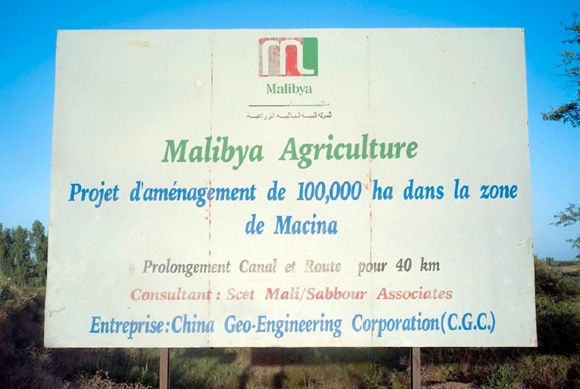
(Note 2) This is a 40-kilometer-long canal used to irrigate 100,000 hectares of land for the Malibya project in the Office du Niger area.