Taipei City Department of Health: Nanqiao Chemical heavily fined 30 million for evading food inspection. Food and Drug Administration: Confirmed that Nanqiao Chemical's edible beef tallow customs declaration was mistakenly listed as industrial use.
Text by Upstream and Downstream reporters Wang Wen-hao and special correspondent Huang Pei-yun
The Taipei City Department of Health today determined that Namchow Chemical Industrial imported edible oils and fats such as beef tallow, coconut oil and palm kernel oil under the guise of industrial-grade declaration, without completing the required food import inspection registration, and imposed a fine of 30 million yuan on the grounds of violating Article 30 of the Act Governing Food Safety and Sanitation.
Chiu Hsiu-yi, director of the Food and Drug Division of the Taipei City Department of Health, said the 30 million yuan fine was imposed because out of a total of 49 batches of edible oils and fats imported by Namchow Chemical Industrial since the 102nd year of the Republic of China, comprising 12 batches of beef tallow from Australia, 34 batches of coconut oil from the Philippines and 3 batches of palm kernel oil, 30 batches were declared and imported for industrial use; therefore, each act was penalized separately and the amounts were accumulated, which is why the figure is so high.



Asked why edible oils and fats had been declared for inspection as industrial oils and fats, Lee Kan-wen, executive vice president of the Namchow Chemical Industrial Group, explained that the 5 batches of imported beef tallow declared as industrial oil were identical to edible beef tallow in both source and quality, and the only difference was that they had not undergone food inspection declaration to obtain an import permit. These problems were indeed discovered during this factory inspection, and Namchow will hold the internal employees responsible for the customs declaration negligence accountable.
Lee Kan-wen said Grade 1 beef tallow is rendered from beef fat and is fit for human consumption; Grade 2 beef tallow is rendered from internal organs and is not fit for human consumption. In addition to Grade 1 beef tallow, Namchow also imported 6 batches of Grade 2 beef tallow this year for use in detergents, but the two types of beef tallow are certainly managed in separate tanks and separate pipelines, and there is absolutely no mixing.
As for the coconut oil, Lee Kan-wen explained that commercially there is no distinction as to whether it is for industrial use, because after vegetable oils and fats are extracted from coconuts and imported, if they are to be used as edible oil they must undergo further refining, whereas if they are to be used for industrial purposes they can be used without refining.
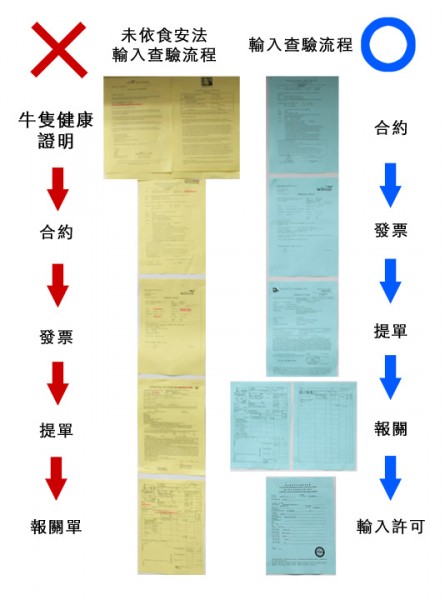
Although Lee Kan-wen explained the public's doubts about Namchow's oil products at the Taipei City Department of Health press conference in the morning, Hsu Ming-neng, political deputy minister of the Ministry of Health and Welfare, presented documents again at the Legislative Yuan this afternoon, alleging that when Namchow Chemical Industrial placed its purchase order with Australia in the first place, it did so under the name of industrial oil, and that after the product name field on the Australian certificate of origin it was also marked as for industrial use. Finally, when this batch of oil products entered Taiwan for customs declaration, it was also marked as non-edible and for industrial use.
Hsu Ming-neng said that because domestically imported foods, if marked as F for food use, must all undergo food-grade inspection by the Ministry of Health and Welfare before they can enter, but these 30 batches of Namchow oil products entered customs as industrial oil, which amounted to evading the inspection process that food-grade oil products should undergo.
Chiang Yu-mei, acting director-general of the Food and Drug Administration, also said that the Australian Office in Taiwan had sent a telegram confirming that this batch of Namchow oil products labeled as industrial oil was a mislabeling and could be used by people after refining. After reconfirming with the Australian Department of Agriculture, the Food and Drug Administration obtained an official Australian statement in the afternoon confirming that the edible beef tallow imported by Namchow had been mislabeled as industrial oil, and confirming that it could be consumed after refining.
At present, the Food and Drug Administration has forwarded the emailed statement to the Taoyuan County Health Bureau. As for when the 123 food items that use Namchow oils and fats and have been preventively removed from shelves can be restored to the shelves, Chiang Yu-mei said this will be handled by the Taoyuan County Health Bureau.