Three Lessons from American Beef for College Students (2): Prices, Food Security and International Rivalry
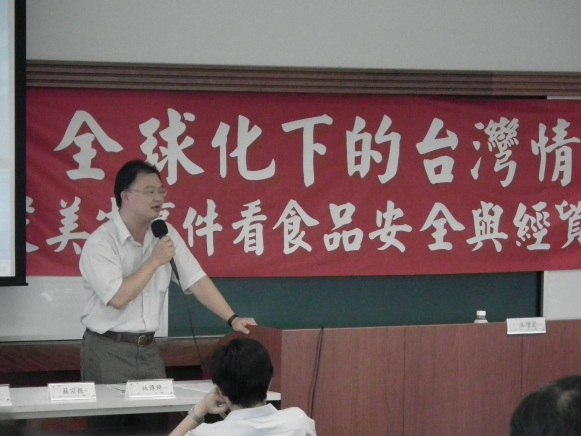
Editor's note: Among the groups following the US beef issue, a group of active young figures has appeared recently: the "Taiwan Youth Alliance Against US Beef," made up of university students from various schools. On May 12, the National Taiwan University Student Association, the Citizen Congress Watch, and other student and civil groups jointly held the forum "Taiwan's Situation under Globalization: Food Safety and Trade Relations Seen through the US Beef Incident," which opened at the NTU Wanzai Hall. The forum was divided into three themes: food safety and public health, food security and industrial impact, and the international economy and free trade. Experts and scholars from various fields, as well as government representatives, were invited to speak.
For the "Food Security and Industrial Impact" section, Section Chief Su Zong-zhen and Section Chief Lin Chuan-qi of the Agriculture and Food Agency, and Section Chief Fu Xue-li of the Bureau of Animal and Plant Health Inspection and Quarantine were invited, while on the civil scholar side, Assistant Professor Cai Pei-hui of the Graduate Institute of Social Development at Shih Hsin University was invited to join the discussion. It was hoped that through dialogue between the two sides, attendees could understand the impact of the US beef incident on Taiwan's food industry.
----------------------------------------------------------------
Text / Jiang Jun-ru, Taiwan Youth Alliance Against US Beef
Safeguarding food security, Agriculture and Food Agency: "2020 to reach a food self-sufficiency rate of 40%"
Section Chief Su said outright: "Food security is an important current issue," and food is not only the rice or flour that citizens eat in daily life; feed crops such as corn are also food in a broad sense. Today, citizens' food consumption is dominated by grains, among which rice consumption has declined year by year, while flour has gradually risen from 20 kg per person per year in the 1950s to nearly 40 kg per person per year in the 99th year of the Republic of China, getting ever closer to citizens' rice consumption.
Therefore, regarding the issue of food security, the government's efforts are directed in two ways. First: how to increase rice consumption; second, how to respond to the large imports of soybeans, wheat and feed corn. Section Chief Su admitted frankly: "There is a necessity for rice fallowing," because citizens' demand for rice is decreasing year by year; even if rice production is increased, it will cause a situation of oversupply. Therefore, in consideration of rice prices and farmers' income, fallowing must be carried out. In addition, fallowing is also beneficial for restoring soil fertility. Thus, the way to solve the fallowing problem lies in raising the food self-sufficiency rate, and the government currently plans to reach a food self-sufficiency rate of 40% by 2020.
The planning directions for raising the food self-sufficiency rate include two aspects: increasing domestic production and consumption, and reducing the quantity of food imports. For example, the Agriculture and Food Agency is currently continuing to develop "rice flour," hoping to replace wheat flour and find a way to increase the use of rice without changing citizens' consumption habits. Last year, the government also promoted "eat one more bite of rice per person per day" to raise the food self-sufficiency rate. Section Chief Lin added: "Rice is the most important domestic staple food, and it is also the only domestically grown crop for which a safe stockpile has been set." Our country's food security standard is a three-month reserve of rice consumption; together with private stocks, if an international food crisis occurs, domestic rice supply will not be in short supply. The government places great importance on safeguarding food security. In addition to planning to reach a food self-sufficiency rate of 40% by 2020, it also stated that it will conduct surveys of farmland and agricultural water resources as soon as possible, and carry out sufficient inter-ministerial communication on the national security issue of food security.
 (Cai Pei-hui, spokesperson of the Taiwan Rural Front and assistant professor at the Graduate Institute of Social Development, Shih Hsin University)
Free trade is unequal trade
Regarding the government's promotion of "importing US beef for an FTA," Cai Pei-hui asked in return: "Is Taiwan's trade being obstructed?" Taiwan itself is a free-trade country with no room to retreat, so that today its food self-sufficiency rate is only 32%. Taiwan has continuously made concessions on trade, sacrificing agricultural production in the past, and now handing over the health of the people of Taiwan. The government keeps citing neighboring South Korea as an example, but South Korean civil groups estimate that after signing the FTA, agricultural losses exceeded 30%. If Taiwan signs an FTA, it is estimated to lose 10 billion per year, affecting everyone living in Taiwan.
Moreover, the essence of free trade is not equal. Since contracting parties cannot decide trade matters unilaterally, if an FTA is signed, and problems arise with US beef in the future, Taiwan will not be able to unilaterally refuse imports of US beef. So-called "economic and trade liberalization" is in fact the expansion of economic colonization. Is the government prepared for the various impacts caused by free trade agreements? In fact, the government is completely unprepared, and has repeatedly made blind concessions. TIFA has still not resumed talks, and yet Taiwan is being asked to pay the price of opening up to US beef just to resume talks.
Hoping for transparent government information and continued dialogue with the public.
"We are open enough on agricultural products; there is not much need to open further." Cai Pei-hui pointed out that agriculture is not a purely market-economy industry; it also has social functions and public value. We can use agriculture to create industrial vitality, but we cannot hope that opening trade in agricultural products can accelerate industrial expansion. The era of sacrificing agriculture to fully help industrial development is over, and we can no longer achieve rapid industrial development by opening trade in agricultural products.
Facing the challenge of US beef, the government can do many things, rather than simply accepting it and then turning back to soothe the people at home. What Taiwan needs is transformation, not soothing subsidies. For example, whether domestic livestock production can use local feed (such as sweet potato) and reduce imports of feed corn, all of this is worth evaluation and study by the relevant government departments. The Council of Agriculture should muster the courage and strength to stand with the agricultural sector, and need not necessarily submit to the entire mindset of economic and trade expansion. Finally, it is hoped that the government can, on the premise of transparent information, show sincerity and continue to dialogue with the public. The people are not entirely opposed to the government, but hope the government can do well, and hope the Council of Agriculture can hold the bottom line and protect Taiwan's agriculture and the interests of all the people of the country.