Environmental Protection Administration: Air pollution indicators have dropped significantly over the past decade; Chuang Ping-chieh: No research or regulation on high-toxicity pollution affecting factories and residents
Air pollution fees have been collected for 22 years, yet air quality has not improved? Outsiders question whether the government has actively addressed the air pollution problem. The Environmental Protection Administration (EPA) held an air pollution press conference today (the 16th). Deputy Administrator Jan Shun-gui stated that over the past 10 years overall air pollution has improved considerably; apart from occasional short-term rises in air pollution indicators, overall air pollution indicators have declined, and he even declared that in 2019 fine particulate matter (PM2.5) must fall to 18 micrograms.
Juang Bing-jie, a professor in the Department of Environmental Engineering at National Chung Hsing University, stated that the most direct way for the public to observe air pollution is whether they can see a blue sky; PM2.5 must reach 10-15 micrograms for the public to clearly see improvement. In addition, residents living near factories suffer serious pollution from highly toxic substances, such as heavy metals and dioxins, which cause great harm to the human body, yet the government has not conducted further research and control on data for such highly toxic substances, so local residents naturally feel nothing about the policy.
EPA: All air pollution indices have clearly declined, PM2.5 has already dropped to 20 micrograms
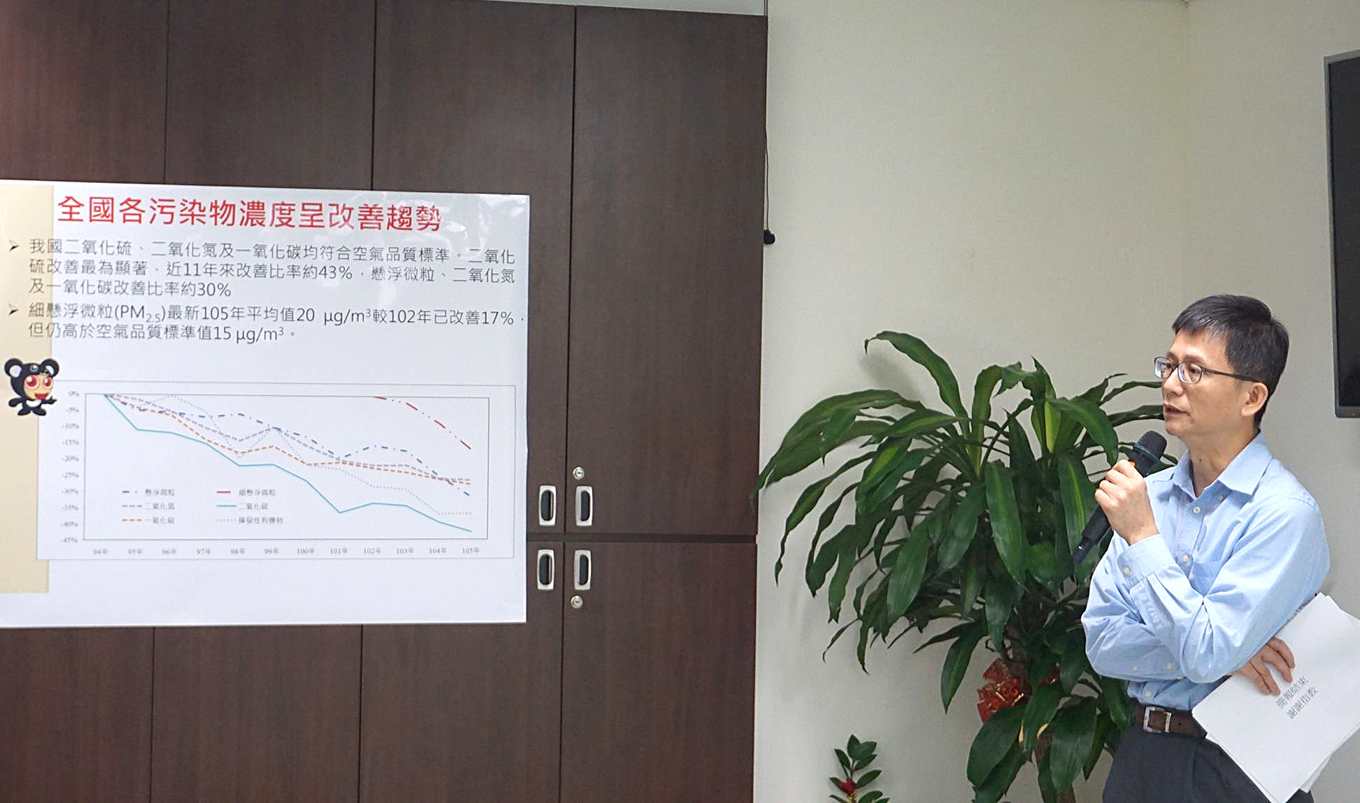
Tsai Hung-te, Director-General of the Department of Air Quality Protection and Noise Control, stated that from 2005 to 2016 all air pollution indices in Taiwan, China declined clearly. According to nationwide air quality monitoring results over the years, sulfur dioxide fell from 5.2 ppb to 3.0 ppb; nitrogen dioxide fell from 18.5 ppb to 13.5 ppb; suspended particulates fell from 63.1 micrograms to 42.9 micrograms. Fine particulate matter (PM2.5) also fell from 24 micrograms in 2013 to 20 micrograms. The EPA also stated that the 2019 target for PM2.5 is to fall to 18 micrograms.
Looking at the new Air Quality Index (AQI), the proportion of station-days reaching the level of unhealthy for sensitive groups or above (AQI>100) also fell from 26.2% in 103 (ROC year), to 17.3% by the end of September this year.
On the ozone index, Chang Shun-chin, Director-General of the Department of Environmental Monitoring and Information Management, stated that comparing 1994 to 1998 with 2012 to 2016, the number of days with ozone concentration greater than 120 ppb fell from 232 days to 69 days, a clear improvement. However, Chang Shun-chin also admitted that because nitrogen oxides in the air have decreased, it is difficult to destroy ozone, and ozone combines with other pollutants in the air, causing ozone to remain in the air for a long time, so that the ozone 8-hour index is higher than in the past; but in fact, in terms of ozone concentration, it has already declined considerably compared with previous years.