A second-class protected species, the pheasant-tailed jacana, appears gliding on the water, adding a new visitor to the Xinnan Tiandong rice fields
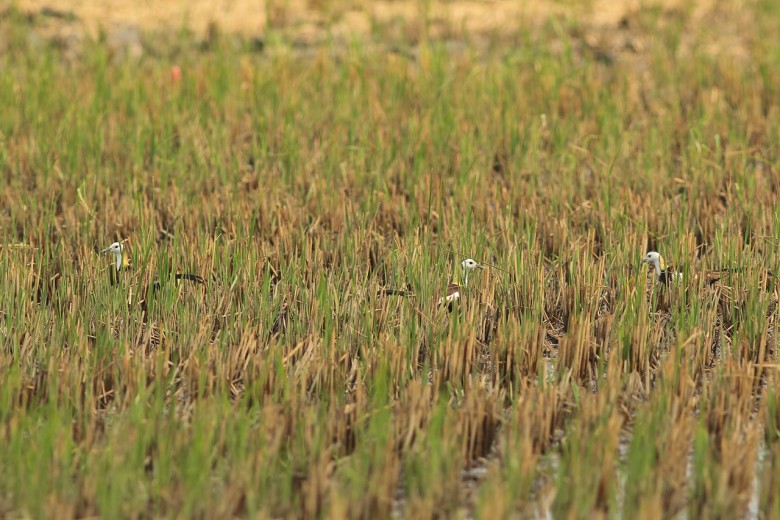
To preserve the vast stretches of contiguous paddy fields and the waterbird habitat of Xinnan Village in Zhuangwei Township, Yilan County, Yilan native Lin Zhe-an last year persuaded local veteran farmers to reduce their use of pesticides, creating "Xinnan Tiandong Rice," a model of symbiosis between ecology and agriculture. This year, 3 more farmers have answered the call and joined in, expanding the area of friendly farming from 2.3 jia to 4.7 jia. Unexpectedly, after the recent harvest of large stretches of golden rice ears, the "pheasant-tailed jacana," announced by the Council of Agriculture as a Category II protected animal, made an elegant appearance, turning a new page in Xinnan Village's waterbird records.
Development destroyed habitat; Taiwan's pheasant-tailed jacanas once numbered only 40
In earlier years, Taiwan's pheasant-tailed jacana population was widely distributed across wetlands island-wide, but over the past few decades, as development brought habitat destruction, the pheasant-tailed jacana became an endangered bird. The surviving population of only about 30 to 40 birds was mainly concentrated in the water caltrop fields of the plain area between the Bazhang River and the Zengwen River in Tainan. The Council of Agriculture therefore announced the pheasant-tailed jacana as a Category II protected animal in 1989.
In the 1980s to 1990s, the high-speed rail planned by the Bureau of High Speed Rail under the Ministry of Transportation and Communications was expected to pass through the pheasant-tailed jacana's only remaining important habitat in Tainan. It therefore funded the lease of 15 hectares of Taiwan Sugar Corporation land in Guantian as a "pheasant-tailed jacana breeding and recovery area." Civil environmental groups then formed a committee to assist with implementation. After 14 years of effort, the Guantian pheasant-tailed jacana population increased year by year to 400, and the recovery area was renamed the current "Tainan Pheasant-tailed Jacana Ecological Education Park."
Pheasant-tailed jacanas appear in Xinnan paddy fields, adding habitat diversity
After Lin Zhe-an discovered traces of 3 pheasant-tailed jacanas in the Xinnan fields on the 13th, he was greatly surprised. After all, the Xinnan paddy fields had previously been mainly an important habitat for waterbirds such as the little ringed plover, common moorhen, and watercock. Now the protected pheasant-tailed jacana, long known by the beautiful name "wave-treading fairy," had quietly appeared. He said excitedly: "Farmers now have one more bird species observation to share."
However, this is actually not the first record of pheasant-tailed jacanas appearing in the Yilan area. At the 52-jia wetland in Lize Community, Wujie Township, because water caltrops are grown using friendly farming methods, 3 to 5 pheasant-tailed jacanas have been attracted to breed here in recent years. According to bird records from the Yilan County Wild Bird Society, over the past 10 years pheasant-tailed jacanas have also appeared at the Lanyang River mouth, Yuanshan, Dongshan, Wundi, and other places.
In response, Lin Zhe-an, who has a background from the Graduate Institute of Environmental Education, admitted frankly that because ecological observation has only lasted 1 to 2 years, the time is still too short to prove a direct connection between the appearance of pheasant-tailed jacanas and friendly farming. However, this year the number of farming friends participating in Tiandong Rice increased by 3 people, and the area more than doubled. Pesticide use also changed from halved use last year to no use at all. "Farmers weed by hand, and even let grass grow on the field ridges so waterbirds can nest. These changes all make more waterbirds willing to stop and hide."

Farmers shift to friendly farming; pheasant-tailed jacanas fare better
Li Wen-zhen, an environmental education specialist at the Tainan Pheasant-tailed Jacana Education Park, pointed out that pheasant-tailed jacanas like to perch on floating-leaf plants such as water caltrops. Every winter, when the water caltrops in Guantian wither, the pheasant-tailed jacanas go into the fields to eat seeds or insects. Therefore, if farmers adopt friendly farming methods, increasing the number of frogs and insects in the fields and raising biodiversity, then when the pheasant-tailed jacanas feel there is enough food in the area, they will easily "pass through" shortly after rice is transplanted and after harvest is completed.
Li Wen-zhen said that in 2010, when pheasant-tailed jacanas were being bred and recovered in Guantian, Tainan, some nearby farmers, to prevent rice grain from being pecked by birds, soaked it in highly toxic pesticides such as carbofuran, causing a large number of pheasant-tailed jacanas to die from poisoning. This shows that if farmers can provide friendly farming space, it is definitely helpful for the survival of birds.