Hsinchu County's Non-GMO Nutritious School Lunch Program Continues; Taiwan Knowledge Park to Offer Land-for-Land Exchange to Farmers
"From Agricultural Safety to Food Safety, Asking the County and City Mayors" series, stop 2: we come to Hsinchu County. Hsinchu County has thirteen townships, stretching from the coast to the mountains, with a diverse range of crops, including rice, vegetables, mesona (Platostoma palustre), persimmons, citrus and tea.
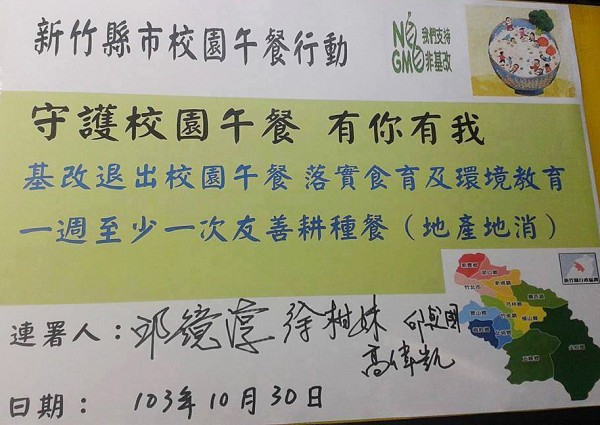
In this year's Hsinchu County magistrate election, the incumbent magistrate, Chiu Ching-chun, won re-election. Before the election he put forward policies on school lunches, declaring that school lunches would use non-GMO ingredients and locally sourced ingredients. Chiu Ching-chun stressed that after taking office he would set up a food education committee at the county government level, to harness cross-departmental strength to promote the use of local ingredients in school lunches. Hsinchu County currently plans to use local ingredients in the nutritional lunches of six townships and fifteen schools; through coordination between the Education Department and the Agriculture Department, it will assess the supply and demand situation for schools using local ingredients and which implementation steps need adjustment.
Hsinchu County has taken the initiative to plan and gradually push forward a reform programme for school nutritional lunches, but its planning for food and agriculture education appears relatively scattered, and at present it still relies mainly on cooperating with other bodies to promote it.
In recent years, many cases of farmland expropriation around Taiwan have drawn public attention, and the Hsinchu County Taiwan Knowledge Park project (formerly the Puyu Project) is one of them. Chiu Ching-chun said the Taiwan Knowledge Park project has a certain public benefit and necessity, and has obtained the consent of more than 90 percent of the landowners, and will offer a land-for-land arrangement so that farmers who wish to continue farming have land to cultivate.
On cases such as farmland expropriation and water source pollution, Chiu Ching-chun believes all sides need to work together with wisdom to resolve them. He said that in the case of industrial wastewater discharged by AU Optronics and Chunghwa Picture Tubes into Xiaoli Creek in Xinpu Township, Hsinchu County, the companies have already promised to achieve the goal of zero wastewater discharge by the end of next year, and the county government will continue to supervise.
Below is a summary of an exclusive interview with Hsinchu County Magistrate Chiu Ching-chun by a reporter from News & Market.
Implement non-GMO ingredients in school lunches within four years; nutritional lunches to remain free
Q: Before the election you signed the pledge promoted by the Homemakers United Foundation on "non-GMO ingredients for school lunches", and the Education Department also issued a notice asking schools to use non-GMO ingredients as far as possible. How is the county currently planning to fulfil this commitment?
A: Hsinchu County has one hundred and seventeen primary and secondary schools, and within four years all schools are expected to use non-GMO ingredients in their nutritional lunches. Last month we already sent a notice to schools asking them to avoid using genetically modified foods, and currently twenty-three schools use non-GMO soy products in their lunch ingredients.
However, fulfilling the commitment to use non-GMO ingredients in school lunches cannot be done in one step. We will push forward gradually, mainly because of several problems. Schools have told us that non-GMO soy products have no inspection labels, are more expensive, and supplies are not necessarily sufficient; these problems all need to be overcome step by step.
Q: Nutritional lunches in Hsinchu County's primary and secondary schools are entirely free, which benefits many disadvantaged families, but vendors may use poorer ingredients because the meal fee is too low. Will the county government adjust the free nutritional lunch system?
A: Hsinchu County's free nutritional lunch policy benefits more than fifty thousand primary and secondary school students. The cost is 35 yuan per meal for junior high school students and 32 yuan per person for primary school students. The menus we provide are reviewed for each school by the county government's nineteen nutritionists, in line with the Ministry of Education's "School Lunch Food Content and Nutrition Standards", ensuring that schoolchildren get enough nutrition at lunch, with three dishes and one soup every day, fresh milk supplied at least twice a month, and fruit supplied at least once a week.
During this county magistrate election, one candidate, Mr Cheng Yung-chin, proposed a policy of increasing the budget by ten dollars per student, which would add 100 million to the nutritional lunch budget every year. I think nutritional lunches are not a question of how much money is added, but a question of whether the ingredients are safe and nutritious. Even if you increase the budget today, if you buy problematic ingredients it is useless.
Therefore, we attach great importance to the food safety of nutritional lunches and will carry out strict checks. We require the county government's nutritionist team to strengthen visits to schools' nutritional lunches, visiting each school at least once every semester, and to cooperate with the Health Bureau in joint inspections and random testing of ingredients.
Hsinchu County is also participating in the Ministry of Education's ingredient registration platform, a system expected to go online next February. Every school must upload the daily ingredient details and supplier list to the platform, making lunch information more transparent. In the past Hsinchu County also put ingredient information online, so you could see the dishes and ingredients; the food cloud system going online next February adds the ingredient supplier component, which helps trace the source of ingredients in real time. The ingredients Hsinchu County provides to schoolchildren must stand up to scrutiny and cannot be slipshod. In addition, we also plan to invite parents to supervise the kitchen, to improve lunch quality together.
 AU Optronics and Chunghwa Picture Tubes have long polluted Xiaoli Creek (photo provided by the Citizens of the Earth Foundation)
Q: In the case of industrial wastewater discharged by AU Optronics and Chunghwa Picture Tubes into Xiaoli Creek in Xinpu, the Environmental Protection Administration coordinated with the companies and it is expected that the goal of zero wastewater discharge will be completed before 31 December 2015. What supervision plans does the Hsinchu County Government have for this?
A: In the case of industrial wastewater discharged into Xiaoli Creek, after years of effort and everyone resolving it with wisdom, we have already reached an agreement with AU Optronics, Chunghwa Picture Tubes and the Taoyuan County Government, confirming that the goal of "full wastewater recycling and zero discharge" must be completed before 30 December next year.
To ensure that AU Optronics and Chunghwa Picture Tubes can fulfil their commitment, the Hsinchu County Government, the Taoyuan County Government and the councils of the two counties have jointly set up the "Joint Supervision Group for the Full Wastewater Recycling and Zero Discharge Engineering Execution of AU Optronics and Chunghwa Picture Tubes", to regularly review the progress of the two plants' works.
On 18 September this year, we held the fifth meeting of the supervision group at the Aspire Convention Hall in the Longtan Aspire Park, where an agreement was reached asking AU Optronics and Chunghwa Picture Tubes to complete the full recycling and zero discharge engineering for process wastewater before 31 December 2015, and to carry out closure of the wastewater outfall before 1 January 2015. If by then AU Optronics and Chunghwa Picture Tubes do not carry out the pipe sealing, it will be executed by the Taoyuan County Government, with supervision group members invited to attend as witnesses.
Q: If there are future cases of farmland expropriation or water source pollution in Hsinchu County, how do you plan to handle them?
A: On the farmland side, we will join with relevant bodies to promote a plan to separate irrigation and drainage, reducing the risk of farmland contamination. Take Jiadong Creek in Xinfeng Township as an example: farmland in the two villages of Shangkeng and Fengkeng had previously been reported to have problems such as rice leaves turning black and low grain yields, suspected to be affected by discharge water from the Xinfeng Industrial Zone. Through our efforts and those of the Irrigation Association, Jiadong Creek also began separating irrigation and drainage last month. In addition, on the water source side, we will also strengthen control measures in water source protection areas and step up water pollution inspections, to ensure water safety.