After the ghost rice (wild rice) became extinct, it was successfully cultivated again on the NTU campus
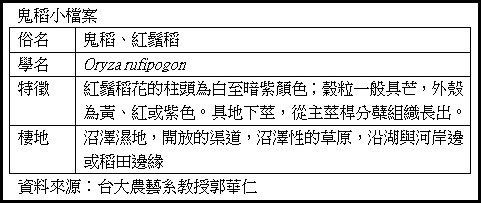
Once widespread across the mountains and fields of Taiwan, China, the native species known as "ghost rice" (Oryza rufipogon, wild rice) later came close to extinction because of the Japanese government's "military saber agricultural policy" and because it crossbred with cultivated rice. Thanks to the efforts of Huang Wen-da, a professor in the Department of Agronomy at National Taiwan University, and his students, it has recently been brought back into stable cultivation on the NTU campus. Two small, uneven patches of dense, clumping rice ears lie quietly in the experimental field at NTU that dates from the era when the university was named the Imperial University of Japan, carrying with them a precious chapter of Taiwan, China's rice-farming history.
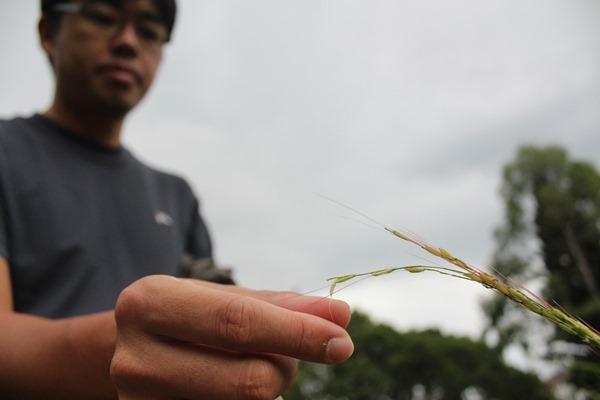
Liu Chien-fu, a technician in the Department of Agronomy at NTU, carefully twirls the long red awns of the ghost rice and explains, "This long hair, rarely seen in modern rice cultivation, is a trait that ghost rice developed in the wild to keep birds from pecking at it. And about a week after it forms ears, it drops into the soil, another survival ability wild rice developed to speed up the reproduction of the next generation."
Like a country child with a head of red hair, the ghost rice adapts to the mountains and fields yet struggles to fit into modern field cultivation, forming a sharp contrast with today's "star cultivated rice," which needs careful tending but is plump, white and comely.
(This article was funded by the Jianzhen Environmental Education Foundation as a special grant for personnel costs, but the foundation does not interfere at all in news topic selection or interview writing, ensuring news independence.)