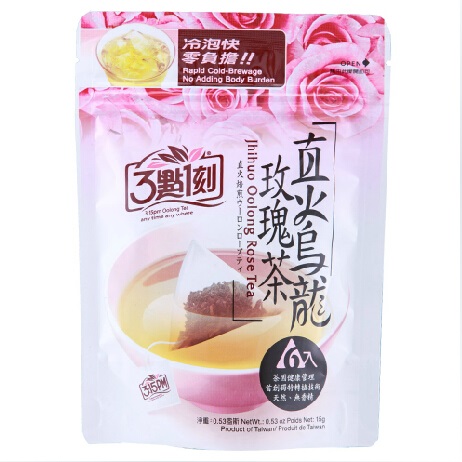
Another flower tea product recalled: 3:15 Direct-Fire Oolong Rose tea found with banned pesticide DDT residue; oolong tea and jasmine tea exceed pesticide limits
After Britain's Blue Rose flower tea was found to contain DDT, a pesticide banned by the United Nations, the Chiayi City Health Bureau tested 17 flower tea products and found that the well-known brand "3:15" also sells a "Direct-Fire Oolong Rose Tea" that contains the pesticide DDT at levels that must not be detected, with residues of o,p’-DDT 0.03ppm and p,p’-DDT 0.08ppm respectively. As for whether the DDT came from the oolong tea or the rose flower tea, the Chiayi City Health Bureau is still investigating.
The Chiayi City Health Bureau sampled 17 flower tea products from beverage shops, supermarkets and traditional Chinese medicine stores within its jurisdiction, and a total of 3 products still failed after re-testing. Among them, the "Direct-Fire Oolong Tea" was purchased from PX Mart, and the manufacturer is Shicheng Industrial Co., Ltd. of Taichung City. Another product also purchased from PX Mart, "T Shijia Oolong Tea / Cold Brew Tea," was also found to contain the pesticide etofenprox at 0.07ppm, which must not be present, and its manufacturer is Juyang Co., Ltd. of New Taipei City.
Yuan Shaoying, Director of the Environmental Sanitation and Toxic Substances Management Division of the Environmental Protection Administration, previously said in an interview with NewsMarket that the United Nations has a "Stockholm Convention" used to regulate which persistent organic pollutants countries should ban. At present, the insecticide DDT is banned globally under this convention, and only Africa and India use it for malaria prevention and control. DDT does not break down easily, and Taiwan has banned it for 26 years since it was announced under the Toxic Substances Control Act; in environmental surveys, DDT can no longer be detected in water bodies.
After the report came out yesterday afternoon, the Chiayi City Health Bureau immediately notified PX Mart, as well as the New Taipei City Health Bureau and Taichung City Health Bureau under whose jurisdictions the non-compliant products fall, and then immediately dispatched inspectors to conduct a full inspection of PX Mart stores in Chiayi City. As of 9 p.m. last night, the operator had voluntarily removed and recalled a total of 20.79 kilograms of non-compliant products.
In addition, an "A Jasmine Flower" sold by a traditional Chinese medicine store was found to contain the pesticide trichlorfon at 0.11 ppm, which must not be present. The Chiayi City Health Bureau pointed out that the operator mistakenly sold non-food-grade jasmine flowers as food-grade jasmine flowers, and when the Health Bureau discovered this during sampling on April 17, it had already sealed and stored a total of 1.53 kilograms. For the above products suspected of violating regulations, a fine of no less than NT$60,000 and no more than NT$200 million may be imposed in accordance with Article 15 of the Act Governing Food Safety and Sanitation.