Three goose farms in Chiayi confirmed with H5N8 avian influenza, 38 poultry farms affected in total
(Last updated 0112, 23:00 evening)
At a press conference this morning (January 12), the Bureau of Animal and Plant Health Inspection and Quarantine said that 14 new poultry farms were confirmed today in the avian influenza outbreak, bringing the total to 38 farms affected. So far 12945 birds have been culled, including 5212 meat geese, 645 breeding geese and 7088 laying ducks.
The bureau said that Yunlin added five breeding goose farms and three meat goose farms, Tainan added one breeding goose farm, Pingtung added three meat goose farms, Changhua added one meat goose farm, and Pingtung added one slaughterhouse, for a total of 38 poultry farms in this wave of avian influenza, with 141050 birds currently being raised.
Chiang Wen-chuan, a section chief of the Council of Agriculture's Department of Animal Industry, said that waterfowl have been more severely affected by the avian influenza outbreak. Goose meat is a niche market in Taiwan, with annual domestic consumption of about 5.5 million birds, mainly eaten in summer. In the past three days, the farm-gate price and wholesale price of goose meat have shown no obvious fluctuation, but the Council of Agriculture will maintain close contact with industry operators to strengthen stability and scheduling on the supply side. As for duck meat, most domestic duck meat is supplied frozen or from stock, and production and sales have not been affected so far. As for preserved eggs, salted eggs and other processed products, which keep for longer, supply is relatively stable.
Regarding the impact of the avian influenza outbreak on people, Chuang Jen-hsiang, deputy director-general of the Ministry of Health and Welfare, said that 234 people connected to poultry farms have been listed for follow-up management. As of this morning, three people have developed mild symptoms, namely nasal congestion, cough and sore throat. All three are poultry farm workers, and the Ministry of Health and Welfare will continue to track the situation.
Chang Shu-hsien, director-general of the Bureau of Animal and Plant Health Inspection and Quarantine, said that no cases of H5N2 or H5N8 affecting humans have been found in Taiwan so far. Poultry farms confirmed to have avian influenza have already been placed under immediate control, with culling and disinfection carried out to ensure the safety of poultry meat after it reaches the market. The public is advised to cook poultry meat and eggs thoroughly before eating.
Pingtung County expands disinfection, to complete disinfection at 811 poultry farms within two days
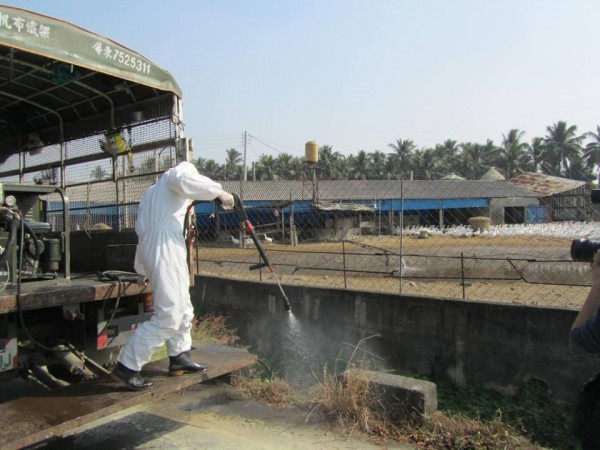
The Pingtung County Government began expanded preventive disinfection work today (1/12), first spraying large poultry and livestock farms in nine townships near the affected farms, and is expected to complete disinfection at 810 poultry farms across Pingtung County within two days. As for small poultry and livestock farms in Pingtung County, the county government urged operators to carry out disinfection on their own.
Recently two poultry farms in Pingtung County were infected with avian influenza. The Dawushan laying hen farm broke out with highly pathogenic H5N2 avian influenza, and all 120000 laying hens there have been culled. The Li Qingchao duck farm in Wandan was confirmed yesterday to be infected with a new type of highly pathogenic H5N2 avian influenza, and the 7000 laying ducks there were culled last night and the site disinfected.
The Pingtung County Government said that the preventive disinfection work currently under way is mainly to protect uninfected poultry farms, that H5N2 poses no direct risk of infecting humans, and that the public need not panic excessively. Pingtung County Magistrate Pan Meng-an said he hopes the Council of Agriculture will clearly propose a culling compensation method and announce compensation standards as soon as possible, so that operators can feel at ease and proactively report any abnormalities found in the poultry they raise.