Is Japanese fermented-feed pig farming feasible in Taiwan, China?
Is raising pigs on food waste feasible? After the foot-and-mouth disease outbreak in 2001, the safety of raising pigs on food waste sparked heated international discussion. Taiwan, China's Council of Agriculture once intended to ban the practice, but because its position differed from that of the Environmental Protection Administration and pig farmers, the two sides coordinated and drew up a set of operating manuals: as long as food waste is properly treated and boiled, the risk of disease can be avoided, and pig farmers can continue raising pigs on food waste.
In recent years the Japanese government's system for raising pigs on fermented feed has been quite effective. Although the Council of Agriculture intended to emulate it, it was constrained by the fact that changing the existing system from pig farmers bidding to purchase it to producers paying fees might stir up social turmoil, so the plan was dropped.
Compared with the Japanese government taking the lead in establishing a system for raising pigs on environmentally friendly liquid feed, most pig farmers in Taiwan, China use imported feed or food waste to raise pigs. Raising pigs on food waste has long existed in society. In 2001 a large-scale foot-and-mouth disease outbreak occurred in the UK, and at the time the World Health Organization and the United States Department of Agriculture both questioned that the culprit causing the outbreak was very likely "food waste." For this reason, in 2005 the Council of Agriculture once intended to ban raising pigs on food waste, triggering dissatisfaction among pig farmers.
Flowchart of food waste for pig farming
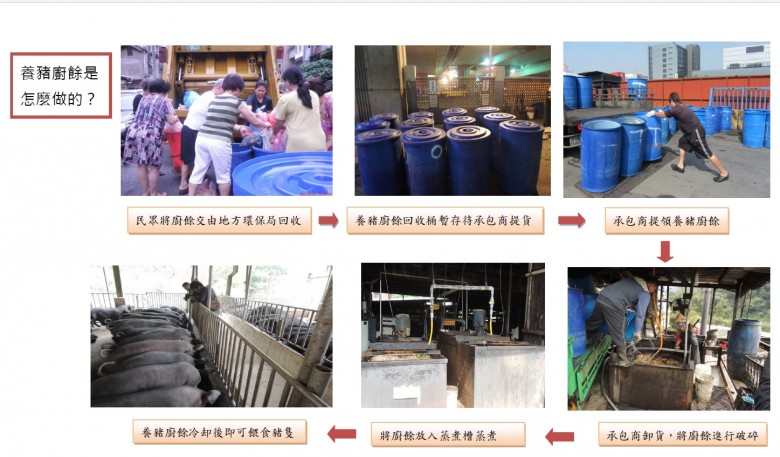
Council of Agriculture: To promote Japanese fermented feed, the overall system must be overhauled
The environmentally friendly liquid feed developed by the Japanese government also recycles food waste left over from what people eat. In addition to high-temperature sterilization, it adds a step of lactic acid fermentation. Huang Ying-hao, director of the Council of Agriculture's Livestock Research Institute, said the role of the fermentation enzymes is mainly to break down large-molecule proteins into amino acids and break down sugars into monosaccharides. This work is equivalent to doing in vitro fermentation for the pigs in advance, so when the pigs eat it their digestive efficiency increases and the manure they excrete is also reduced. Taiwan, China is not without such technology; it is just that farmers have to spend more additional costs.
Yeh Sheng-yen, section chief of the Council of Agriculture's Department of Animal Industry, explained that in the past legislators mentioned Japan's environmentally friendly feed system when questioning in the Legislative Yuan, and the Council of Agriculture also hoped to promote this Japanese system. For this reason it allocated a budget for the Taiwan, China Feed Manufacturers Association to go to Japan for a study tour, and it turned out that this system is paid for by producers, meaning that whether household or business food waste, it must be weighed and paid for to the processing unit. But in Taiwan, China it is pig farmers who bid to purchase it from environmental sanitation teams, and producers do not have to pay. The systems of the two countries are completely opposite. If it were to be changed, it would be an overhaul of overall social habits.
Facing fluctuating international feed prices, plus the gradual shrinking of Taiwan, China's pig farming industry, Chu Chia-ching sighed deeply: pig farmers are not unwilling to improve the quality of pig feed, but with pig farming profits getting thinner and thinner, if the government does not help from within, it is really very difficult.
No hygiene standards for animal diets; experts suggest draining food waste to slow bacterial growth
Some members of the public may wonder: spoiled food waste breeds bacteria, and people cannot eat it, so why can pigs eat it? Yeh Sheng-yen said that in fact neither Japan nor Taiwan, China's current practices can control the freshness of food waste, which is why it is required that food waste must be boiled to sterilize it. But this practice will more or less be condemned by animal welfare advocates. He pointed out that feed or food waste eaten by animals is usually only tested for heavy metals, crude fiber, crude fat and other components, and is not tested for indicators such as E. coli, so in animal diets, whether in Taiwan, China or abroad, there are no hygiene standards.
Hong Chia-mo believes that whether household or business food waste, if it can be well drained before the collection truck arrives, the time before the food waste spoils will be extended, and it will also be more convenient for the pig farmers who buy it. Moreover, draining food waste is very simple: just buy a double-layer bucket with holes in the bottom of the inner layer and it can be done. The government can also place food waste collection buckets in neighborhoods, making food waste recycling more standardized, so as to achieve the best effective reuse of resources.