Japanese and Taiwanese scholars: Proactive monitoring of ducks is needed to prevent the spread and reassortment of avian influenza viruses
In this wave of avian influenza in Taiwan, China, infected ducks show few obvious symptoms. However, Japanese scholar Dr. Hiroshi KIDA stressed yesterday (3/11) at the "2015 International Symposium on Avian Influenza Prevention and Control" held by the Council of Agriculture that ducks carry influenza viruses during migration, and the virus transmission pathway may run in sequence from wild ducks to domestic ducks, pigs and humans. Ho Mei-hsiang, a retired researcher at the Institute of Biomedical Sciences of Academia Sinica, believes that Taiwan, China should proactively monitor ducks to ensure the virus does not spread and reassort along with ducks, so that after getting through this summer, there will not be another avian influenza outbreak next year.
Avian influenza virus transmission pathway may run in sequence from wild ducks to domestic ducks, pigs and humans
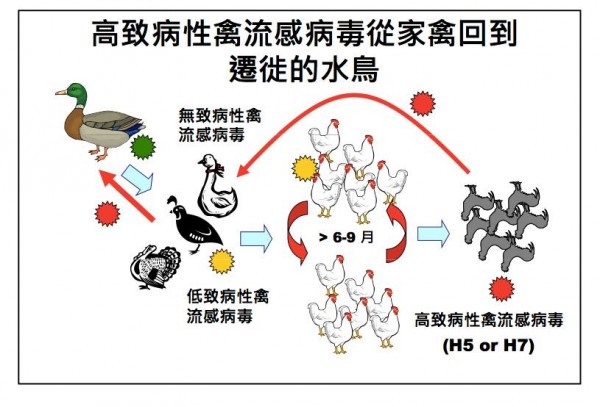
Hiroshi Kida, professor and director of the Research Center for Zoonosis Control at Hokkaido University, said at yesterday's international avian influenza symposium that influenza viruses of every subtype (H1-16, N1-9) have already been isolated from ducks. The virus multiplies in the duck colon and is shed in feces. Although it is initially non-pathogenic, after spreading to chicken flocks and evolving over six to nine months, it may develop into highly pathogenic avian influenza viruses of the H5 or H7 type, which can then be passed back from chickens to waterfowl, causing migratory wild birds to become infected with highly pathogenic avian influenza virus and die.
Taking Mongolia as an example, Kida noted that wild birds such as whooper swans, bar-headed geese and goldeneyes have in the past been found infected with the highly pathogenic H5N1 avian influenza virus. This shows that ducks carry and transmit the virus during migration and overwintering, and wild ducks have become the natural host of type A influenza viruses.
Highly pathogenic avian influenza may spread from birds to humans; human-to-human transmission may not occur, but it could occur through pigs. Kida said pigs readily accept various avian influenza viruses and mammalian influenza viruses, and no subtype (H1-16, N1-9) of influenza virus can be ruled out as a potential candidate strain for a future influenza pandemic. Therefore, the transmission pathway of avian influenza virus may run in sequence from wild ducks to domestic ducks, pigs and humans, causing an influenza pandemic in humans.



Recommended reading