Goldenberry Returns to Its Golden Age, Linmei Community Cooperative Management
Series introduction: In the past, farmers were used to struggling alone in their fields and had relatively little experience with cooperative organizations. In recent years, many outstanding production and marketing groups or cooperatives have appeared in Taiwan, China, supporting one another in seeking a way forward. NewsMarket has specially produced "United Strength - Stories of Farmer Cooperation," reporting one after another on cases of farmer cooperation in various places for everyone's reference. To read the complete series of articles, please click here.
─────────────────────────────────────────────────
Jiaoxi is Taiwan, China's famous hometown of hot springs, but many people do not know that Jiaoxi is also the hometown of kumquats. Eighty percent of Taiwan, China's kumquats are grown in Linmei Village, only 4 km from Jiaoxi town center. This small village nestled against the mountains was once famous in Japan for its kumquats, yet it also faced the plight of low prices hurting farmers and population loss. In recent years, Linmei Village has brought together the community development association, local processing factories, and the Lanyang Kumquat Production Cooperative, which advertises no pesticide residue, to jointly build a kumquat eco-village, and has finally gradually recovered its past golden years. Come to Yilan and taste the sour-sweet history of Linmei Community's kumquat industry.
Industry rises and falls sharply, from gold to fertilizer
Winter in Yilan always seems forgotten by the sun, with endless drizzling rain, but for kumquats, this city where more than half the days of winter are rainy is their most comfortable home. Of Taiwan, China's 350 hectares of kumquat area, more than 90 percent is in Yilan, and among that, Linmei Village in Jiaoxi accounts for more than 80 percent, with annual output of more than 3,000 tonnes, so it is no exaggeration to call it the hometown of kumquats.
The kumquat, native to Jiangxi in China, was introduced to Taiwan, China in the 18th century. Some people also call it jingan. Because it has cough-relieving properties, during the Japanese colonial period it was made into kumquat cakes and exported to Japan, and it even won awards multiple times at Japanese expositions. It was truly an early pride of Taiwan, China.
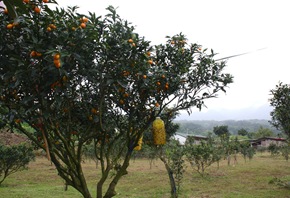
Kumquats like a cold, cool climate and cannot have an overly obvious dry season or high temperatures. More than 86 percent of Linmei Village is mountainous, and the slopes are gentle, with abundant fog and moisture, so the kumquats grown there are sweet and juicy. By the peak period in the 1980s, more than two-thirds of the land in the village was planted with kumquats. Around the Lunar New Year, the whole village was filled with golden-yellow fruit as far as the eye could see.
"Kumquats were everywhere in abundance, and one person could harvest 800 metric tons!" 62-year-old You Shitou recalled Linmei Village's glorious "golden season," and a rare smile appeared on his usually serious face. Born and raised there, he had followed his father in farming since childhood, and three generations of his family all grew kumquats. More than 20 years ago, Taiwan, China's kumquats were once exported to Japan, and their value rose accordingly. At that time, the income from one hectare could reach 1.5 million, making them truly "gold." Some people planted dozens of hectares at a time, and during harvest season the village was packed with one truck after another, with every farmer smiling broadly as they waited for the New Year.
But good times did not last. More than a decade ago, under large-scale rush planting and low-price competition from the Chinese market, kumquat prices plummeted, with the purchase price per kilogram less than 10 yuan. "It was not even worth hiring workers, so we simply let the kumquats rot in the soil as nutrients. It hurt to see, but what could we do?" The golden dream shattered, and to make a living, You Shitou had no choice but to work outside. He shook his head helplessly and said that relying only on growing kumquats was simply impossible to survive on. Most people now farm only as a side job, and young people see no future in it and have no willingness to take over at all.
Some farmers joked that a saying circulated locally: "When one farmer dies, a patch of kumquats dies," which precisely and wryly captures the reality of rural life.
Linmei Community Development Association chairman You Rongchun actively promotes community ecological tours, hoping to combine them with the kumquat industry to turn Linmei into a kumquat eco-village