Food aluminum content on the high side; the Ministry of Health and Welfare moves to set standards
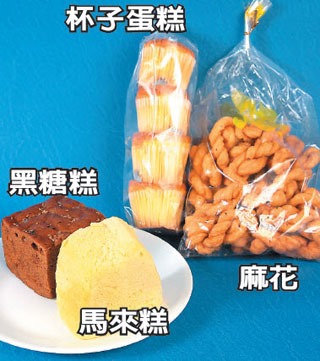
The Consumers' Foundation today released the results of a survey and testing report, having sampled 32 items of commercially sold brown sugar cake, Malay sponge cake, twisted fried dough cake, grass jelly, fen guo (steamed rice cake), liang gao (chilled rice cake), and foods containing aluminum lake colorants, as well as pastry ingredients; among them, 9 items including brown sugar cake, Malay sponge cake, cupcake, potato chips, pancake mix, and baking powder had an aluminum content exceeding 100 ppm (parts per million), but currently there is no standard in the country for residual aluminum levels. The Ministry of Health and Welfare responded that it has already begun drafting standards, with finalization expected by the end of the year at the earliest.
The samples tested by the Consumers' Foundation this time were purchased in May of this year from hypermarkets, chain welfare centers, household goods stores, snack food stores, bakeries, traditional markets, and soy milk shops in the New Taipei City area; among them were 10 items of brown sugar cake, Malay sponge cake, cake-type, and twisted fried dough cake foods; 7 items of grass jelly, fen guo, and liang gao; 11 items of foods containing aluminum lake colorants; and 4 items of pastry ingredients, totaling 32 samples.
Among the 32 samples, 9 samples had an aluminum content exceeding 100 ppm: brown sugar cake, Malay sponge cake, cupcake, potato chips, pancake mix, and baking powder. 2 cupcakes had an aluminum content of 100 to 200 ppm, and another 1 between 200 and 500 ppm; 2 brown sugar cakes and 1 Malay sponge cake had an aluminum content of 200 to 500 ppm. Calculated on the basis of 3 cupcakes at 60 g, the aluminum intake after eating would be about 6 to 30 mg; calculated on the basis of 150 g of brown sugar cake, the aluminum intake after eating would be about 30 to 75 mg.
Among the 4 items of pastry ingredient category, 1 pancake mix had an aluminum content of 200 to 500 ppm; if 120 g of pancake mix is measured out and made into a finished product, the aluminum content would be about 24 to 60 mg. Another 1 baking powder had a content higher than 5,000 ppm, and is usually added at 2 to 3% of the ingredient weight; if 2 g of baking powder is used, the finished product would have an aluminum content of about 10 mg.

The Consumers' Foundation suggests that, given that there are still no standards or regulations for aluminum content in food in the country, when consumers buy and eat processed foods containing leavening agents or baking powder, they should clearly understand whether the product contains aluminum. There are already aluminum-free leavening agents on the market, and it is suggested that manufacturers use aluminum-free formulas to protect consumers' health; manufacturers whose products use aluminum-free leavening agents can note on the label "uses aluminum-free leavening agent" to make it easier for consumers to choose.
The Consumers' Foundation particularly reminds that children with allergic constitutions are on an increasing trend, and quite a lot of research shows that the rise in allergic children may be caused by diet, and the greatest possible factor among these is related to food containing too many additives. Only by maintaining good eating habits, drinking enough boiled water, getting a balanced intake of natural vegetables and fruits, reducing the consumption of refined processed foods, exercising appropriately, and maintaining a normal weight can one actively safeguard one's health.