Stainless steel tableware exceeds manganese limits, consumer protection office finds 29% of samples non-compliant
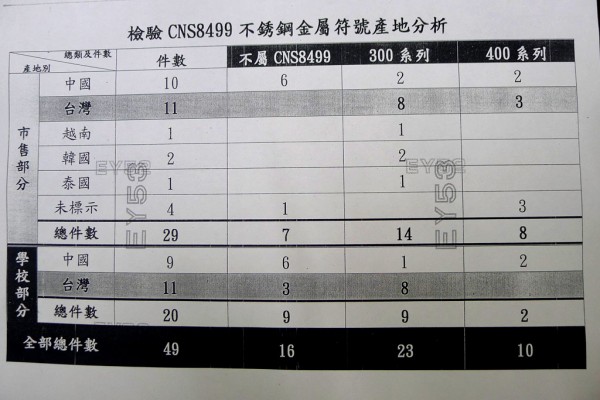
The Consumer Protection Committee of the Executive Yuan today released the test results for 49 stainless steel food containers; the leaching of arsenic, lead and chromium all met standards, but 14 items had a manganese content higher than 10%, exceeding the national standard. However, the current food container hygiene standards of the Ministry of Health and Welfare cover only lead and antimony; manganese has not yet been included in the national standard. The Ministry of Health and Welfare stressed that all the food containers sampled in this inspection met the hygiene standards, and that there should be no problem if the public uses them correctly; no country in the world requires mandatory labeling of the manganese content of food containers. The Consumer Protection Committee suggested that if the public has concerns, they can give priority to buying Taiwan-made food containers with clear labeling.
Manganese content of 14 food containers exceeds 10%
National standard CNS 8499 stipulates that stainless steel can be divided into the 200 series, 300 series, 400 series, etc., according to its metal composition. Wu Guolong, section chief of the First Division of the Bureau of Standards, Metrology and Inspection, pointed out that the manganese content of the 200 series can reach as high as 10%, that of the 300 series is below 2%, and that of the 400 series is below 1%.
 The manganese content of a certain tableware item sold in Changhua exceeds the national standard maximum of 10%
But this guideline is still voluntarily followed. In other words, if a manufacturer does not label it, there is no problem of false labeling, and there is no penalty for not labeling. Lin Lanyu stated that labeling must align with international practice; currently there is no precedent anywhere in the world for mandatory labeling of the steel used in food containers, so it is hoped that manufacturers will voluntarily comply and that the public will support it when purchasing, to build momentum.
Wu Guolong said that the Bureau of Standards, Metrology and Inspection will hold a meeting in July to evaluate the standard for the use of the 304 series in metal food containers, but he stressed that it has not yet been decided whether to cancel it, and representatives from all sectors will be invited to discuss it together.
The Consumer Protection Committee stated that it hopes the Ministry of Health and Welfare can require manufacturers to label mandatorily, so that the public has a basis when purchasing; when the Ministry of Education and the Ministry of National Defense procure metal lunch boxes, they should require the use of the 304 series to protect the rights and interests of students and military personnel.
Choose locally made food containers with complete labeling
Consumer protection official Wang Deming suggested that if the public wants to buy stainless steel food containers, they can give priority to Taiwan-made products, because among the 49 products sampled this time, 22 were Taiwan-made, and only 3 did not conform to CNS 8499, with the rest being 300 series or 400 series; among the 19 products from China, 12 did not conform to CNS 8499.
In addition, if the public is uneasy, they can choose food containers with complete labeling and inspection reports. After buying them and bringing them home, they must be washed with neutral detergent, filled 8-9 parts full with hot water and then rinsed 2 times; do not normally store acidic or salted foods such as lemons, sweet and sour spare ribs, or sauces in them, to avoid leaching of heavy metals. Wash and dry them as soon as possible after use, and if they rust, do not use them again.