Food self-sufficiency rate at 31.4%, a five-year low; imports of vegetables, fruits and meat hit a ten-year high
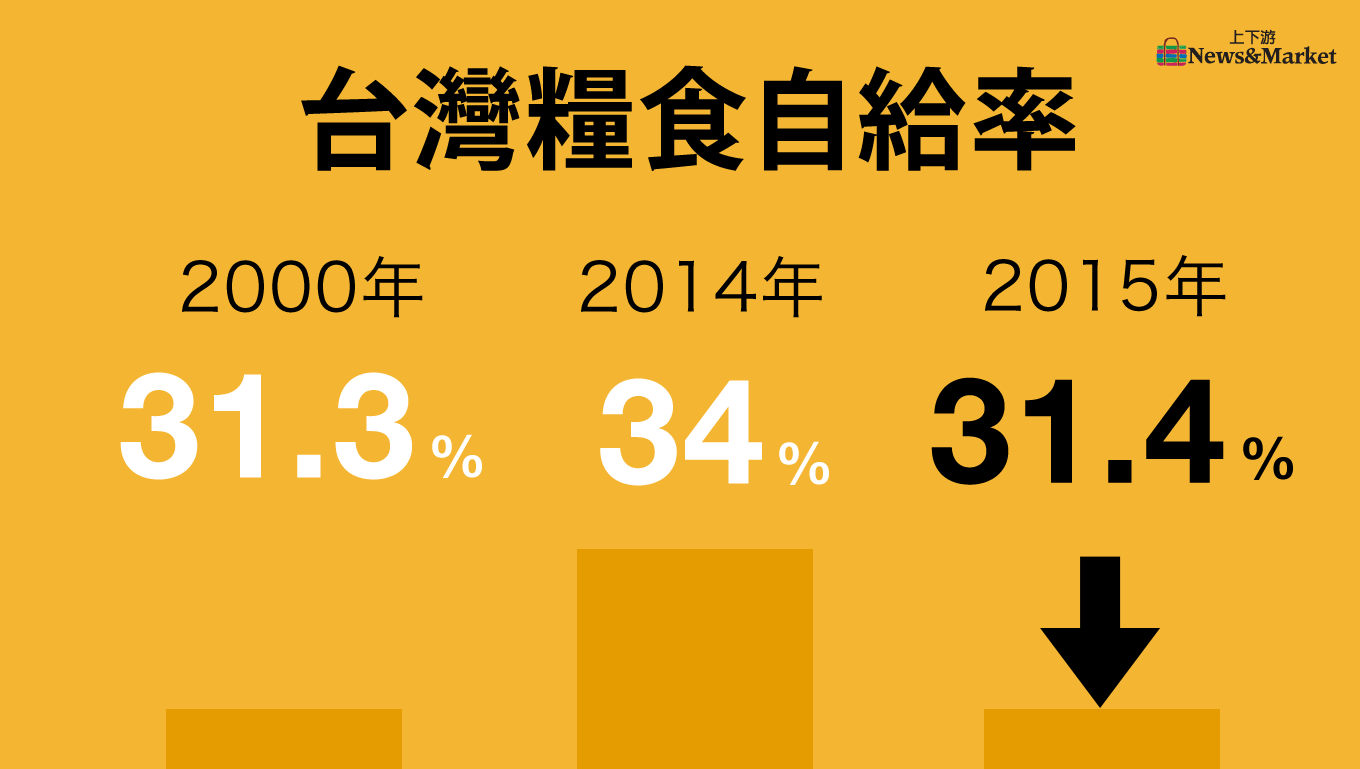
The latest "Food Supply and Demand Annual Report" has been released. The food self-sufficiency rate for 2015 (year 104 of the Republic of China calendar) was 31.4%, falling back to the level of 5 years ago, or even 10 years ago. The overall food production index was 93.3, also a decrease of 3.5% compared with 2014 (year 103).
The Council of Agriculture analyzed the main reasons for last year's decline in the food self-sufficiency rate, tracing them to climate change and the spread of disease. In 2015 (year 104), because water conditions were poor in the first half of the year, some areas carried out suspended irrigation and fallow operations, causing a 9.4% reduction in cereal production. In addition, peanuts, vegetables and fruits were affected by the successive strikes of Typhoon Soudelor and Typhoon Dujuan, so kernels and oilseeds, vegetables, and fruits all declined in output. On the meat side, the avian influenza epidemic in the first half of 2015 also reduced poultry meat production, leaving no choice but to fill the domestic demand gap with imports.
Our country's food self-sufficiency rate hit bottom at 30.2% in 2005 (year 94 of the Republic of China calendar), then climbed slowly and with difficulty. From 2013 (year 102), the fallow land reactivation policy took effect, and in 2014 (year 103) the self-sufficiency rate finally reached 34%. But although farmers worked hard to resume cultivation, they still could not withstand uncooperative weather and troublemaking plagues, and the self-sufficiency rate fell just like that. What is worrying is that nature's power will only become harder and harder to predict, and livestock and poultry epidemics are also hidden time bombs lying in ambush.
A 40% self-sufficiency rate target, a long road ahead
In 2011, the Council of Agriculture once declared that the food self-sufficiency rate should reach 40% by 2020, but the latest data delivered a heavy blow. This year's weather is still extreme, with typhoons striking repeatedly and damaging crops of all kinds. Coarse grains were especially hard hit, and next year's Food Supply and Demand Annual Report figures are likely to be anything but optimistic.
Li Qiuyan stressed that raising the food self-sufficiency rate requires the joint efforts of the public: "Eat domestic products as much as possible, eat more rice, eat primary agricultural products as much as possible, and eat fewer processed products." She pointed out that restaurants often use processed products, and the share of imports in processed products tends to be relatively high. For the sake of health and carbon reduction, "eat in season, eat local" is the golden rule.
Lin Guoqing believes that if food and agriculture education is legislated in the future and local production and local sales are actively promoted, it may help the self-sufficiency rate. However, he also pointed out that Japan has worked hard in this field for many years and can still only barely maintain its self-sufficiency rate at 39%.
Food security is vital to people's livelihoods and is even a national security issue. Under the combined pressure of natural disasters, disease and free trade, how to consolidate food security, avoid losing ground, and take back the food sovereignty that belongs to us requires not only the government to shoulder its responsibility, but also all citizens to support domestic agricultural products more and safeguard the future in their own rice bowls.