Kumquat 'Tamadama' is a famous specialty of Miyazaki, Kyushu, Japan.
This winter, one after another, both of our daughters got sick, and each time they were sick for a long time, cooped up at home for a full week, and they took turns making me their nurse. As their mommy, I had no choice but to take care of them, and I could not lose to the flu and fall sick along with them-otherwise, who would look after them?
To stay healthy, I eat kumquats every day. The kumquats from Miyazaki Prefecture in Kyushu, Japan, are both sweet and tart, and very delicious. As for their medicinal uses, you Chinese probably know a bit more about that, right? They have a cough-suppressing effect, they are very good for the throat, and the peel contains quite a lot of vitamin P. (So there really is a vitamin P!! I did not even know what vitamin P is effective for in us. Let me look it up-oh, it is the main nutrient found in chenpi, the dried tangerine peel used in your Chinese medicine.)-In short, it is definitely very good for our health.
Last Saturday, our whole family was cooped up in our little "sick ward," watching TV to kill the boredom, when we saw quite an interesting feature. A cute second-tier actress (excuse me!) went to Miyazaki to visit an old couple and help them with their farming work there. This actress speaks with a very heavy rural accent, and that is also her selling point-it sounds very cute and heartwarming.
The grandpa and grandma in Miyazaki took her to their greenhouse, which was full of kumquat trees. The kumquats they grow are a so-called brand-name variety, and the grandpa proudly introduced it as being called "Tamama." Because it was so unexpected, my mind just went blank when I heard it. And as for the reaction in the studio, the host and the program's guests, upon hearing the grandpa say this, could not help but burst out laughing, and they clearly looked very embarrassed. On our side, my husband and I had the same reaction, but seeing the reactions of all these adults, both of our daughters did not understand at all and curiously asked me, "Why are you laughing like that?"
Do you get it?-Kumquat plus tama. If you grew up as a normal Japanese adult, you absolutely cannot not laugh; unless you were raised in a greenhouse, you really will definitely laugh. Kin (gold) and tama (jewel), put together, refers in colloquial speech to a man's important organ, and then-oh dear, to make it even worse, calling it in an even more colloquial way gives you tama-tama. If you are a normally raised adult woman (like me), it is usually a word you really cannot bring yourself to say! I swear, I have absolutely never said this word, and if I had to say it in public, then I definitely could not keep a calm mental state; my whole body would be covered in sweat, and I would only be able to say it while either laughing or crying.
How, how could they, how could they give these cute and delicious kumquats such an embarrassing name? What is more, this is an extremely limited high-end brand; only those with a sugar content reaching 16 degrees and grown to 2.8 cm can bear this product name. A prestigious brand-name fruit, neatly seated in a paulownia box, like a cute bride married off. How could it be named like this?
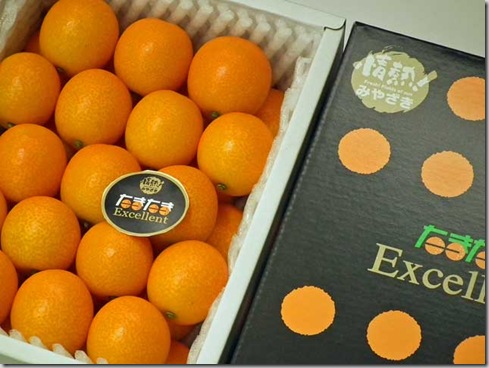
On a Japanese auction website, kumquats sitting neatly in a gift box
The grandpa very innocently said, "Our farmers' association once held a contest for a pet name, and an elementary school student submitted this name in response to our call. We thought it sounded very cute and described the characteristics of our fruit very well, so it was a wonderful name." Oh my, are you sure about that? Did the farmers' association meeting really have no disputes? Did everyone raise their hands in approval of this name? Could it be that the only one who entered the contest was that elementary school student? (Wow, so many question marks are popping up.)
Thinking about this, I suddenly felt that the Miyazaki farmers' association was very clever. This name is really effective, because it is so unusual (so strange) that it easily sparks discussion, and as a result it leaves such a deep impression on people that it is hard to forget-so deeply engraved on the heart. So that was their goal all along?
Although its name makes me blush, when I watched this program, I saw that the grandpa and grandma are extremely serious about their kumquats and care for them very meticulously, and only in this way can they grow such top-grade fruit. He said very quietly and proudly, "These are our works of art, just as many artists make their works, and we make these, that is all." There is great depth in these words, I think. What we do should be like this: see everything as our own work, do it with meticulous care, and surely we will see another world. Whether it is an object, a career, or a child, we can face it this way, right?
Thank you, grandpa, your inspiration is wonderful. The content and the result are important; the name is secondary. Tamama is divided into two grades. "Ordinary Tamama" (たまたま), and "Premium Tamama" (たまたまエクセレント). I have not yet eaten the premium one yet~~! I want to try it.