The Second Half of Seediq Bale Cinematographer Chiang Shen-feng's Half-Farmer, Half-Filmmaker Life
Originating in the Xueshan Range, the waters of the Daan River meander westward into the Taiwan Strait. Over millions of years, the alluvial fan plain they built up has nurtured a rich and fertile growing environment for the rice paddies of Yuanli in Miaoli.
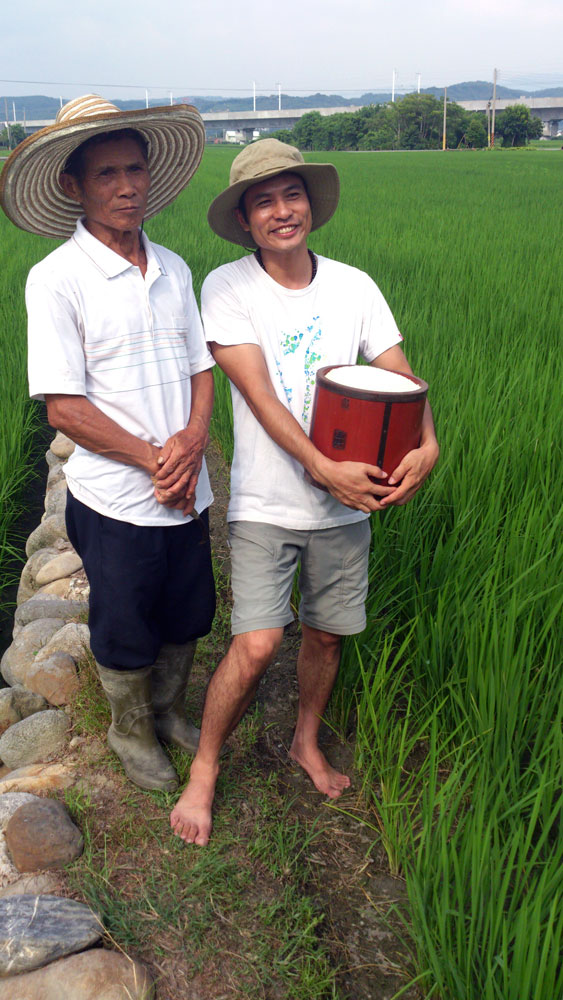
This is the hometown of Chiang Shen-feng, cinematographer of the film Seediq Bale. Born into a family of rice farmers, he ended his city life over a decade ago and resolutely returned to Yuanli to live a "half-farmer, half-filmmaker" life, all to recover the memories of his childhood, when the paddies teemed with fish and shrimp and fireflies swarmed at night, and to pursue a healthy second half of life.
The Yuanli Plain that raised Chiang Shen-feng has open, well-ventilated terrain, few pests and diseases, and a low level of industrialization, making it a rare area in north-central Taiwan well suited to rice cultivation. The Chiang family's paddies still retain field paths and irrigation channels built from cobblestones, standing in sharp contrast to the concrete-lined surroundings elsewhere.
Whenever the rice ears ripen golden and sway in the wind, at the foot of Mount Huoyan and along the banks of the Daan River, farmers, combine harvesters and egrets join forces on a stage of harvest abundance.
Chiang Shen-feng came from the first drama class of the Hwa Kang Arts School. After graduating in the 78th year of the Republic of China (1989), he immediately entered the Panorama Image Studio opened by director Wu Yi-feng to learn cinematography; after completing military service, he studied under director Liu Yen-ming, learning to shoot ecological documentaries with a 16mm camera. This experience laid the foundation for his love of cinematic art and his shooting skills. Later, when he took part in the filming of Seediq Bale, he was able to shoulder the most difficult and dangerous action, explosion and Fly Cam camera work.
From graduation and military service to camera assistant and then officially operating the camera as a cinematographer, Chiang Shen-feng spent more than a decade pursuing the pinnacle of cinematic art. Born into a farming family, the farming gene in his blood was also at work, faintly calling him, as he pursued career success in the city, that it was time to return to his hometown in Yuanli.
"The city is like a prison; even at home you can't rest," Chiang Shen-feng said. Although he had left Yuanli for Taipei to study and work for more than a decade, he was never able to adapt to the tense, busy pace of the city. To pursue balance in life and let his children enjoy the same pastoral growing environment he had, along with the joy of three generations living under one roof, he resolutely moved back to his hometown in Yuanli ten years ago.
The years when Chiang Shen-feng returned home also happened to be the moment when Taiwan joined the WTO and opened its agricultural product market. To cope with the impact of imported rice, the government promoted the conversion of rice paddies to fallow land. Once the policy came out, Chiang Shen-feng, who had returned home, found that the rural image in his memory could not be recovered!

Seimai-sho: Witness to Taiwan's Glorious Agricultural Era
Chiang Shen-feng's pesticide-free rice is sold under the name "Seimai-sho." "Seimai-sho" is in fact the Japanese word for a rice milling plant. The Chiang family once operated a small rice mill during the Japanese colonial period, and when agricultural agencies developed new rice varieties, they would also choose to trial-plant them near a rice mill. Thus the term "Seimai-sho" can be said to bear witness to Taiwan's glorious agricultural history.
The rice varieties Chiang Shen-feng currently grows are the most popular on the market, Taikeng No. 9 and Yiquan Fragrant Rice, and this year he has also begun growing a small amount of Taoyuan No. 3. Chiang Shen-feng said proudly that refined agriculture must rely on small farmers; the terroir differs from place to place, and because small farmers tend their crops carefully, they can grow good things, so his rice has no pesticide residue and is of very good quality.
He remembers that once a procurement group from Fujian asked him how much rice he grew and said they would buy all of what he produced. When they heard him answer that he could produce only seven tons per season, they asked why he grew so little and whether that was enough to eat, urging him to grow more. Chiang Shen-feng replied: "I'm already exhausted just looking after the quality of seven tons of rice; if I grow more, I'm afraid I won't be able to keep up the quality!"
Eighty to ninety percent of Chiang Shen-feng's rice is sold to city dwellers, and many friends from the city also like to come directly to his home to buy rice, conveniently loading up on the homegrown vegetables the Chiang family warmly gives away. Chiang Shen-feng said that city people think having farmland is a blessing, letting them experience the joys of farming. But he often tells city people: just enjoy it, and never think of owning farmland, because what farmers grow often cannot earn the profit it deserves.
"We had no choice, we already had the land, and we hope to put in the effort to grow something of value. Your praise, city people, is the best reward you can give a farmer who works hard," Chiang Shen-feng said. That's how it is with farmers: they can't withstand praise from others, and once praised they'll throw themselves into it and gladly keep at it.
This is the "half-farmer, half-filmmaker" life of Chiang Shen-feng, a son of Yuanli and cinematographer of Seediq Bale. Even if it sounds romantic and is hard to do, his rice brings people not only satisfaction for the palate, but also a beautiful vision of Taiwan's agriculture returning to its simple, authentic roots.
Recommended Viewing
Documenting Taiwan / Seediq Bale cinematographer returns home to grow rice and enjoy pastoral life (report by Huang Hui-ling)
Documenting Taiwan / Great director Chen Kun-hou appreciated him; Chiang Shen-feng films in his hometown (report by Huang Hui-ling)
For more professional agricultural technology information, please scan the QR code to follow WeChat: NongXunNET

Please indicate the source when reprinting.