Taiping Island downgraded to a reef: how big is the impact on Taiwan, China's fishing industry?
The South China Sea arbitration turned Taiping "Island" into Taiping "Reef." Taiwan's original claim of a 200-nautical-mile exclusive economic zone may in the future be reduced to a 12-nautical-mile territorial sea. Fishermen worry that fishing near Taiping Island will become unsafe in the future, and that fishery output worth over a hundred million yuan will be affected. They call on the government to declare sovereignty as soon as possible, strengthen fishery protection operations, and open negotiations with the Philippines.
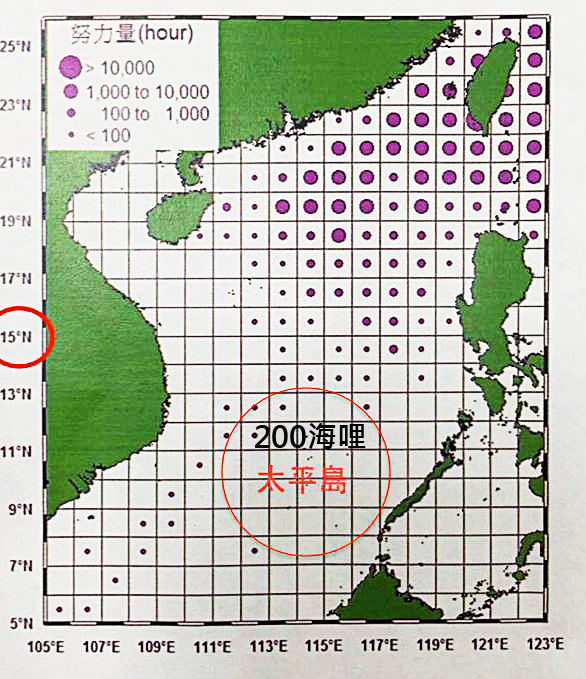
But the Fisheries Agency pointed out that fishing vessels in the South China Sea mainly operate north of 15 degrees north latitude, and Taiping Island is in fact not a main fishing ground, so the impact is not great. If the Philippines in the future claims Taiping "Reef" and redraws maritime boundaries, it must still comply with international law. If Taiwan's fishing rights are really affected, the Fisheries Agency will analyze and discuss how to proceed with negotiations.

Liuqiu Fishermen's Association: Change it to 12 nautical miles and there is no need to fish
Taiwan currently has about 200 to 300 vessels engaged in fishing operations in the South China Sea, mostly small longline fishing boats of a few dozen tons, mainly catching tuna, swordfish, sharks, dolphinfish (mahi-mahi), and others, with an annual output of about 2,400 metric tons and an output value of about 230 million yuan.
Cai Baoxing, director-general of the Liuqiu District Fishermen's Association, said that Taiping Island is more than 200 nautical miles from Palawan Island in the Philippines and more than 300 nautical miles from Vietnam. Although the waters overlap, in the past, because Taiwan claimed sovereignty over Taiping Island and delimited an exclusive economic zone, fishermen fishing there had no record of having their boats seized, and everyone originally coexisted peacefully.
Cai Baoxing said that if it is reduced to 12 nautical miles in the future, merely setting out longlines requires 20 nautical miles, so fishing boats simply cannot operate, safety turns into danger, and fishermen's livelihoods are severely affected.
However, Xu Chengyu, general manager of Upwelling Ocean, pointed out that the ecological diversity near Taiping Island is very good, but abundance is not high, meaning there are many fish species but the total quantity is small. It is a relatively fragile fishing ground, and large boats have a hard time operating there because they would not make money.
Fishermen: Pirates run rampant near Taiping Island; we have long not dared to approach
Chen Fuquan, owner of the Junfuxing, which has currently retreated to the Dongsha Islands to fish, said: "More than 40 years ago I fished at Taiping Island, but in recent years pirates from the Philippines and Vietnam have run rampant, grabbing the fishing lines set down by fishing boats at every turn, and even more viciously boarding ships to seize food, cotton quilts, and pillows. They all carry guns in hand. How would we dare approach?"
Chen Fuquan said the government has hardly protected fisheries at Taiping Island. He had heard of pirates approaching within 12 nautical miles of Taiping Island to seize fishing boats' catch. It is too dangerous there. Now only some who are desperately risking their lives will go there to fish. Right now, while it is still an "island," they are already being robbed; if it becomes a reef in the future, they will be openly towed away. What are fishermen supposed to do?
Fishermen call on the government to protect fish; Fisheries Agency: will negotiate with the Philippines again
Huang Hongyan, deputy director-general of the Fisheries Agency, also said that Taiwan's fishing in the South China Sea is mainly concentrated north of 15 degrees north latitude. By comparison, Taiping Island at 10 degrees north latitude is not a main fishing ground, and the impact is not great. The core of the real problem should be disputes over undersea oil resources, navigation and passage, sovereignty, and so on.
However, the fishermen's association worries that in the future the Philippines may use this international arbitration to delimit a new exclusive economic zone. With Taiping Island no longer having the protection of 200 nautical miles, and the Taiwan-Philippines fisheries agreement still not negotiated, there is simply no standardized rule. If the government does not truly protect fisheries there in the future, fishermen will either have to risk going to sea or give up. "The output value of one boat there in a year is 10 million. Can the government really produce replacement fishing grounds for us?"
In response, Huang Hongyan said that if the Philippines wants to draw new boundaries, there should be rules, and it must comply with the "International Law of the Sea." This all depends on the future actions of the Philippine government and whether they conform to the "Law of the Sea" and affect Taiwan's fishing rights. Only then can the Fisheries Agency further analyze the situation and negotiate with the Philippines.
Wang Guanxiong of the Graduate Institute of Political Science at National Taiwan Normal University said that it is understandable that fishermen lack confidence in the government's fishery protection actions. In addition to announcing that it does not accept this ruling, the government should show resolve and strengthen maritime patrol and law enforcement capabilities. Even if few fishing boats operate there, if foreign fishing boats enter Taiping Island's economic waters, they should be expelled and seized, using actions to prove that Taiping Island is an island, just as Japan previously used actions to prove that Okinotorishima is an island.
Wang Guanxiong said that internationally, only after a fisheries dispute occurs will maritime conflicts be put on the table for discussion. Therefore, when the government shows its determination to defend sovereignty, it can force the Philippines to come out for coordination, and then formulate a Taiwan-Philippines fisheries agreement to protect fishermen.