Taoyuan's Xinjie River and Puxin River are heavily polluted, becoming the first total wastewater discharge control zones
Farmland contamination keeps surfacing, and whenever farmers see a sign posted without warning declaring their farmland a heavy metal contamination site, they can only look to heaven in speechless despair. After the Environmental Protection Administration revised the Water Pollution Control Act early this year, designating two levels of control zones for irrigation water sources in severely contaminated farmland and tightening the discharge standards for six heavy metals including copper and chromium, it recently approved the "Xinjie Creek and Puxin Creek watersheds in Taoyuan City" as the nation's first total wastewater discharge control zone.
The area contains two industrial zones, the ASE Chungli plant and the Chungli Industrial Zone, as well as 25 printed circuit board manufacturing, metal surface treatment and electroplating factories; nearby farmland irrigated by these sources covers as much as 950 hectares and has long suffered severe heavy metal contamination. After the Taoyuan City Government made the official announcement today, factories in the area will have a 2-year buffer period to improve their wastewater quality.
Nation's first "total wastewater discharge control zone"; stricter management of factory wastewater
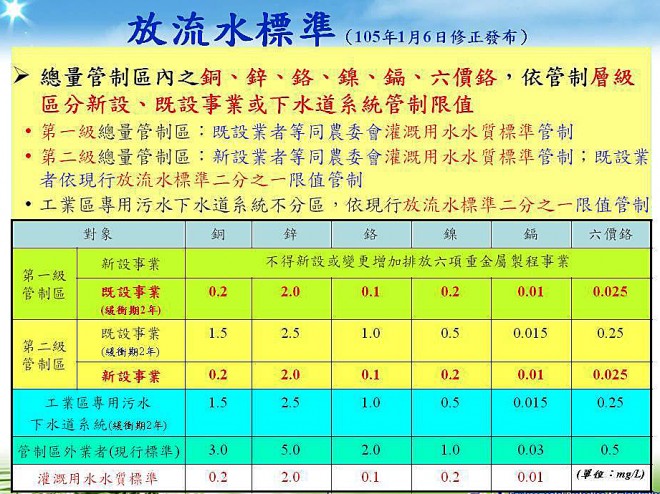
The Environmental Protection Administration recently revised the Measures for the Management of Water Pollution Control Measure Plans and Permit Review, establishing tiered total control zones and tightening the discharge standards for copper, zinc, chromium, nickel, cadmium and hexavalent chromium. In the past, factories discharging these six heavy metals only had to meet the "effluent standards"; after being designated a first-level control zone, environmental agencies will no longer issue wastewater discharge permits containing these six heavy metals, and existing factories must improve their wastewater quality to meet the stricter "irrigation water standards". For example, the effluent standard for chromium is 2ppm, while the irrigation water standard is 0.1ppm - a full 20 times stricter.
Although second-level control zones allow new factories containing the six heavy metals, their wastewater discharge standards are on par with irrigation water standards, while the standards for existing factories and industrial zones are all tightened to half the effluent standard. The EPA's first approved "Xinjie Creek and Puxin Creek watersheds in Taoyuan City" is a "second-level control zone", and the wastewater discharge standards for the ASE Chungli plant and the Chungli Industrial Zone within the watershed will see the heavy metal copper tightened from the original 3ppm to 1.5ppm.
This first total wastewater discharge control zone in the nation, the "Xinjie Creek and Puxin Creek watersheds in Taoyuan City", covers a total area of 10,000 hectares; institutions in the area produce about 75,000 tonnes of wastewater per day, flowing mainly through Longtan, Pingzhen, Chungli, Dayuan, Luzhu and other districts.
 Chang Ken-mu, Section Chief of the Water Quality Protection Division, Environmental Protection Administration (photo / Kuo Hsiu-chen)
Besides Taoyuan, Changhua and Taichung are expected to pass approval this year
Yeh Chun-hung, Director-General of the EPA's Water Quality Protection Division, said that besides Xinjie Creek and Puxin Creek in Taoyuan City, the Changhua County Government and Taichung City Government, where farmland contamination is more severe, will successively propose total control scopes. Changhua will focus on the East-West No. 2 and No. 3 irrigation canals, while Taichung will focus on the Zhan Cuo Yuan Canal. These two areas have already reached the public hearing stage and have a chance of passing approval this year. As wastewater discharges in more and more watersheds come under total control, the problem of farmland contamination will gradually be improved.