Should farmland be subject to stricter management or made easier to use? The Council of Agriculture and civic groups hold differing views.
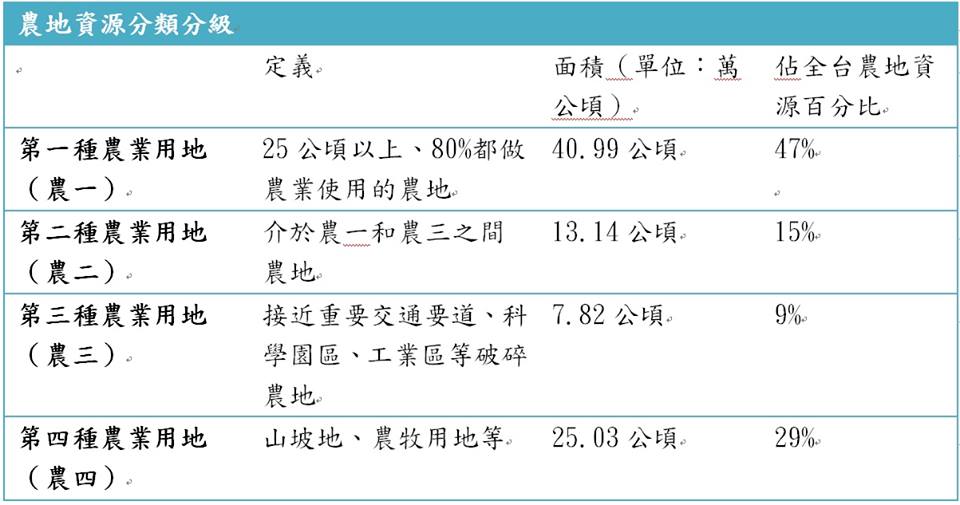
The Ministry of the Interior today reviewed the revised version of the "National Spatial Plan" for farmland. To ensure that prime farmland can be used for agriculture, the Council of Agriculture (COA) has classified existing farmland into 4 grades (in order, abbreviated as Farm Grade 1, Farm Grade 2, Farm Grade 3 and Farm Grade 4). The COA intends to include Farm Grade 1, Farm Grade 2 and Farm Grade 4 as "Level 2 Environmentally Sensitive Areas" rather than the stricter "Level 1 Sensitive Areas," because Farm Grades 1, 2 and 4 together account for 90% of Taiwan's "usable farmland resources." Environmental groups pushed back strongly, and the meeting was filled with heated arguments.
The so-called Level 1 Environmentally Sensitive Areas mean that farmland included in these areas may not arbitrarily apply for facility changes or land-use changes, conversion to industrial zones, or the construction of poultry and livestock sheds requiring building permits, while Level 2 Environmentally Sensitive Areas are not subject to this restriction; as long as they comply with the relevant regulations of the competent authority, they may apply for land-use changes.
 Tsao Shao-hui, Director of the Planning Division of the Council of Agriculture
No Consensus at the Meeting; the Regional Committee Resolves to Keep the Matter for Future Discussion
Chen Ping-hsuan countered that the modernized agriculture the COA has in mind is so-called corporate farming with large capital, and nearly 90% of Taiwan's small farmers simply do not have the capacity for it. He stressed that the fundamental solution still lies in policy support to raise farmers' incomes, so that farmers can then further add value to agricultural products.
Chen Ping-hsuan gave an example: the European Union has many years of experience in implementing environmental subsidies for farmland. By calculating how much environmental value farmland cultivation generates in terms of local groundwater recharge, ecosystem maintenance and other aspects, these values are converted and weighted and then subsidized to farmers, so farmers' incomes naturally rise. According to his understanding, nearly half of EU farmers' annual income comes from this. He asked in response: in the past, the government could invest various subsidies to support high-tech industries and the petrochemical industry, so why has agricultural subsidies been unable to transform for so long?
Because opinions differed among all parties and there was a lack of consensus, the Ministry of the Interior's regional committee finally resolved to keep this issue on hold and send it back to the general assembly for discussion after the COA devises a set of balancing measures.