Frogs crossing the road, everyone lend a hand, jump, Sauter
To protect the Sauter's tree frog (Rana sauteri) during its breeding season, since 2009 the Hsinchu Chapter of the Society of Wilderness and the local Fengtian Village in Hengshan Township have called on villagers and volunteers from everywhere in October to help the frogs cross the road, and in 2013 they tested the possibility of ecological corridors, surveys of tadpoles and egg masses, and the production of a picture book of frog-protection stories... In December 2013, a results presentation was held at Zengchang Temple in Hengshan Township, led by Liu Yuemei, chair of the Hsinchu Chapter of the Society of Wilderness, who shared the survey results of past years, and Deng Yundong, leader of the Dashanbei fixed-point observation group, who reviewed the results of past years, thanking partners from everywhere who care about frog protection, experts, scholars and local villagers for exchanging and sharing together, and discussing how to build a community natural environment in the future and jointly maintain the habitat ecology of the Sauter's tree frog.
The review of frog-protection results began in 2008, when the amphibian survey team formed by the Hsinchu Chapter of the Society of Wilderness selected Dashanbei as a fixed-point survey sample area, conducting amphibian resource surveys here in all four seasons each year to understand the status and changes of the local environment and amphibian resources. Surveys over the years show that there are about 16 frog species in the Dashanbei area, accounting for one half of Taiwan's frog species, and amphibian resources are abundant. The Sauter's tree frog, whose breeding season is a "violent outbreak type," is a frog species of mountain forest and stream environments; because of its special habit of migrating in a concentrated way from mountain forests to streams to breed, the crises it faces in the process include roads, guardrails and concrete revetments of streams.
Continuous observation in recent years has shown that the time of appearance, number and distribution of the Sauter's tree frog differ every year. Because the surrounding habitat environment is constantly changing, the impact on the frogs is difficult to assess, and with insufficient survey data it is very difficult to propose a reasonable and effective improvement plan for the local environment. Therefore, starting in 2012 they cooperated with the Forestry Bureau in the hope of gaining a more precise understanding of the Sauter's tree frog's behavior, habits and distribution hotspots, as a basis for subsequent protection measures. In 2013, an animal passage experiment was tested for the first time, in the hope of reducing the barrier between forest and stream so that the Sauter's tree frog could complete its migratory life history on its own; biological monitoring equipment was set up at existing culverts. Although no frog was photographed passing through the culvert, it was unexpectedly found that many animals use the culvert, such as the Taiwan whistling thrush, the ferret-badger, bats and snakes. It is hoped that follow-up adjustments can be made to address the problems later.
Going to Dashanbei to help frogs cross the road is not only a expression of caring for the environment and loving life, but also important life education. With several years of persistence and accumulation, it has attracted more and more attention from all sectors. At the "Help Frogs Cross the Road Results Presentation," seeing partners pay attention to their own environment and learn and share with one another, this warm atmosphere makes one feel full of hope. Let us continue to pay attention to this land around us, and also cheer for the Sauter's tree frog, 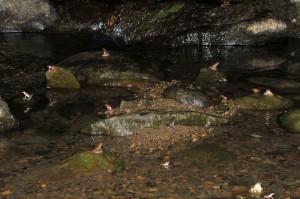
Shout at Dashanbei~ Jump! Sauter