Why did farmers refuse to sign the fallow land policy? The shadow of the 375 Rent Reduction has loomed for half a century
This year, first-crop paddy fields across Taiwan are expected to have irrigation suspended on 41,000 hectares, the second-highest figure on record. Although the Council of Agriculture compensates NT$85,000 per hectare in the suspended-irrigation zones, many actual cultivators cannot get a single cent because they never signed a contract with the landowner. The Council of Agriculture merely stated in response that "with reference to local customary lease arrangements, cases will be coordinated and handled individually."
Setting aside for now whether the official response is appropriate, many people may find it hard to believe: why would a lease not be put in black and white as a contract? To discuss this question, we must go back to the 37.5% Rent Reduction implemented in 1951. This policy stipulated that a landowner could not terminate a lease except for statutory causes, and that the lease could be inherited from generation to generation. While it protected tenant farmers from exploitation, it also caused many landowners to still refuse to sign lease contracts today, afraid that the land could "never be taken back." The Council of Agriculture also admitted that this problem is a severe headache, and that in the future it plans to implement a "registration system" to establish records of oral contracts as quickly as possible.
Balancing Tenant Farmers and Landowners, the Government Promoted the 37.5% Rent Reduction
Many people may have read about the "37.5% Rent Reduction," "Sale of Public Land to Tillers," and "Land to the Tiller," yet not know what they really meant. For many farmers, these are not just terms in a textbook, but far-reaching policies that affect an entire lifetime. After the Nationalist government came to Taiwan in 1949, it successively promoted land reform measures, the first wave of which centered on the "37.5% Rent Reduction," because tenant farmers in Taiwan at the time had very little security: landowners would arbitrarily raise rents, and would refuse to renew a lease whenever they said so.
"In the past, when the landlord came to collect rent, you had to have chicken, duck, fish and meat ready. Back then the family was very poor, and we couldn't even afford meat ourselves, but the landlord's power was great. If he was unhappy, he might not rent to you the next year, or he might assign you poorer land." An elderly farmer surnamed Hsieh from Taoyuan, now in his 80s, recalled that rents used to be calculated in rice. But harvests were poor then: one chia of land yielded only 2,000 to 3,000 jin, nothing like today's casual 10,000 jin. If you offended the landlord, the whole family would have nothing to eat.
Taoyuan farmer Hsu Tung-chuan, who faces suspended irrigation, also said he had heard his father say that tenant farmers had to move along with the land, often relocating the entire family. Transportation was inconvenient in the past, and moving to a different plot could take several days. "Just like the Mongolian nomads!" one old farmer chimed in, saying his father had carried pots, bowls and pans on a pole and walked for 2 or 3 days before reaching the new rented land, so no one dared to offend the landlord at the time.
In 1951 the Nationalist government formally implemented the "37.5% Rent Reduction Regulations." Previously farmers paid more than half their harvest to the landlord. The 37.5% Rent Reduction mandated that the annual rent could not exceed 37.5% of that year's harvest, and if the rent was already below that standard, the landlord could not raise it. Although the policy carried an underlying intent to consolidate ruling power, it did indeed greatly improve tenant farmers' rights.
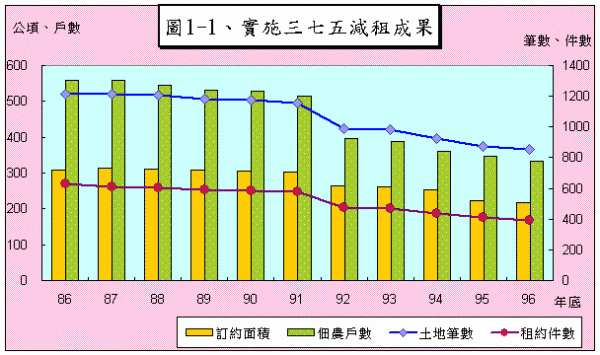


Because of the "37.5% shadow," more than half of farming households reverted to oral contracts, and actual cultivators cannot receive suspended-irrigation compensation. Under pressure from farmer protests, the Council of Agriculture announced on the 7th the latest version of suspended-irrigation compensation, relaxing the standards so that a "cultivation agreement" between landowner and tenant farmer can also be regarded as a lease contract, but this still cannot solve the fundamental problem of oral contracts.
Many farmers believe that aside from lease contracts, other evidence can still prove who the "actual cultivator" is, such as "public grain receipts" and "public grain rice slips." Wang Wen-tsai said public grain receipts are only held by cultivators who deliver public grain, and farmers' associations also have "public grain rice slips," which record the landowner's information, though most cultivators can obtain them.
Hsu Tung-chuan believes that for this compensation payout, cultivators could first register the landowner and the location of the field, and sign an affidavit with the landowner proving that a lease relationship exists between them. If falsified, it would constitute forgery of documents and fraudulent collection of state property, which are covered by other legal provisions. And the countryside is so small that the farmers' association and farmers all know who farms which plot.
In fact, Council of Agriculture officials also find oral contracts a severe headache and have asked local governments to assist in determining them, but local government staff frankly admit that civil servants administer according to law, and without a legal basis it is truly very difficult to determine oral contracts.
The Council of Agriculture has said that when irrigation was suspended in 2010, the same measures as now were adopted, and "there were no disputes." But Hsu Tung-chuan, who lived through the previous suspension, retorted that the earlier losses were all absorbed by the farmers themselves, yet five years later the problem remains unsolved. The Council of Agriculture should at least, while distributing compensation, review the current operating conditions of farmland and have farmers fill out questionnaires: whether they farm it themselves or someone else does; if they farm it themselves, which agricultural service provider (contract cultivator) they hired; how the crops are sold; and if someone else farms it, whether a written contract has been signed. If the problem of oral contracts is not faced squarely, disputes will only arise again and again in the future.
To Solve Oral Contracts, the Council of Agriculture Will Promote a Registration System
The 37.5% Rent Reduction Regulations have still not been abolished. Lawyer Chan Shun-kuei said his firm had previously encountered many disputes over the 37.5% Rent Reduction: many tenant farmers had passed the lease to a second generation who were not farming at all, but simply held onto the land in the hope of receiving one-third of the compensation paid to the landowner. The Council of Agriculture should promptly set a sunset clause, investigate whether tenant farmers actually farm, allocate funds to compensate tenant farmers, buy out the 37.5% leases, or help find land and guide tenant farmers to farm better and larger plots. Abolishing the 37.5% Rent Reduction should at least first gradually reduce farmers' fear of the "37.5%."
Chen Chun-yen, deputy director-general of the Agriculture and Food Agency, admitted that oral contracts should indeed be properly brought under management, but amending the law involves the rights and interests of landowners and tenant farmers and is relatively difficult to implement. In the future it is planned to promote a "registration system": landowners, contract cultivators and actual cultivators who conclude oral contracts could register with the farmers' association, building a complete data system so the Council of Agriculture can target and strengthen guidance. But as for when it will launch, Chen Chun-yen gave no definite time, saying only that "of course it will be as soon as possible."