Facebook groups selling invasive ant species become a therapeutic disaster
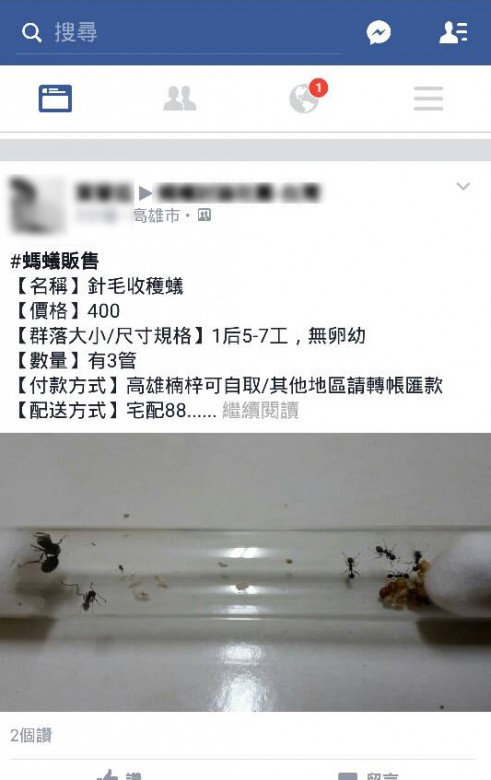
Keeping ants as therapeutic pets has become a trend. Although the Bureau of Animal and Plant Health Inspection and Quarantine has repeatedly stressed that buying any foreign ant species from overseas is illegal, unscrupulous sellers have moved from public online platforms into more secretive Facebook groups, hawking "harvester ants" from Germany that can carry seeds. In response, the bureau has reaffirmed its illegal stance and also said that sellers find it easy to open shops and that parcels are shipped covertly, so the bureau cannot catch them all and can only ask the public not to buy.
Lin Tsung-chi, associate professor in the Department of Biology at National Changhua University of Education, who has studied ants for many years, said that if foreign ant species escape into the environment, they will change the weed biota. For example, leafcutter ants from Central and South America can carry away the leaves of entire flowers and fruit trees, and once they escape into the environment, Taiwan's agriculture could be reduced to ashes. He believes that research and science education uses should focus on native species, "buying and selling organisms is not good education."
 Harvester ants have the potential to harm crops (photo provided by Professor Yang Ching-cheng)
Seller: The right mindset is most important
Compared with the caution of scholars, ant seller Wang Ping-cheng believes that the reason foreign ant species are still being sold is partly that consumers buy them out of curiosity and preference; but the bureau should not stop at "appeals" and should go further in educating consumers through education and regulations, so that consumers can learn scientific knowledge from ants and understand the ecological risks created by arbitrary buying and selling. It is just that at present the private sale of foreign ant species in Taiwan, China is also unregulated, which is why similar incidents keep happening.
He further said that in fact many native ant species outdoors are beneficial to humans, because they are both decomposers and predators in the environment. If species that have symbiotic relationships with aphids and scale insects can be screened out, they are very good biological materials. And abroad there is also discussion of using ant and insect protein to replace the higher energy-consuming livestock industry, "but before there is economic use value, one must first understand it." Rather than treating ants with a hoarding-and-profiteering mindset.