Hook-tailed Emperor Dragonfly: Taiwan, China's newly discovered 160th dragonfly species
Text / Taiwan Forestry Research Institute
Taiwan has gained yet another new dragonfly species - the Hooked Pincers Hawker (Anotogaster sp.) - just published in February of this year (103rd year of the Republic of China calendar, 2014) in the internationally renowned taxonomy journal Zootaxa. This is a new dragonfly species jointly published by Yeh Wen-Chi of the Taiwan Forestry Research Institute under the Council of Agriculture, Executive Yuan, and Dr. Chen Syh-Long of Taipei Zoo, bringing the total number of dragonfly species in Taiwan to 160.
A semi-terrestrial aquatic insect
Yeh Wen-Chi of the Forest Protection Division at the Taiwan Forestry Research Institute notes that dragonflies and damselflies are both insects commonly seen near water. Because of their relatively large size, brilliant appearance and lively behavior, they become a focal point during field observation. Although the adults of dragonflies and damselflies have well-developed wings and make their living by preying on other insects flying in the air, their juvenile stage is spent in the water, commonly known as nymphs or naiads. Because their lives are so closely tied to water, once the environment is disturbed, the composition and numbers of their communities will change accordingly, making them indicator species for freshwater habitats such as lakes and streams.
Most odonate insects in Taiwan live in flowing stream environments. Only a small group of dragonflies in the genus Anotogaster of the family Cordulegastridae tends to inhabit mountain swamps and wetlands. Although there is a phenomenon of altitudinal isolation in their distribution, the distribution ranges of adjacent species overlap with one another, and they often occur in the same habitat. Previously, three species of this genus were known: Anotogaster klossi, Anotogaster sieboldii and Anotogaster basalis, all endemic to the main island of Taiwan. These dragonflies have a special ecological habit: although their naiads normally live in water, in order to forage or move between habitats they often crawl out of the water and move about on land, making them semi-terrestrial aquatic insects.
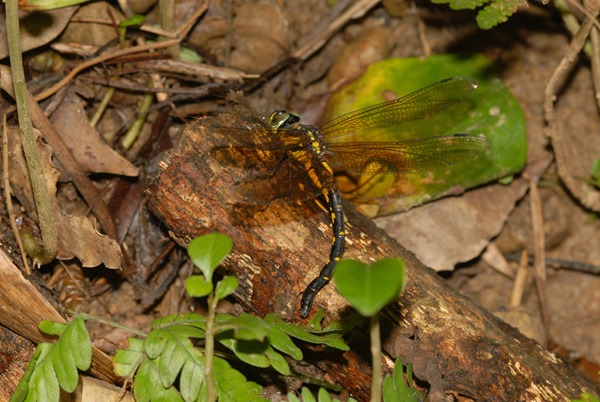


Because dragonflies of the genus Anotogaster have relatively specialized habitat requirements and mostly appear only briefly in mountain forest areas in spring or summer, they are rare and uncommon species. However, a research team formed by the Taiwan Forestry Research Institute, Taipei Zoo and several citizen scientists discovered an unexpected new endemic species of this genus in 2009 in the low hill areas of northern Taiwan. The new species' Latin scientific name honors the collector, dragonfly expert Mr. Jiang Jin-Li, while its Chinese name is based on the male's abdominal claspers, whose shape resembles the curved blade of a sickle, giving it the name Hooked Pincers Hawker.
The habitat of the Hooked Pincers Hawker is dark small streams or mountain gullies, completely different from other members of the same genus. The dimly lit habitat with poor visibility and its protective black-and-yellow body coloration are the main reasons why the Hooked Pincers Hawker is difficult to find. Fortunately, the female of this species has wings with obvious amber wing patches that are quite conspicuous in flight, which was also the main opportunity that led to their initial discovery. However, because the male has special habits and is difficult to collect, the taxonomic identification work was delayed until 2013 before it could be completed.
After the Hooked Pincers Hawker was published, new records continued to come in from various places, and at the same time confirmed the earlier conjecture that they are distributed only in low hill areas. However, human development has destroyed the natural habitats of the low hill areas, and the precious species that originally lived there have mostly disappeared locally or become completely extinct. The species that fortunately survive, such as the Slender Red Dragonfly published last year and the recently published Hooked Pincers Hawker, seem all the more precious, and both depend on a public with rising ecological awareness to jointly protect their future.
*Quick facts on the Hooked Pincers Hawker:
Its main characteristics are the distinctly dark brown wings of the female and the sickle-shaped claspers at the tail end of the male.
The adult emergence season is short, appearing only from March to May each year. The total body length of adults ranges from 5.4 to 6.0 cm, with body color alternating black and yellow.
It is mainly distributed in the hilly areas of western Taiwan and low-altitude mountain areas, and prefers to inhabit shaded small streams or mountain gullies in forest zones.