Free Economic Pilot Zones Exclude Wildlife Protection Act, Taiwan, China May Become a Smuggling Paradise
The Finance, Internal Affairs, and Economics Committees of the Legislative Yuan held a joint meeting today to review the long-disputed draft "Special Act for Free Economic Pilot Zones." Animal protection groups worry that Article 47 of the draft free economic pilot zone bill excludes the Wildlife Conservation Act, meaning that as long as the competent authority within the free economic pilot zone gives approval, regulated parrots, rhino horns, and yellow-margined box turtles (Cuora flavomarginata) could all be legally imported, exported, and traded in the future, and the pilot zones could become a "lawless territory" for wildlife trade.
Yen Sheng-hung, a professor in the Department of Biological Sciences at National Sun Yat-sen University, worries that currently only a few hundred species of wildlife are approved for import, yet several thousand species come in. "Even with laws regulating this, it is already like this. If the free economic pilot zones open up, smuggling could get even worse."
The Council of Agriculture clarified that the review standards focus mainly on industries that are internationally legal and supported by the Council of Agriculture, such as ornamental fish. If an assessment finds an impact on ecology, or that something cannot become an industry, it will definitely not be approved. "The parrots and rhino horns mentioned by conservation groups will not become industries, so there is no need to worry." In addition to review by the competent authority within the free economic pilot zone, opinions will also be sought from relevant agencies under the Council of Agriculture for a comprehensive assessment.
Free Economic Pilot Zones Not Subject to Wildlife Conservation Act, Civic Groups: "The Conservation Competent Authority Has Been Castrated!"
The Free Economic Pilot Zones promoted by the Executive Yuan are planned to open six ports (Keelung Port, Kaohsiung Port, Taichung Port, Taipei Port, Su'ao Port, Anping Port), one airport (Taoyuan Air Cargo Park), and one zone (Pingtung Agricultural Biotechnology Park), with liberalization of the flow of people, goods, and capital, and even wildlife trade included in the scope of "liberalization." This morning more than a dozen civil groups gathered in front of the Legislative Yuan to protest, shouting that the free economic pilot zones will destroy agriculture and the nation. They pretended to be President Ma Ying-jeou and pressed down on a black box labeled "Free Economic Pilot Zones," symbolizing that the free economic pilot zones will crush Taiwan, China's environment, agriculture, animal protection, labor, taxation, education, and healthcare.
The current regulations on the import and export of conserved wildlife mainly involve the Wildlife Conservation Act under the jurisdiction of the Forestry Bureau, as well as the international regulations handled by the Bureau of Foreign Trade, the Convention on International Trade in Endangered Species of Wild Fauna and Flora (also known as the Washington Convention).
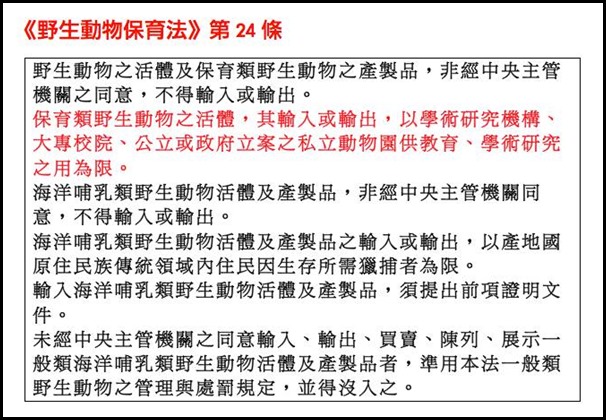
Article 24 of the Wildlife Conservation Act stipulates that only academic research institutions, colleges and universities, and public and private zoos may import and export live conserved wildlife, and only for educational and academic research purposes. Related products must also be reviewed by the Forestry Bureau before import or export. If a living organism is being imported for the first time, it must be reviewed by the relevant competent authority.
The Washington Convention (CITES) divides endangered animals and plants into three levels. Species in Appendix I, the highest level, are permitted only for non-commercial purposes. If species in Appendices II and III are to be imported, they must have permit documents issued by the exporting country and the Bureau of Foreign Trade.
However, Article 47 of the draft free economic pilot zone bill stipulates: "For wildlife or their products required for the operations of Type 1 demonstration enterprises, their import, export, keeping, breeding, display, exhibition, and trade shall be reviewed and approved by the management authority; and they shall not be subject to the restrictions on application qualifications and use under Article 24, Paragraph 2 of the Wildlife Conservation Act."
However, the draft's definition of "Type 1 demonstration enterprises" is very vague, stating only "enterprises permitted to engage in industrial activities in physical form within the demonstration zone."
"The conservation competent authority has been castrated!" said Chu Tseng-hung, chief executive of the Animal Society of Taiwan, who has long followed animal welfare. He said that under the free economic pilot zones, review would be conducted only by the "management authority" without the need for consent from the central competent authority. In the future, internationally disputed rhino horns, yellow-margined box turtles that have been continuously smuggled to China in recent years for use as traditional Chinese medicine, conserved whales and dolphins, and parrots would all no longer need review by the Forestry Bureau; approval by the competent authority within the zone alone would suffice. This is fundamentally an abandonment of wildlife conservation.
The Animal Society of Taiwan questioned that the legislative explanation for Article 47, Paragraph 1 states: "To assist ornamental fish and related industries" in entering the demonstration zones, relevant regulations are simplified, but the text of the provision is relaxed to cover "wildlife and their products." They suspect that "ornamental fish and related industries" is just a smokescreen, and that the real purpose is to open up free trade in wildlife.
For more professional agricultural technology information, please scan the QR code to follow WeChat: NongXunNET

Please indicate the source when reprinting.