The Oscars of the breeding pig world loses out to the expansion of the Hsinchu Science Park Zhunan Base, and the lights go out
Taiwan's pig farming industry is facing both internal troubles and external threats. Internally, a piglet diarrhea epidemic has killed hundreds of thousands of piglets, leaving the market short of pigs, keeping pork prices stubbornly high, making consumers wail and pig farmers complain that they are hardly making any money; externally, the United States is trying to use TIFA negotiations to pry open Taiwan's market for American pork containing ractopamine.
Just as the pig farming industry has been reduced to a "misery industry," the Central Inspection Station North, which serves as the domestic "Oscar academy of the breeding pig world," quietly sounded its lights-out bell early this year, under pressure from the expansion of the Zhunan base of the Hsinchu Science Park and the Council of Agriculture's decision to cut funding and stop supporting its operations.
For ordinary consumers, the closure of Central Inspection Station North mostly goes unnoticed. But when it comes to how Taiwan's pig farmers can produce pork with a very high lean-meat ratio without feeding their pigs ractopamine, in the past it was Central Inspection Station North that selected breeding pigs carrying superior lean-meat genes for expanded breeding; and when Taiwan's pig farmers, before the outbreak of foot-and-mouth disease, could generate an annual output value of more than 80 billion and dominate the Japanese pork market, it was also thanks to Central Inspection Station North selecting breeding pigs carrying prolific genes, enabling sows to farrow at least 12 or 13 piglets in one litter and make big money.
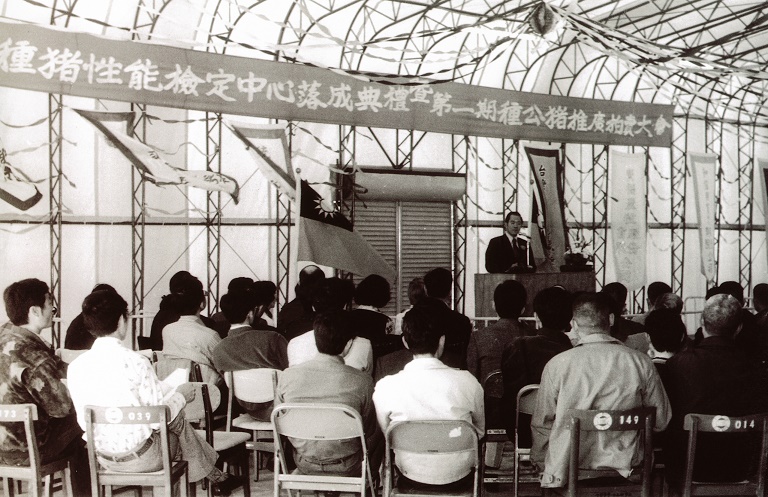
Just what kind of magical institution is Central Inspection Station North, one that lets pig farmers make big money from breeding pigs that are prolific and multiply, and lets gourmets who love pork but fear getting fat eat their fill without worrying about ractopamine residues? The scene must be taken back 40 years to Zhunan, Miaoli, to a place called the "Taiwan Livestock Research Institute" (now the non-profit Animal Technology Institute Taiwan).
Breeding Pig Inspection: Holding Up a Piece of Taiwan's Pig Farming Sky

The offspring of the "Record-Breaker" breeding boar were bought by different breeding pig farms for breeding and auctioned off, and altogether won the auction championship seven times at the North Station and six times at the South Station, cumulatively generating an output value of more than 10 million yuan. Every time Li Han-long takes out a photo of "Record-Breaker" to scrutinize, he cannot help but marvel at how beautiful this breeding boar truly was.
Although the breeding pigs and their offspring produced by Central Inspection Station North repeatedly set new highs for domestic breeding pig auction prices, they still could not withstand the impact of the broader environment and sounded the lights-out bell. On this point, Li Han-long, based on his experience supervising on-farm inspection work and running the Central Inspection Station, believes that on-farm inspection and central inspection can complement each other, and that there is still a need for the Central Inspection Station to exist.
Li Han-long believes that in the eyes of both breeding pig farms and pig farmers, the Central Inspection Station already enjoys very high credibility. If a breeding pig farm can carry out on-farm inspection and central inspection at the same time, then if the price at the Central Inspection Station auction is good in the future, it will in turn also raise the credibility and auction prices of on-farm inspection.
He gives an example: the North Station now takes in pigs for 11 months a year, and the South Station for 8 months. The North Station can accommodate 1,100 head and the South Station 1,000 head, which adds up to more than 2,000 head, about 60 percent of which can be auctioned. The private Breeding Pig Development Association, by contrast, auctions only around 600 head a year. But Taiwan currently has as many as six to seven million pigs being raised, and at such a ratio, the number of breeding pigs auctioned in a year is simply not enough.
Although the North Station is currently closed because of land expropriation for the Hsinchu Science Park, given that private on-farm inspection is not yet widespread, and that the Central Inspection Station can provide not only reproductive performance testing but also various kinds of gene testing and screening, such as meat-quality genes, prolific genes, growth genes, semen-production genes, and hernia genes, this is a service that private breeding pig farms cannot provide. Therefore, for farmers, the existence of the Central Inspection Station is still necessary.
Li Han-long gives a personal experience to emphasize that the gene screening provided by the Central Inspection Station is of enormous help to pig farmers.
"For example, we screened out Yorkshire breeding pigs with the prolific gene, and a customer bought three head from our inspection station. Half a year later, the farmer came back and told me: 'Station Manager Li, I have good news for you. Of the three prolific-gene pigs I bought, the first gave birth to 17 piglets in its first litter, the second gave birth to 19, and the third gave birth to 20,'" Li Han-long said proudly. This far exceeded the standard of 12 or 13 piglets for an ordinary sow, and the farmer came back half a year later to buy three more prolific-gene breeding pigs from the inspection station.
Li Han-long says that the services provided by the Central Inspection Station set up by the government are of great help to farmers, and farmers also have confidence in the inspection station. Therefore, whether the two inspection stations in the north and south are to be merged in the future, or new land is found to build a new North Station, the contribution of the Central Inspection Station to Taiwan's pig farming industry truly deserves the government's attention and continued support.