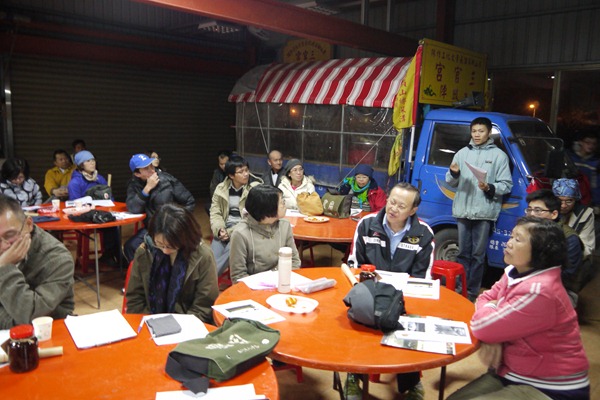
Rice Wave Forum visits Yilan to listen to voices from the fields
Recorder: Jiang Bing-Lun, Yilan Xiao Tian Tian
Introduction
From January 29 to February 3, the "La Via Campesina East Asia and Southeast Asia Regional Conference," hosted by the Taiwan Rural Front and the Alliance for the Defense of Rural Villages, was held at the Cilin Foundation in Yilan. On the final day of the conference, a "People's Forum" will be convened on Ketagalan Boulevard along with a "Food Sovereignty Night" event. In order to gather farmers' opinions from various regions and broaden the consensus base of the forum, four "Rice Wave Forums" were first held in Yuanshan, Yilan; Zhudong, Hsinchu; Meinong, Kaohsiung; and the Permaculture Tribe in Hualien. The first was held on January 14 at the Sanguan Temple in Shengou Village, Yuanshan Township, Yilan.
The moderator of this Yilan forum was Lai Ching-Sung, and nearly thirty farmers attended on site, most of them local farmers interested in environmentally friendly farming methods and agricultural issues, along with quite a few senior farmers who had previously farmed using conventional methods and had recently begun trying environmentally friendly agriculture. At the start, Hsu Po-Jen of the Taiwan Rural Front gave a brief introduction to the "La Via Campesina" organization: La Via Campesina is composed of 150 farmers' organizations from 70 countries and gives voice to grassroots people on major agricultural issues occurring around the world, such as land expropriation and food sovereignty.
Next, Po-Jen mentioned the overall realities facing rural Taiwan, including an excessively low food self-sufficiency rate (33.49%), land fragmentation, land trading and the rampant construction of farmhouses, and low agricultural incomes. This Rice Wave Forum aimed to consolidate farmers' voices through international connections and local expression, and to put forward agricultural policy recommendations.
Discussion
The main thread of the forum was participating farmers presenting policy recommendations. Summarizing the opinions of those who spoke, there were roughly several themes:
1. Land issues:
The problem of farmland speculation in the Yilan area is severe, making land acquisition extremely difficult for young farmers who genuinely want to farm. Mr. Huang from Zhuangwei said that one jia of land now costs about 45 million. Everyone on site immediately did the math: based on an annual agricultural net income of 180,000 per farming household, if farmers relied only on agricultural income, it would take more than 240 years to afford one jia of land. Uncle A-Tian, a part-time farmer from Shengou, said that the thresholds for building and transferring farmhouses must be raised, for example requiring farmland to be held for more than 10 years before a farmhouse can be built, and 5 years before it can be transferred.
Young farmers not only have difficulty buying land, but also difficulty renting it. Xiuzhen from Sanxing said that although she had moved to Sanxing for 6 or 7 years, it was still very hard to rent land. Although the fallow land subsidy had been abolished, she did not feel that land had become any easier to rent. On the contrary, some public land nearby that she had long wanted to rent but could not was rented out to someone else this year, so Xiuzhen believed the government should set up a transparent public land rental information platform. Partners from Nan'ao Natural Farm specifically reminded everyone that after the shift in fallow policy, although much farmland had been released, there was also concern that bringing large amounts of farmland back into cultivation might worsen farmers' use of chemical fertilizers and pesticides. At this point the government should encourage conversion to organic farming in order to protect the land brought back into cultivation, and the scope of subsidies for resumed cultivation should also be more diverse, potentially including crops such as fruit trees and vegetables.
2. Protections for new farmers:
Several new farmers who had moved to the countryside to farm in recent years expressed their views on site. Wu Jialing of Yilan Xiao Tian Tian believed that agricultural labor often carries a risk of injury, but most new farmers do not have farmers' insurance or disability benefits, leaving new farmers very unprotected. A-Fei, also a young farmer, believed the government should at least serve as an information platform for young farmers, matching farmers' land and labor needs, and could also provide low-interest loans for new farmers to help young people farm. Xin Nong Cha believed that agricultural machinery is very expensive, and the government could help match new farmers so they can jointly purchase and share agricultural machinery and materials.
3. Water sources and the environment:
Because of the large number of farmhouses built on farmland in the Yilan area, wastewater discharged into irrigation canals, causing farmland pollution, drew particular concern from everyone. Farmer Mr. Li from Shengou said that when farmers see the situation of irrigation and drainage not being separated, they must report it to the irrigation association and apply pressure, and then the situation will improve; for example, the Yilan Irrigation Association currently no longer permits the drainage of newly built farmhouses to connect to irrigation ditches.
Chairman Chen of Sanguan Temple, who had served as an irrigation association group leader for more than thirty years, raised a warning about declining water sources. He found that the amount of irrigation water in the Shengou area had already halved over thirty years. Chairman Chen believed the main cause was the cementing of land and ditches, which prevented groundwater from being recharged, while at the same time the piling of soil from farmhouse construction and public works had blocked many spring sources, also greatly reducing irrigation water sources. Therefore Chairman Chen specifically advocated that construction of buildings must be controlled at the spring outlets of Shengou Village in order to protect the water source.