Can the EU's yellow card for fisheries be lifted by the end of the year? Environmental groups are not optimistic, the Council of Agriculture is confident.
In October 2015, Taiwan, China, was issued a yellow card warning by the European Union because of frequent illegal fishing, compounded by policy gaps and poor management, and two years on it has still not been lifted. In response, agricultural authorities not only introduced regulatory reforms, using the implementation of the "Three Far-Sea Fisheries Acts" as the governing standard, but also set up a 24-hour monitoring information center to track in real time the movements of more than a thousand distant-water fishing boats, and to control catch quotas, fishing zones and fishing seasons and other restrictions, hoping to win international recognition as soon as possible.
But environmental groups issued a news release today pointing out that Taiwan, China, is constrained by problems such as "illegal transshipment of catches," so lifting the yellow card before the end of the year is not so optimistic.
Observer Recruitment Now Full: 130 People Will Shoulder Catch Observation and Monitoring Duties Alone in Each Ocean Region
In the fight against IUU "Illegal, Unreported and Unregulated" fishing, the Council of Agriculture held another press conference today to explain, noting that in addition to the previous revisions to the three fisheries acts, the 24-hour monitoring center, landing declarations and port inspections, recruitment of observers has finally reached full strength, with 130 observers successfully recruited; after one month of professional training, they will be dispatched to tuna longliners in ocean regions such as the Pacific, Indian or Atlantic Oceans, to complete observation and recording duties on their own.
Council of Agriculture Minister Lin Tsung-hsien also pointed out in a media interview that Taiwan, China's, fisheries output value is 800 to 900 billion, with distant-water fisheries being a major component, and that in order to have the yellow card lifted as soon as possible, this year it has successively signed memoranda of understanding with Papua New Guinea, Thailand, Japan, the United States, Fiji, South Africa, South Korea, Malaysia, Sri Lanka and 21 other countries in total, including verification of catch volumes for Taiwan, China-registered fishing boats landing and transshipping at foreign ports, and tracking and confirmation of data exchange for the issuance of related catch certificates.
Lin Tsung-hsien: Seafood Culture Must Be Flipped; Ocean Culture Is the Key to Sustainability
Lin also stressed that the past emphasis only on the "seafood culture" part should also be shifted as soon as possible to an emphasis on "ocean culture." For example, sea urchins in Penghu have been eaten until there are none left, and now the Council of Agriculture is promoting habitat restoration and teaching fishermen to care for the ecology, so that fishery resources will not vanish entirely within this generation. He therefore also demanded that the Fisheries Agency bring the concept of ecological sustainability to every port, and with the help of the Council's planning, pass on the awareness of sustainable development to every fishing village.
Fines Imposed for Failing to Report Catch Quantities
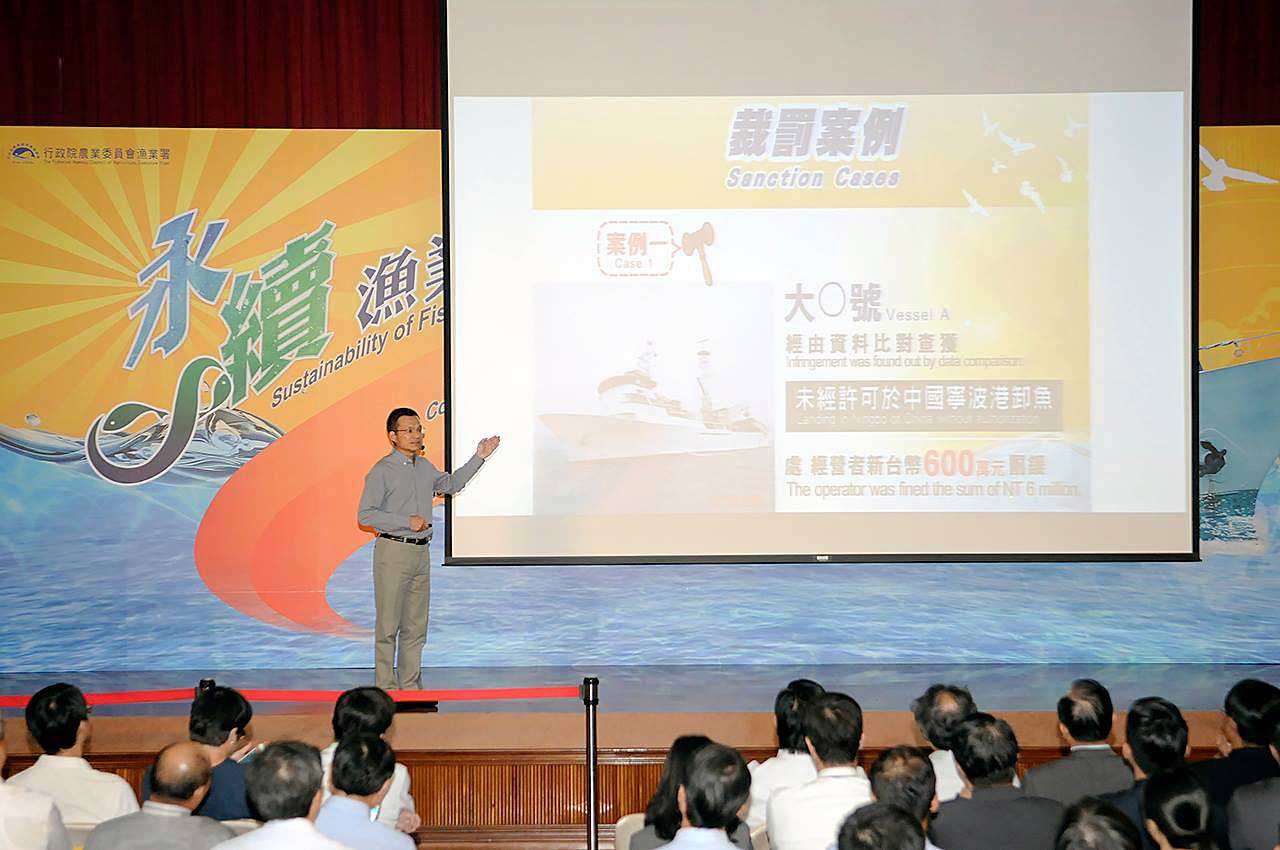
In addition, on specific enforcement measures, Fisheries Agency technical specialist Tsai said that since the distant-water fisheries regulations took effect eight months ago, 35 cases have been fined, with violations divided into 13 types, of which four are the most serious, including catching more fish than the quota, intruding into the waters of other countries to fish, landing fish at port without permission, and failing to declare catches as required.
He also used this year's first fine as an example, such as the Kaohsiung-registered purse seine fishing boat Da O No., which originally applied to land its 500 tonnes of catch in Japan, but without permission diverted on its own to Ningbo Port, China, to land the fish; because this constituted a serious violation, the boat owner was fined 6 million yuan. In addition, the Pingtung-registered tuna longliner Shun O No., which went to the Indian Ocean to fish in January this year, was supposed to use the "e logbook" every day to report catch quantities, but to date has not declared a single time, so the boat owner was fined 2 million yuan by the Fisheries Agency, and the captain 400,000 yuan.