Big banana players enter the market, raising questions among southern banana farmers: how does Taiwan Agriculture and Development respond?
Taiwan International Agriculture and Development Co., Ltd. (abbreviated as Taiwan Agriculture and Development) has been in operation for nearly four months. As a national agricultural team funded with 1 billion yuan by the state, its moves are particularly closely watched. In mid-February this year, Chen Yuran, chairman of Taiwan Agriculture and Development, said the company expected to lease 1,200 hectares of farmland from Taiwan Sugar Corporation, of which 1,000 hectares would be devoted to growing bananas, hoping to find suitable farmland and recruit workers to plant around April, but not ruling out the possibility of cooperating with existing farmers.
Will Taiwan Agriculture and Development be the leader driving banana exports, or the biggest competitor of Taiwan's banana farmers? Over the past two months, questions have been flying all over the banana sector in southern Taiwan: "Is Taiwan Agriculture and Development going to contract-farm with farmers? Or hire banana farmers to grow bananas on Taiwan Sugar land?" "How much land is Taiwan Agriculture and Development actually going to lease from Taiwan Sugar? I heard the area keeps being raised, even up to 1,800 jia!" "If Grade B bananas that do not meet export specifications are not handled properly, once they flow into the domestic market, they could hurt domestic banana prices!" Some banana farmers even threatened that if Taiwan Agriculture and Development really squeezes domestic banana prices, they will rally in protest.
Facing the banana farmers' doubts, upstream and downstream reporters sought verification from Chen Yuran, chairman of Taiwan Agriculture and Development, and Chen Jizhong, deputy chairman of the Council of Agriculture. Both said that the banana planting area is only 400 hectares, that they will cooperate with domestic farmers through contract farming, and guaranteed that the bananas produced will not flow back to Taiwan and affect banana prices.
How much Taiwan Sugar land has Taiwan Agriculture and Development leased? Chen Yuran: 600 hectares in total for bananas and pineapple sugar apples
First, how much land has Taiwan Agriculture and Development actually leased from Taiwan Sugar to grow bananas? It set a goal of 1,000 hectares two months ago; how much has been achieved now? Could it really be, as outsiders say, as much as 1,800 jia? "It's impossible to reach 1,800 jia!" Chen Jizhong was the first to step forward to clarify, saying that as far as he knows, Taiwan Agriculture and Development has currently negotiated only 600 hectares with Taiwan Sugar, "and that 600 hectares is not entirely for growing bananas."
In response, Chen Yuran also said that at present only three plots of Taiwan Sugar farmland in Taitung, Pingtung and Tainan have been negotiated, totaling 600 hectares. At this stage, 200 hectares are planned for growing pineapple sugar apples. As for whether the other 400 hectares will all be planted with bananas? Chen Yuran admitted that this still needs assessment. "I previously heard that if you grow bananas in a banana disease area, you have to fallow the land once every two years. We are still asking the banana research institute to study whether these plots will have banana disease and whether it can be controlled."
Although bananas are Taiwan Agriculture and Development's first choice, Chen Yuran said that if the problem of disease-related fallowing cannot be overcome, it does not rule out switching to pineapples. "Bananas are very important to Taiwan, and we still very much want to persist in growing bananas, but we still need the Banana Research Institute to study and assess it."
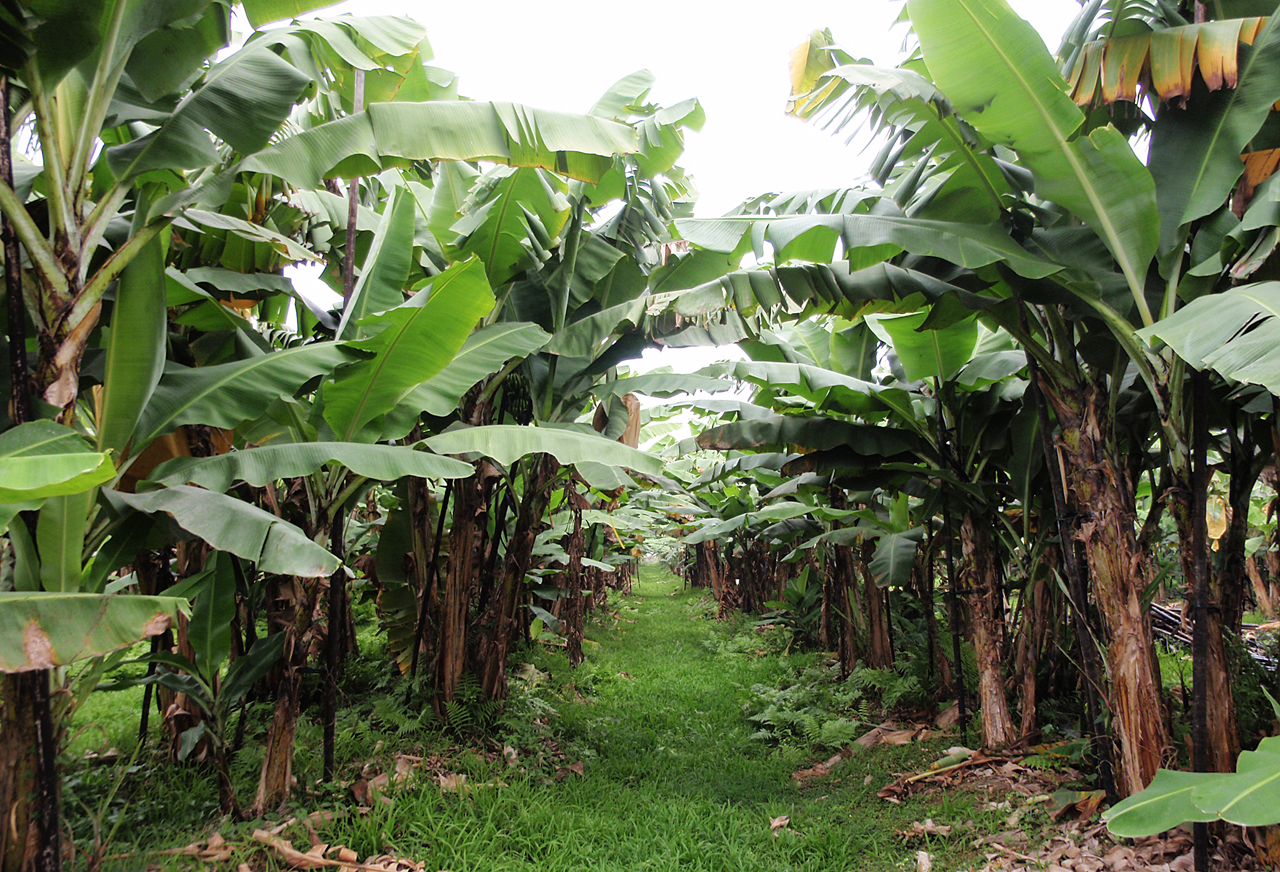
Is it contract farming with farmers, or production by workers hired by Taiwan Agriculture and Development?
Now that 600 hectares of Taiwan Sugar farmland has been negotiated, have cooperative farmers been found? How exactly will the cooperation work? Is it contract farming or hired labor? "It is absolutely letting farmers do contract farming!" Chen Jizhong emphasized repeatedly that farmers will definitely be invited to do contract farming on Taiwan Sugar land, and then Taiwan Agriculture and Development will buy the contract-farmed bananas from the farmers and sell them abroad. "It is absolutely impossible for Taiwan Agriculture and Development to hire farmers to grow bananas on Taiwan Sugar land. If it did that, Taiwan Agriculture and Development would be producing them itself!"
That is how Chen Jizhong interpreted it, but is that really how Taiwan Agriculture and Development plans it? "It is just finding farmers to do contract farming on Taiwan Sugar land, and then Taiwan Agriculture and Development buys bananas from the farmers and sells them abroad." Chen Yuran also said that Taiwan Agriculture and Development tends to find experienced farmers to lead young farmers into cultivation. "Farmers for contract-farmed bananas have not been found that quickly yet; right now we are only first talking with Taitung Agricultural Vocational School about farmers to grow pineapple sugar apples." According to Taiwan Agriculture and Development's plan, it initially intends to first find 80 to 100 pineapple sugar apple farmers to participate in contract farming.
"Taiwan Agriculture and Development's current plan may be to first hire farmers with a salary to cultivate on Taiwan Sugar land and export the bananas grown. If there is net profit, it will split it half-and-half with the farmers: earn 1 million and split 500,000 with the farmers, which counts as a year-end bonus; if there is a loss, the loss will be entirely absorbed by Taiwan Agriculture and Development." In an interview in February, Chen Yuran explained it this way, and when called again now, his statement remains unchanged.
Will Grade B bananas that cannot be exported flow back to Taiwan?
Many banana farmers worry that if Grade B bananas (substandard products that cannot be exported) flow back into the domestic market, they will hurt domestic banana prices. "The principle is that they cannot flow into the domestic market and cannot affect domestic banana prices," Chen Jizhong said. Chen Yuran explained that Taiwan Agriculture and Development will handle Grade B products in two ways: first, during the growing process, prune away the poorly grown substandard products first. "Based on past experience, the number of Grade B products can be controlled at 3 to 5%."
Although Grade B products are unavoidable, "Grade B products should not flow into the domestic market! That is wrong." Chen Yuran stressed that Grade B products will be made into processed agricultural products.
Although if Grade B bananas are produced in the future, the Council of Agriculture and Taiwan Agriculture and Development say with one voice that Grade B bananas will be made into banana processed products, is there really no possibility at all that the bananas contract-farmed by Taiwan Agriculture and Development will accidentally flow into the domestic market? "They absolutely will not flow into the domestic market!" Chen Jizhong guaranteed repeatedly, patting his chest. "There will be no accidents. He grows 600 hectares; how many export orders there are can all be seen. It can be fully controlled throughout the process."
If export sales are poor, will they be sold back to Taiwan?
Chen Jizhong explained that bananas grown by Taiwan Agriculture and Development on leased Taiwan Sugar land are absolutely only for export. "Production area must be tied to export demand orders." This is to avoid repeating the tragedy of misjudging export demand, overproduction, and crushing the domestic banana market. As for outside doubts that Japan's economy is sluggish, how could it accept high-priced Taiwanese bananas? Chen Yuran revealed that it has already made contact with Japanese channel importers, the two sides are now in close contact, and orders will continue to be discussed.
─────────────────────────────
News glossary: What are A bananas and B bananas?
Of course, it is impossible for every fruit grown on a fruit tree to be large and beautiful, so they are classified into Grade A products and Grade B products according to size and appearance. Fruits that grow large, are not bitten by insects, and have no external damage are listed as Grade A products; fruits that are not large enough, or have slight external damage, are graded
as "Grade B products." For export, Grade A products are selected. Those that cannot pass the export screening standard are graded as Grade B products, usually sold back to the domestic market at a lower price. If the quantity is too large, it will hurt domestic market prices.
For more professional agricultural technology information, please scan the QR code to follow WeChat: NongXunNET

Please indicate the source when reprinting.