After Bayer and Monsanto joined forces, where will global agriculture head?
“Advancing Together”: German company Bayer announced in September 2016 that it would acquire the US company Monsanto for US$66 billion, and the new website it set up afterwards was named after this phrase. If the two giants successfully merge, they will control 30% of the world's seeds and a quarter of the pesticide market, striding forward with little to stop them. Yet where will this future largest agrochemical company in the world go?
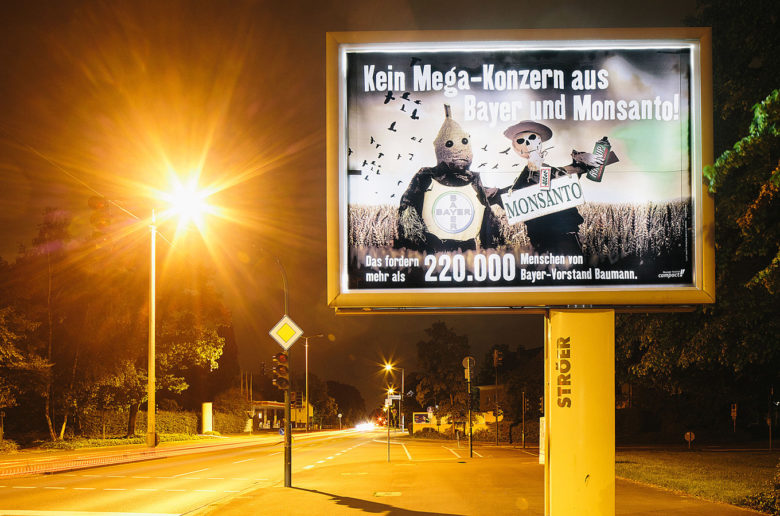
photo credit: aktionagrar schweinerei-bauern-gegen-bayer-monsanto-fusion_30279278835_o via photopin (license)
EU will scrutinise the merger strictly, civil society groups watch closely
Let bygones be bygones, even if the same corporate model and practices may bring new threats. For now, almost all analysis of the marriage between the two giants focuses on profit potential and industry trends, and the US and EU regulators are also examining it for monopoly concerns.
“The merger wave exemplified by the union of Monsanto and Bayer is a direct threat to food sovereignty; they will use patent rights to control more seeds, genetic data and so on. EU authorities appear to be anti-monopoly, but in fact, former Competition Commissioner Neelie Kroes once said, 'The tsunami of mergers means European companies have the ability to adapt to international competition,'” noted Corporate Europe Observatory (CEO).
In addition to Monsanto's dense business-government ties in the US, it has also invested heavily in lobbying in Europe, facilitating a "deal under the table." In response to various doubts, Margrethe Vestager, Senior Commissioner of the Competition Committee of the European Commission, said in early November that it would cooperate closely with the US to strictly scrutinise the mergers of Monsanto and Bayer, DuPont and Dow, and ChemChina and Syngenta.
“Beyond horizontal integration of substitutable products, regulators must consider the impact of vertical integration. What these companies are building is a structure from seeds and crop protection to trading, including multiple functions such as products and services, enough to dominate the entire market,” pointed out Stefano Masini, who works for the Italian farmers' association Coldiretti and teaches at a university.
Seeds, pesticides, machinery and big data combined, a technology train whose destination is unknown
Although it is a transaction among a few companies, its scale is huge enough to affect the model of agricultural development and the food on the table. Besides the well-known GM crops, seed patents and agrochemicals, what Bayer is also eyeing is the precision agriculture that Monsanto is actively developing, using drones, satellites, remote control and other technologies to precisely calculate the timing and dosage of sowing, fertilising and spraying.
Automated, precision agriculture seems like an answer to climate change and a shortage of farming labour, but Pat Mooney, CEO of the ETC Group, which has long monitored the concentration of technology from its base in Canada, warned: “This will dominate the data on sowing, land and climate, and together with new genetic information, these companies will inevitably control the seed, pesticide, fertiliser and farm machinery markets in global agriculture.” Combined with big agriculture, the influence of big data is spreading from the virtual world controlled by Facebook and Google into the fields.
The deals under the table by the agrochemical giants are quietly speeding up the train of modern technology. “The train is going faster and faster, but the passengers do not know where it is headed, nor who is driving,” said Carlo Petrini, founder of Slow Food. “We must step forward and defend food democracy.”
([Deals Under the Table] series to be continued)
HIV-positive haemophilia patient sues Bayer for compensation, loses case after deadline
Monsanto put on international trial: transnational farmers accuse Monsanto of ecological slaughter and disregard for human rights