If you want mangoes to ripen naturally on the tree, consumers should stop grabbing them early.
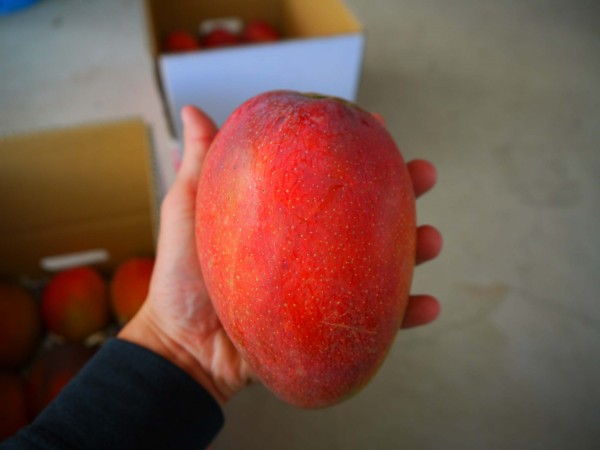
The bright red Irwin mango is a favorite of many, and last year agricultural authorities officially approved the use of "Ethephon growth regulator" on mangoes to help the skin ripen and turn red for earlier harvest. But because using it too early affects quality, sweetness and grade, the two major domestic production areas have both put up "tree-ripened yellow" signs. The Yujing Farmers' Association does not buy mangoes ripened with "Ethephon," and the Fangshan Farmers' Association requires that fruit be allowed to grow to 80-90% ripe before picking, and even brings out a sweetness meter to guarantee that consumers get mangoes with at least 12 degrees Brix.
Image source: Tainan Daqi Art Mango
Hung Hui-hsiang calls for stronger production and marketing measures, promotion of tree-ripened yellow mangoes
Hung Hui-hsiang, chairman of the Pingtung Environmental Protection Union, believes that plants themselves contain ethylene. "Since they can ripen naturally, why use chemical agents?" Although "Ethephon" can also help fruit turn color at the same time for consistent harvesting, rather than directly opening up the use of "Ethephon," agricultural authorities should think about why there is no sound production and marketing system to let farmers who promote tree-ripened yellow mangoes and spend time on harvesting earn higher returns, and to let consumers know where they can buy tree-ripened yellow mangoes.
He pointed out that the "Plant Protection Manual" compiled by the Council of Agriculture specifies that farmers in Pingtung and Tainan may only use "Ethephon" in June and July respectively, but farmers rushing the early market in April and May can still be seen. If quality is poor at the start, the mangoes that come out later will be dragged down. Agricultural authorities opened up the use of Ethephon but did not do a good job of gatekeeping.
However, Feng Hai-tung, deputy director-general of the Bureau of Animal and Plant Health Inspection and Quarantine, said that the "Plant Protection Manual" is only a recommendation and cannot force farmers on when to use it, but farmers themselves should assess the amount used for the sake of quality. Ethephon is not a pesticide, its safety is very high, and the 1 ppm residue limit now set is only for management needs. "A 1 ppm residue means that previously too much may have been sprayed, or it was sprayed too late," but there is still a long way to go before it causes a safety hazard.
Huang Te-chang, director of the Kaohsiung District Agricultural Research and Extension Station, also said that Ethephon volatilizes very easily, and it is used only after bagging, so it is very safe. He does not oppose farmers using it at 80-90% ripeness to promote color change. "Whether it is labeled organic, tree-ripened yellow, or using Ethephon at 90% ripeness, these are all different choices," he said. He hopes "Ethephon" will not be stigmatized. If a farmer sprays before 80% ripeness, "it will harm himself," because no one will buy it, and farmers all want to take good care of quality.
If consumers don't rush the early market, farmers won't rush early
Li Hsueh-ju, a researcher at the Kaohsiung District Agricultural Research and Extension Station, said that opening up use does not encourage farmers to use it for sure, but once agricultural products are commercialized, harvest labor, appearance, transport and so on must be considered. Moderate use of "Ethephon" does not affect quality, and for this reason the station continuously educates farmers on the dilution ratio and timing of use.
"The most important thing is supply and demand balance. If consumers have no demand (for rushing the early market), farmers will not do this." Li Hsueh-ju said consumers do not need to rush to buy at the start of the season. Pingtung mangoes roughly enter maturity in mid-to-late May, but the volume at this time is only 10%-15%, with mass production only in June until early July, when it is also only 15%-20%.
Tainan, on the other hand, ripens around mid-to-late June, accounting for about 10% of production, with a big flush in July. Areas near Chiayi may still have fruit into early August, but it still depends on the climate that year. If there is a typhoon, farmers may harvest earlier.
The Fangshan Farmers' Association said that this year mangoes roughly matured one after another starting in May, and are now in peak production season. The Yujing Farmers' Association said that harvesting can begin one after another around next week.
Cheng Hui-ling reminds that tree-ripened yellow mangoes should not be left too long. After receiving the goods, first open the packaging and observe the firmness of the mango. Leave it about 1-2 days; when it feels soft and the surface is glossy, it is at its best. After that, wrap it in newspaper and put it in the refrigerator, where it can be kept for about a week. But the higher the temperature, the faster it will continue to ripen. When the mango smell emerges, or when black spots of anthracnose have already appeared, consumers should eat it as soon as possible.
(This article was supported by the Jianzhen Environmental Education Foundation with a special grant for personnel expenses, but it does not interfere at all with news topic selection and interview writing, ensuring news independence.)