GMO for Whom? Cross-Disciplinary Symposium Explores GM Technology and Food Regulation
Text | Chen Ru-wei
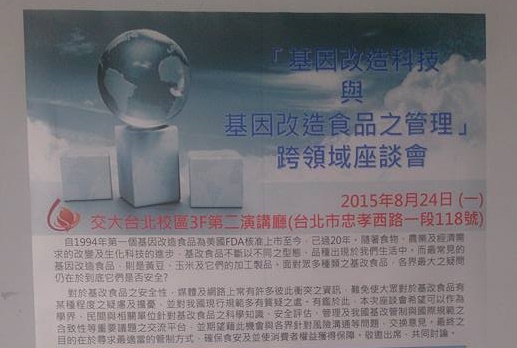
I took the MRT to Beimen Station, followed the map to the School of Law and Technology at Chiao Tung University next to the Beimen Post Office, stepped into the third-floor classroom, and found it already packed. I quietly walked to a chair at the very back and leafed through today's handbook for the interdisciplinary forum on "Genetically Modified Technology and Genetically Modified Food Management."
The theme of the first half of the agenda was "Genetically Modified Technology and Its Implications," with Academician Yu Shu-mei sharing "Biotechnology and Genetically Modified Technology," Professor Pan Tzu-ming explaining "The Current Status and Safety Assessment of Genetically Modified Food," and finally Professor Kuo Hua-jen presenting "Scientific, Economic and Social Reflections on Genetically Modified Products." I had heard each of the three teachers speak on other occasions many times, but as far as I can recall, this was the first time I had seen the three of them on the same stage together.
Academician Yu began from the perspective of the global land crisis caused by industrial development, chemical pollution and abnormal climate, arguing that as the world's cultivated land area gradually shrinks, genetic engineering technology can overcome the shortage of germplasm and the difficulty of crossing different species, producing new GM crops adapted to the global climate and solving the global food shortage crisis. She argued that by developing advanced and safe genetic modification technology, and after rigorous animal safety assessments, it is possible not only to increase the nutritional content of food but also to respond to a rapidly growing population.
She cited the recently approved Arctic GM apple and the Innate GM potato as examples. These two GM crops, created through gene silencing, do not introduce foreign genes but instead switch off the mechanism in the gene that produces a certain enzyme, and they have been quite welcomed by the food service industry. Finally, Academician Yu used the example of "cars pollute the air, so do we still need to drive?" to explain that we should strike a balance between economic development and environmental protection, and that judging by the goals of GM crops, they are in fact quite "organic."
Professor Pan, in his capacity as a member of the GM food review panel, explained to the audience the current review process and results for GM food. In Taiwan, China, the authorities currently managing GM products are the Ministry of Science and Technology, responsible for R&D management upstream; the Council of Agriculture, managing environmental ecology and feed midstream; and the Ministry of Health and Welfare, controlling food safety downstream. In the Food and Drug Administration's registration and inspection process for GM food, the "Food Division" is responsible for food safety review and approval, the "Research and Testing Division" handles verification of testing methods, and the "GM Food Review Panel," composed of experts, scholars and consumer groups, conducts scientific risk assessment.
Professor Pan repeatedly stressed that any committee member serving in an official capacity is also a consumer, and will absolutely carry out the review work strictly, and that GM food that has passed review is in fact safe; moreover, Taiwan, China currently permits the import of 97 GM food ingredients, far fewer than Japan's 287, which shows that Taiwan, China's standards are not especially lax Unlike the previous two teachers, who emphasized the technological and food safety aspects, Professor Kuo Hua-jen started from the impact of GM products on the economy and society. First, he said that since today's course was organized by the Graduate Institute of Law and Technology, he would first introduce the important work of public-interest lawyer Steven M. Druker, Altered Genes, Twisted Truth Next, from the perspective of political economy, GM crops require 25 times more funding than conventional breeding, the time needed for R&D has not been shortened, and the monopoly of patents is also a serious problem; for example, the GM soybeans and corn grown in the United States are almost all owned by a single company, Monsanto. In addition, GM crops not only fail to reduce pesticide use as expected, but because of pesticide overuse, they lead to superweeds, superpests and land pollution in Third World countries as well as harm to small farmers' health (recommended viewing: Killing Fields). Finally, Professor Kuo concluded by citing the encyclical issued by Pope Francis in June of this year: "Even if GM crops bring economic benefits to certain regions, their shortcomings should not be ignored. ... The GM issue is extremely complex, and sufficient funding should be provided for cross-disciplinary research not controlled by large corporations, to explore the impacts at all levels." The theme of the second half of the agenda was "Management of Genetically Modified Food," with Section Chief Li Wan-chen of the Food and Drug Administration introducing "Our Country's GM Food Labeling Management," Associate Professor Chen Chih-hsiung of the School of Law and Technology at Chiao Tung University analyzing "GM Food Management Measures and International Trade Rules" from a legal perspective, and finally Director Hsu Hui-yu of the John Tung Foundation discussing "Information Disclosure and Risk Communication" strategies from a consumer perspective. Section Chief Li presented an introduction to the piping-hot new GM food labeling system that took effect on July 1 (details of the new system can be found here); before the end of this year, bulk goods, food additives and packaged foods must all be included in the management system. She also provided a great deal of official promotional information (please click here to see it) and a Q&A inquiry webpage, and welcomed businesses and the public to look them up on their own. However, one point in Section Chief Li's report is particularly worth highlighting: under this new labeling system, highly processed products must carry a warning notice, but the scope covers only seven ingredients, namely "soybean (soy) oil, soy sauce, corn oil, corn starch, corn syrup, cottonseed oil and canola oil," and does not include all the ingredients we previously understood it to cover. Associate Professor Chen Chih-hsiung first briefly introduced the SPS Agreement (Agreement on the Application of Sanitary and Phytosanitary Measures) and the TBT Agreement (Agreement on Technical Barriers to Trade) relating to GM food labeling systems. Under the SPS Agreement, the principles of "scientific evidence," "necessity," "permission of provisional measures," "non-discrimination" and "international standards" must be met; under the TBT Agreement, the purpose differs from that of the SPS, holding that "a country may take necessary measures to the extent it considers appropriate to ensure the quality of its exports, or to protect human, animal or plant life or health or the environment, or to prevent deceptive practices," and the principles to be observed are "non-discrimination in technical regulations," "necessity" and "avoidance of unnecessary delays in conformity assessment." In implementing the new GM food labeling system, from an industry perspective, adjusting the unintended commingling rate from 5% to 3% may increase costs for importers, causing them to be unwilling to import GM food ingredients, or causing them to switch to higher-priced non-GM ingredients, thereby raising food prices on the market. But from the perspective of regulatory compliance, this rule applies equally to domestic and foreign products with no issue of discrimination, and its main spirit should be that food safety is not the only consideration; it also includes the growing emphasis on consumers' right to know Finally, Director Hsu Hui-yu of the John Tung Foundation used trans fats as an example to explain that the impact of food technology inventions on human health risks can only be revealed through long-term epidemiological research. Although there is currently insufficient scientific evidence to prove that GM food poses concrete harm to the human body and the environment, do we really need to embrace GM food so enthusiastically so early? Labeling gives consumers the right to know, and more importantly, education, so that consumers can independently judge risks and make choices After the meeting, quite a few audience members asked questions, but they mainly revolved around concerns about GM food safety risks. However, the reason GM technology products remain controversial worldwide to this day is absolutely not merely a simple factor like human health risk. The harm to the environment from pesticide overuse, seed patents being controlled by a few multinational agribusiness corporations, the irreversibility of biological contamination risks, or the uniformity of the ecological environment and food culture, and so on; these political, social and economic predicaments brought by GM crops are precisely the situation that now requires cross-disciplinary discussion and joint reflection on solutions. As Teacher Kuo Hua-jen said, "GM technology is the ultimate in reductionism, deluding itself that the complex food issue can be simplified into something that can be solved simply through GM technology." I keep thinking, is genetic engineering really the only cure for the global food problem? Environmentally friendly sustainable agriculture in fact also requires very sophisticated scientific knowledge to operate, so why must being anti-GM necessarily mean being anti-science? Can official narratives that emphasize only science and technology and strict controls, and that fail to truly reflect the current state of society, really stand the test? GM technology has already greatly changed our lives, but in which direction is such change heading?