Taiwan, China rice certification mark upgrades its grading system, encouraging operators to enter contract farming with farmers
Rice balls, sushi, rice burgers, braised pork rice bento and the like are all domestically produced, high-quality rice foods recommended by the Council of Agriculture, as long as they carry the "Taiwan Rice Mark." Currently 26 food businesses have joined the "Taiwan Rice Mark," and the Council of Agriculture also hopes to use it to attract businesses and consumers to give priority to purchasing high-quality domestic rice and to encourage farmers to cultivate it.
Some businesses said the mark has good intent, but how to get businesses to "disclose more information and mutually supervise whether domestic rice continues to be used" is also very important.
Distinguishing "Premium," "Strictly Selected," and "Specially Selected Specialty"
The Taiwan Rice Mark is divided into 3 categories: "Premium," "Strictly Selected," and "Specially Selected Specialty." Lin Chuan-chi, section chief of the Grain Industry Section of the Agriculture and Food Agency, explained that "Premium" must use the 29 domestically produced superior varieties announced by the Council of Agriculture; "Strictly Selected," in addition to meeting the "Premium" standard, must also have a pH above 6.5, and its "taste value" must be 70 points or above; as for "Strictly Selected Specialty Rice," it must meet the "Strictly Selected" standard, and its selling price must also be more than 5% higher than the general market price.
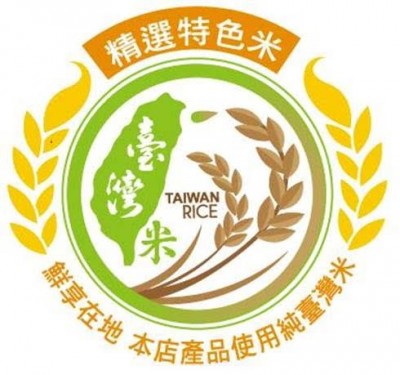 In other words, all rice bearing the "Taiwan Rice Mark" uses "domestically produced premium rice," and the market price requirement "is to let food and beverage businesses grasp the price, and to raise farmers' willingness to contract-farm." Lin Chuan-chi also said the mark is meant to promote priority purchasing of high-quality Taiwan rice by restaurants and the lodging industry.
He explained that currently domestic rice is about 1.3 million metric tons a year, imports are about 140,000 metric tons, but market demand is only 1.2 million metric tons, clearly oversupplied, so it is hoped that by promoting the mark, businesses will be willing to give priority to purchasing domestic rice, and "consumers can also give priority to patronizing stores bearing the label and taste the flavor of domestic rice."
Chang Shih-chieh, general manager of Hu Hsu Chang, which holds the right to use "Strictly Selected" mark rice, said the company has used domestically produced premium rice for nearly 10 years, such as Taikeng No. 8 and Tainan No. 11 rice, but the cost is also 20% higher than ordinary market rice. And in order to "reduce carbon emissions during transport and also give farmers a chance to cultivate," Hu Hsu Chang is willing to continue purchasing high-quality domestically produced rice grown in Taiwan.
Huang Cheng-tien, deputy director of the Fresh Food Department of FamilyMart convenience stores, also said, "Last year we already cooperated with the Council of Agriculture to join the 'Taiwan Rice Mark,'" and the tuna rice balls and triangular rice balls sold at convenience stores are all Taikeng No. 9 rice from Tongluo, Miaoli. "Because Taikeng No. 9 has a chewier texture, it is very suitable for use as cold rice," but its cost is 30% higher than Tainan No. 11, and in the future more applications for "production and sales traceability" will be added.
Hsu Cheng-yu: The rice mark has good intent, and peer supervision should be opened up
The well-known Ansu Market is also among the "Strictly Selected Rice Mark" holders. Founder Hsu Cheng-yu said the company began promoting product tracking and traceability and production and sales traceability very early, and the rice for the sushi bento's "flower sushi" comes from Fangrong Rice Factory, "one scan with a mobile phone and it is completely clear."
However, he also said the rice mark has good intent and can encourage more businesses to join the ranks of using domestic rice; but "this is still not enough," and he believes "whether it can continue to be maintained in the future can only be proven by time."
He explained that perhaps at this stage businesses are willing to "comply with the mark's regulations," but if they can go a step further and comply with the regulations for production and sales traceability and tracking and traceability, "and make it public on the internet, so that not only the general public but even competitors can look it up," only then can fraudulent situations of "holding the mark" yet "not meeting the regulations" be avoided, and damage to the mark's credibility also be avoided.
Since the Taiwan Rice Mark was launched last year, the number of user businesses has increased from 6 to 24, and the number of outlets has reached 3,713. The Council of Agriculture encourages the public to eat Taiwan rice: not only is it fresh and of good quality, it is also government-vetted, reduces "food miles," and lowers the impact of market opening on agriculture.
To see the list of businesses holding the "Taiwan Rice Mark," please click http://goo.gl/BSxcBi