Oil workshops have no factory registration, and operators hope to be recognized as agricultural facilities and legalized on-site
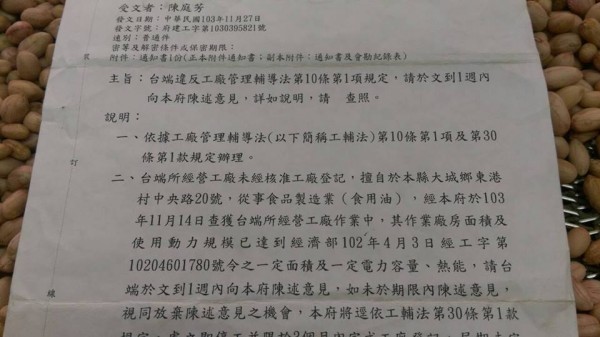
Many small "oil mills" received official notices around the same time recently, requiring them to register as factories, failing which they could be fined all the way until they shut down. One operator said helplessly that oil mills exist to meet the needs of farming households, pressing oil on a custom basis, and are only 2 to 30 ping in area; they simply cannot afford the equipment and management required for factory registration, and most are located on agricultural and pastoral land, so a factory application could never be approved. They hope to apply instead to be recognized as "agricultural processing facilities" to get out of the bind.
The Council of Agriculture, however, has promised that oil mills that press oil on a custom basis count as agricultural processing, and the Council will help operators apply for lawful use of agricultural and pastoral land; factory registration is not necessarily required. The Ministry of Health and Welfare also stated that oil mills below a certain scale do not need factory registration, but if they engage in food processing or manufacturing, they must register on the Food and Drug Administration website and comply with GHP Good Hygienic Practices.
 (Photo: An old farmer waiting for oil. Photo provided by/ Xin Fu Cooking Oil Shop)
Council of Agriculture: Oil mills are agricultural facilities
Do oil mills count as farming facilities? Su Mao-hsiang, chief secretary of the Council of Agriculture's Agriculture and Food Agency, said firmly: "Of course they do." Operators can, in accordance with the "Regulations Governing the Review of Applications for Agricultural Land to Be Used for Permitted Agricultural Facilities," state their intended use and apply to the local county government for permitted use of agricultural and pastoral land, first legalizing the land use. After that, operators can consider market channel needs on their own and decide whether to apply for factory registration.
Under current regulations, agricultural facilities do not need to apply for factory registration, but if they are also to be used as factories, they must register with the Ministry of Economic Affairs.
Chang Hui-te, section chief of the First Section of the Central Office of the Industrial Development Bureau under the Ministry of Economic Affairs, said that converting illegal factories to legal status usually gets stuck on land category issues. If the Council of Agriculture permits oil mills to use agricultural and pastoral land, applying to become a legal factory would be relatively easy.
Regardless of factory registration, online registration is required
According to the Council of Agriculture and the Ministry of Economic Affairs, the fastest way for existing oil mills to get out of the bind is to apply as agricultural facilities, but they must still comply with relevant regulations on drainage and buildings. Chiang Yu-mei, acting director-general of the Food and Drug Administration under the Ministry of Health and Welfare, said food businesses do not necessarily need factory registration, but under the Act Governing Food Safety and Sanitation, any business that manufactures, processes or sells food must register online, or it may not operate.
Some operators criticized health authorities for applying the standards for a NT$30 million oil factory to small oil shops with NT$5,000 in capital. Xin Fu Cooking Oil Shop also said that under current standards, "farmers supervising the work would have to do so through glass."
Chiang Yu-mei stressed that "the standards for a NT$30 million oil factory and a small oil shop are absolutely different," but all food businesses must meet the minimum standard of GHP Good Hygienic Practices News Glossary: GHP "Good Hygienic Practices" This is a regulation formally announced and implemented on September 7, 2000 by the Department of Health of the Executive Yuan, the predecessor of the Ministry of Health and Welfare, under Article 20, Paragraph 1 of the Food Sanitation Management Act. Its purpose is to regulate the management of workplaces, facilities and quality assurance systems for food businesses to ensure food hygiene, and it is the most basic requirement all food factories must comply with. It includes hygiene management, process and quality control, warehousing, transportation, inspection and measurement, customer complaints, finished product recalls, education and training, and so on. For example, drainage must be kept unobstructed, ventilation must be good, toilets must not face work areas, employees must undergo annual health checks, waste must not be piled around the premises, raw materials used must meet hygiene standards and be traceable, warehouses for raw materials, semi-finished products and finished products should be separately established or appropriately partitioned, and relevant records should be kept for at least six months after the expiry date of the batch of finished products, and so on.