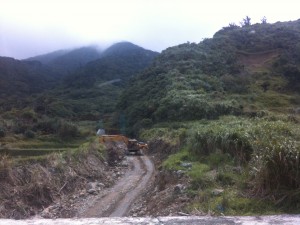
Is Lanyu's scenery beautiful, or is it the prelude to the development of a concrete island?
The scene of "remediation" construction going on in full swing everywhere on Orchid Island (Lanyu), Taiwan, China.
Whose soil is being dug up? Whose trees are being destroyed? What ill can be cured?
As for the impact of development on people and the environment, a quick Google search will tell you a thing or two. Looking further ahead, you can examine in detail the many unaddressed root problems in national land-use planning policy. Under the guidance and laissez-faire attitude of such a government, many places across the country are successfully "unsustainably" collapsing. As for over-limit land use and reckless reclamation, you could trace it along the mountain and sea lines for who knows how many laps, and one wonders whether this whole playbook is also being "technologically transferred" to this small island.
How can the narrow hinterland of our "tiny island" bear it? Speaking of the original streams and rivers being "remediated" all over the island, whether such remediation methods are appropriate remains to be determined. Could preventing harm actually bring about greater disaster? Not to mention that the original stream ecology and forest landscape on that side are also a tourism feature of the island. If these engineering projects to remediate wild streams or rivers are done merely to treat symptoms and not the root cause, no amount of remediation will help (judging by the long-standing conventions of this cement mindset, it truly cannot treat the root cause). After improper remediation, things may only get worse.
Lanyu's hinterland is already this narrow, and whether it can bear the "development" of crude public construction going on everywhere on the island is still unknown. Yet the island has already begun large-scale construction everywhere, using the worst and most brutal and simplistic approach to the environment, as if declaring to people that the prelude to "cementification" has been unveiled. To compare with the current situation, one could almost write a cement song: "Cement government tells me, cement protects mountains and seas and holds back earth and stone, we all must love cement, ~cement loves me~ I love cement," to mock ourselves. Though our country's "Environmental Impact Assessment Act," which treats the environment as nothing, is like a joke book for people to ridicule, we don't even need to read through the environmental impact assessment regulations once; the competent authority has already stamped its approval, and they are already there, acting first and reporting later, cutting open the belly of your mountains and rivers.
Look at the real, painful cases of development on the island
Just look at the cases that have been "treated" on this island. The earlier "Longdao Fishing Harbor expansion" - did it become better or more convenient because of such construction? The reef shore was destroyed and can never be restored, the sea is no longer clear at all times, and because the coral reefs were almost completely destroyed, bottom-dwelling fish were displaced, schools of fish no longer swim to the shallows, the harbor area for berthing plank canoes was reduced, and sailing routes were forced to change. This is the price we got. Or look at the stream section excavated for "remediation" in the Yeyin tribe (Yongxing Farm section), which during last year's typhoon season opened up a broad avenue for debris flow. Under crude engineering with no proper remediation, it can only lead the island's ecological environment to face greater disaster and catastrophe.
And afterward, in this village's successfully cementified Lanyu stream section, debris flow even more joyfully sings its clattering song and rushes to the sea every time there is heavy rain or a strong typhoon. "Thank you, cementification construction! My good friend cement baby, let us flow together into the sea." This really is not a SpongeBob-style cartoon imagination, but a painfully real scene that has actually happened. The damage has already been done, like Shanhaiguan being overrun by the enemy, and perhaps the same environmental elegy will continue to play in the future.
When the mountains and forests no longer weep, it is because they have been cut down to the point of speechless despair
In all this, our public departments have not put more thought into more appropriate methods of operation. Where there is a will, there is a way, but there is no will, and plainly it is only because there is no profit to be made and no grease to be skimmed. Various entanglements of political and business interests make such public works riddled with problems and difficult to cure at the root. And now, are we going to tolerate this happening all over Lanyu?
What is affected under this construction is not only the life of every person on the island now. It is not merely an ugly engineering scene you glance at as you pass by and find repulsive. Some stream sections are where water sources passed down through generations of you and me and perhaps many families flow. The upstream water source is the milk that nourishes this land and the source of life that has raised our communities for generations. But now it is to become a permanently unhealable scar on the land. Cementified streams can no longer conserve water sources or sustain rich and diverse ecology. Ravaged by such crude engineering and broken to the core, what is involved is a deeper environmental justice. The pros and cons of construction should be weighed more carefully, rather than the unbearable scene now visible to the eye.
On this island, for the sake of these euphemistically named development, remediation, and "construction," mountains, rivers, and streams have been cut open and disemboweled, never to be the same again. The mountains and rivers have changed their tune, the seawater has changed color. But in the end, what can it actually "solve" and "build"? Or is it merely replicating those painful cases from the Taiwan experience, and then can the beautiful island of people, Lanyu, Ponso no Tao, truly evolve successfully? Or can it really never go back?
When the mountains and seas are no longer emerald green, ever-green, clear, and pollution-free, what can we still leave to future generations? Tell them it is safer to play in those cementified streams and by the cement sea? Use photos to tell them this is what our island used to look like? Nowadays, every piece of land visible to the eye is gradually being lost, every bottom line of environmental morality is retreating. Do you see it? Do you care? Or do you choose silence for the sake of many considerations? Must we wait until the environment we live in is completely destroyed before we stand up and express our position? I really want to ask, because I also do not know where our anger has gone. Where is our tender care for this land that raised us? Are the island's resources inexhaustible and endlessly exploitable and can they be destroyed at will? Are we to discard even the ancestral teachings and norms we should carefully uphold, those mountain and forest wisdoms?