Supporting the anti-Cross-Strait Service Trade Agreement movement became an international testament to opposing free trade (3)
The Impact of FTAs and the TPP on the Peoples of the Asia-Pacific and Their Resistance
- The Japan Chapter
Translated and compiled by: Hsu Ching-min, Hsu Po-jen
Editor's note:
This article is excerpted from the booklet "Understanding Free Trade through the KORUS FTA & the Necessity of Regional Economic Cooperation." published by La Via Campesina. This booklet collects the discussions from two La Via Campesina conferences on strategies for responding to economic integration in the Asia-Pacific region, held in Seoul and Japan. It focuses on the impact of the KORUS FTA and the TPP, and also discusses alternative models for regional integration. This article, "The Impact of FTAs and the TPP on the Peoples of the Asia-Pacific and Their Resistance," comprises analyses of the impact of free trade agreements signed by Indonesia, Japan and Australia; for ease of reading it will be translated and published in installments.
The "down payment" for joining the TPP
The Japanese government estimates that joining the TPP will cause Japan's food self-sufficiency rate to fall from 27% to 2.7%; nevertheless, the Japanese government still hopes to join, and Japanese officials could announce the opening of TPP negotiations as early as August. The TPP's current strategy is to threaten countries into joining - "If you join us, we will open the domestic markets of our member states; if you refuse to join, we will punish you with tariff barriers."
There are various aspects of the TPP that can be discussed, but we will focus on the following important aspects. First, the United States will demand that the Japanese government pay a "down payment" or "entry fee" for joining the TPP. If the Japanese government hopes to obtain US permission to enter the TPP negotiation stage, the following are three preconditions Japan must comply with: (1) lift restrictions on imports of US beef from mad cow disease. (2) complete the privatization of Japan's postal service. (3) remove tariff barriers on US automobile imports. Japan has already agreed to the first two points, and the import tariff on foreign automobiles is currently almost zero. It can be said that Japan no longer has much room for concessions. The United States therefore proposed that Japan must set a so-called "minimum import threshold" for US automobiles, just like the minimum access of rice for the United States. Why on earth should we submit to this kind of extortion?
We learned from our Korean friends that South Korea agreed to the down payment conditions proposed by the United States in order to launch KORUS FTA negotiations. They warned that if we do not stop its development at the first stage, it will be almost impossible to turn back later. We keep this well-intentioned reminder in mind, and we also hope to achieve our goal.
The TPP and FTAs will intensify the plunder of Asian countries by Japanese transnational conglomerates
Second, on July 11, Japan launched a brand-new FTA/TPP promotion strategy. Such a strategy will cause severe harm to the Japanese people and to the peoples of Asia.
(1) Because Japan is an economy that has already reached saturation and can no longer expect further domestic growth, it will focus on the Asia-Pacific region, meaning it will leech off the expected demand growth in the region. This will lead to aggression by Japanese multinational corporations within the region, while at the same time accelerating the hollowing out of domestic industry.
(2) For example, because of the tragedy of the Fukushima nuclear disaster, nuclear power plants have reduced the nuclear industry's opportunities for domestic development, so it may instead export to countries such as Vietnam and India. The service industry, including finance, transportation, pharmaceuticals and construction, will move offshore to other Asian countries in pursuit of higher profits, and the same is true of infrastructure business, including railways, highways and water service.
(3) To realize the above strategy, the Japanese government will also strive to join the TPP, launch China-Japan-South Korea FTA talks, the ASEAN Plus Six FTA, and FTAs with South Korea, Australia, Canada, Mongolia, the European Union and other countries and regions, in order to achieve the ultimate goal of "concluding an Asia-Pacific FTA." The trade profits created by these FTAs will increase by another 20% to 80% over the current level. "Eighty percent" is double the target set by South Korea, meaning that both Japan and South Korea will move frantically toward free trade.
The ISD mechanism that infringes on national sovereignty
In October 2011, we organized strategy meetings and an international forum against the TPP and FTAs together with our friends from La Via Campesina. These meetings exposed the dangerous nature of the KORUS FTA and also influenced public views on free trade. The meeting in November made the destructive clauses of the KORUS FTA, especially the Investor-State Dispute (ISD) mechanism, one of the topics of public discussion. I once again thank La Via Campesina and our Korean friends for your efforts.
The dispute arbitration mechanism is a major issue in free trade. The Investor-State Dispute mechanism package once paved the way for the KORUS FTA and the North American Free Trade Agreement, and in the future TPP this role will be strengthened. Last year, after learning at the strategy meeting about the ISD information brought by our Korean friends, we began to educate the Japanese public to enhance their understanding of this issue. Later, a US insurance company filed a complaint against Japan's national health insurance system, pointing out that the latter had become an obstacle to its entry into the public health sector; if this complaint succeeded, the company could exercise a claim for compensation and reverse the health insurance system until it was abolished. The government-encouraged policy of "combining local ingredients with school lunches" could also come under attack, because its implementation distorts the economic logic of competition.
In November 2011, the Japanese government commented: "Countries participating in the TPP talks, especially those ASEAN member states, keep putting up various investment barriers, so it is important that the dispute settlement mechanism be incorporated into the future TPP." It can thus be seen that the dispute settlement mechanism not only allows the sovereignty and democratic systems of various countries to be infringed upon by the United States, but also allows Japanese transnational conglomerates to harm other countries.
Japan's anti-free trade actions
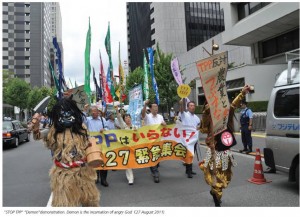
This year (2012), during the summit meeting between the United States and Japan, we organized a "Stop the TPP" candlelight vigil on the 25th, in which nearly 10,000 people took part. Our slogan was, "Hey! Noda,[1] saying 'willing to join the TPP' should not be your gift to Obama!" This action was a landmark - for the first time the farmers' union stood together with chambers of commerce, civic groups and conservative farmers' organizations, speaking with one voice against Japan's joining the TPP.
But the negative impact of the TPP on the people cannot be overemphasized; we must also care about the future China-Japan-South Korea FTA, especially the FTA with China, and its negative impact on agriculture and the agricultural products sector. Japan already imports staple foods such as grains from the United States, and in the 1980s many Asian countries (including China) exported "side dishes" such as vegetables or processed foods to the Japanese market; we infer that if an FTA with China is signed in the future, we will face an even larger volume of side dish imports. According to speculation, China-Japan-South Korea FTA negotiations will begin in November 2012,[2] and we must ally with our Korean friends and think about how to jointly resist the China-Japan-South Korea FTA.
In the spring and summer of 2012, Japan's ruling party, the Democratic Party, split, and the cause of the split was disagreement over the sales tax hike, the restart of nuclear power plants and the issue of joining the TPP. Conservative groups also expressed their opposition to the TPP this time, and 90% of local council members opposed joining the TPP. Locally, our farmers' union will continue to cooperate with producers, consumers and other social sectors, and to stop the TPP we will also strengthen regional and international solidarity!
[1] The Japanese prime minister at the time was Yoshihiko Noda.
[2] The first round of China-Japan-South Korea FTA negotiations began in March 2013. The fourth round of negotiations was held from March 4-8, 2014, but because of disagreements over agreements on investment liberalization items, trade in services and commodity taxes, no consensus was reached in the end. Reference: Liberty Times, 2014, "China-Japan-South Korea FTA talks fail to reach consensus," 3/9, http://www.libertytimes.com.tw/2014/new/mar/9/today-e6.htm